Unit Organizer Routine supports students’ sensemaking
The current Standards of Learning in the core content areas have become increasingly rigorous and focus on student sensemaking. As teachers, we should be helping students see themselves and their peers as the “doers” of math, science, social studies, and English/Language Arts. Another term for “doing” is sensemaking. Advance organizers, concept mapping, and high-level questions are effective evidence-based approaches to supporting student sensemaking.
- Advance organizers are related to learning intentions. They provide a Global Positioning System (GPS) that helps students to understand concepts and connect prior knowledge to new understandings (Deshler & Lenz, 2004).
- Concept mapping is the representation of relationships between critical information. Interestingly, concept mapping is part of learning intentions, as the map allows students to predict and revise the big picture of what they are learning. Hattie (2023) notes that teachers co-constructing concept maps with students can considerably accelerate student achievement (Learn more about effect sizes here).
- High-level questions scaffold students in reflecting on their learning and deepening their thinking. Because rigorous standards require students to retrieve and combine separate skills during discussion, problem-solving, and task completion, good questions help students select wisely from their strategy toolkits (Goodwin, Rouleau, Abla, Baptiste, Gibson, & Kimball, 2022). Students can use questions to self-assess their skill at selecting learner-owned strategies, another critical part of learning intentions (Deshler & Lenz, 2004; Hattie, 2023).
It’s important to focus on co-construction when considering advance organizers, concept maps, and high-level questions. Providing students with a concept map results in a much smaller effect size than teachers working together with students to co-construct a concept map. In these situations, the teacher sketches out the map ahead of time. However, the impact comes from working with students to scaffold their development of the big ideas, concepts, structures, and strategies…and then predict and revise the relations among them (Hattie, 2023).
Students also can co-construct high-level questions, just as they do in a KWL chart and countless other widely-known, traditional student-centered activities. As students engage in these sensemaking activities, their autonomy and self-regulation develop in the classroom (Deshler & Lenz, 2004; Hattie, 2023).
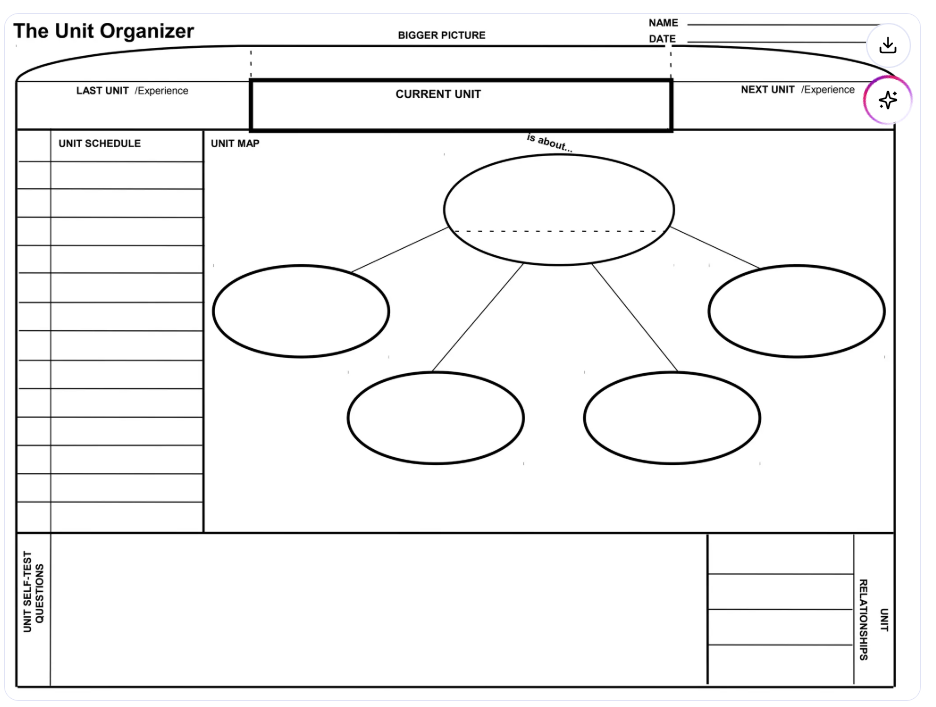
The Unit Organizer Routine supports many high-leverage practices (HLPs) for students with disabilities (Aceves and Kennedy, 2024), including HLP 12, which relates to systematically designing instruction toward a specific learning goal. The Unit Organizer Routine serves as an advance organizer for students to co-construct a concept map and engage in high-level questions. See Figure 1 for an example of a Unit Organizer a teacher drafted prior to co-constructing with students.
The backward design approach of the Unit Organizer Routine helps inclusive teachers systematically design students’ experiences while aiming for rigorous goals. This evidence-based practice is worth investing in now and in the years to come.
Figure
Resources
- Follow this link to learn more about The Unit Organizer Routine.
- The Central Virginia SIM Network offers free professional learning every year. Follow this link to join the Central Virginia SIM Network mailing list.
- Follow these links to read these recent articles from the VDOE’s T/TAC at VCU:
For more information, contact Susanne Croasdaile ([email protected]), Program Specialist, T/TAC at VCU.
Categories Inclusive Practices, Math, Reading