The art of safe and connected learning spaces
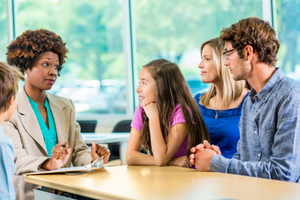
Classrooms are more than academic spaces; they are places where trust, safety, and connection grow. The physical environment communicates a sense of belonging through its layout, color, and materials, shaping how students feel and engage with the space. When those environments intentionally invite creative expression, research shows they strengthen student wellbeing by helping learners process emotions, reduce stress, and build resilience (Henriksen et al., 2025; Zarobe & Bungay, 2017). Arts integration also strengthens academic achievement, with studies showing gains in math when visual arts are linked to literacy and numeracy instruction (DeMoss & Morris, 2012).
Research at a Glance
- Arts‑rich schools: 25% fewer discipline incidents (U.S. Dept. of Education, 2012).
- Cortisol reduction: levels drop after just 45 minutes of structured art‑making (Kaimal et al., 2016).
- Graduation outcomes: students with four years of arts education graduate at 90.2%, compared to 72.9% without (U.S. Dept. of Education, 2012).
- College completion: former high-school arts students were 29% more likely than non-arts students to have earned a four-year college degree by ages 24–32, after accounting for measured preexisting differences between the groups (Elpus, 2013).
Creative Outlet Spaces and Illustrative Notes
Creative outlet spaces, small areas for drawing, collage, or writing, offer low‑stakes ways for students to regulate emotions and express identity. Color, texture, and movement help students settle, focus, and reconnect with themselves, especially those who internalize stress (Beauregard, 2014). Shared creative routines strengthen belonging and emotional awareness, deepening connections between students and teachers (Jankowska & Atlay, 2008; Beauregard, 2014).
Building on these benefits, visual note‑taking provides another gentle entry point for expression. Simple sketches, icons, and spatial layouts help learners organize ideas in ways that feel intuitive and calming. Research shows that drawing information produces robust gains in recall compared to writing alone, because it engages multiple modalities of learning (Wammes et al., 2016). As Terada (2018) emphasizes, sketchnoting works best when classrooms provide varied materials and keep the practice ungraded. When classrooms make space for illustrative notes, blank paper, markers, and shared symbol libraries, they extend the same benefits as other creative micro‑spaces: belonging, focus, and authentic expression.
Environmental Design as a Protective Factor
Environmental design amplifies these benefits. Micro‑spaces such as sketch stations, reflection corners, collage bins, or “What I Need Today” boards signal that students’ feelings and experiences are welcome. Even simple materials, such as scrap paper, markers, and visual prompts, can create openness and safety. Creative environments encourage students to take risks, explore ideas, and engage with unconventional materials, supporting both creative thinking and emotional expression (Jankowska & Atlay, 2008).
Representation deepens this impact. When students see culturally responsive visuals, multilingual prompts, student‑created displays, and identity‑based artwork, they feel recognized and valued. This sense of representation supports autonomy and belonging, key factors in adolescent wellbeing (Korinek, 2021).
Educators do not need to act as mental health providers to create supportive environments. The goal is not diagnosis or treatment, but the cultivation of protective factors: belonging, predictability, creative outlets, and supportive adults. Creative learning environments help students feel comfortable trying new things, making mistakes, and expressing themselves without fear of judgment. They also promote persistence, teamwork, and problem‑solving skills that support both academic and emotional growth (Siu & Chan, 2020).
Creative outlet spaces also strengthen student advocacy. Visual tools such as “What Helps Me Learn” boards, identity collages, or color‑based reflections allow students to communicate their needs and strengths in ways that feel safe and authentic. These practices help students build confidence and voice while giving educators insight into what supports each learner (Siu & Chan, 2020).
As educators look ahead, the question becomes: What is one creative practice you can begin tomorrow? It might be a color check‑in at the start of class, a mini sketch station near the door, or a reflection corner with sticky notes and prompts. These small choices add up. When classrooms become places where students can express themselves freely and safely, connection grows, and well-being follows.
References
Beauregard, C. (2014). Effects of classroom-based creative expression programs on children’s well-being. The Arts in Psychotherapy, 41(3), 269–277.
DeMoss, K., & Morris, T. (2012). How arts integration supports student learning: Students shed light on the connections. Chicago, IL: Chicago Arts Partnerships in Education.
Elpus, K. (2013). Arts education and positive youth development: Cognitive, behavioral, and social outcomes of adolescents who study the arts. National Endowment for the Arts.
Henriksen, D., & R. K. Sawyer. (2025). Creative engagement for well-being: Implications for growth and learning. The Journal of Creative Behavior, 59(3). https://doi.org/10.1002/jocb.70047.
Jankowska, M., & Atlay, M. (2008). Use of creative space in enhancing students’ engagement. Innovations in Education and Teaching International, 45(3), 271–279. https://doi.org/10.1080/14703290802176162
Kaimal, G., Ray, K., & Muniz, J. (2016). Reduction of cortisol levels and participants’ responses following art making. Art Therapy, 33(2), 74–80. https://doi.org/10.1080/07421656.2016.1166832
Korinek, L. (2021). Supporting students with mental health challenges in the classroom. Preventing School Failure: Alternative Education for Children and Youth, 65(2), 97–107. https://doi.org/10.1080/1045988X.2020.1837058
Siu, A. F. Y., & Chan, A. H. C. (2020). Multimodal expressive arts in school counseling: a strength-based intervention program for academic underachievers in secondary schools. Asia Pacific Journal of Counseling and Psychotherapy, 11(2), 139–158. https://doi.org/10.1080/21507686.2020.1771603
Terada, Y. (2018). How and why to introduce visual note‑taking to your students. Edutopia. https://www.edutopia.org/article/how-and-why-introduce-visual-note-taking-your-students
U.S. Department of Education, Office of Innovation and Improvement. (2012). Arts in education: Opportunities for impact. Washington, DC: U.S. Department of Education.
Wammes, J. D., Meade, M. E., & Fernandes, M. A. (2016). The drawing effect: Evidence for reliable and robust memory benefits in free recall. The Quarterly Journal of Experimental Psychology, 69(9), 1752–1776. https://doi.org/10.1080/17470218.2015.1094494
Zarobe L, Bungay H. The role of arts activities in developing resilience and mental wellbeing in children and young people a rapid review of the literature. Perspectives in Public Health. 137(6), 337-347. https://doi:10.1177/1757913917712283
For more information, contact Kristen O’Sullivan ([email protected]), Program Specialist, T/TAC at VCU.
Categories Behavior, Inclusive Practices, Intellectual Disabilities