Understanding SRSD: A game-changer for teaching writing
Imagine a classroom where even reluctant writers feel empowered to express their ideas. That is the promise of the Self-Regulated Strategy Development (SRSD) model—an approach that combines writing strategies and self-regulation to transform how students learn to write. Originally designed to support students with disabilities, SRSD has been effective for writers of all levels, helping them grow in confidence and skill.
SRSD equips students with practical tools for success through strategy instruction tailored to different writing genres. Students learn to set goals, use self-talk to stay focused, and monitor their progress. These skills help students manage the emotional and cognitive challenges of writing, fostering resilience and independence that extend beyond the classroom.
SRSD follows six flexible stages that adapt to students’ needs (Harris, 2024):
- Developing background knowledge: Preparing students with the tools they need.
- Discuss it: Exploring strategies and expectations.
- Model it: Teachers think aloud to demonstrate effective writing.
- Memorize it: Students internalize strategies with mnemonics.
- Support it: Scaffolding helps students gain confidence.
- Independent performance: Students apply strategies on their own.
This structured and adaptable process ensures that every student can succeed at their own pace. Teachers provide individualized support while encouraging collaboration through group activities and peer discussions, creating a community of writers.
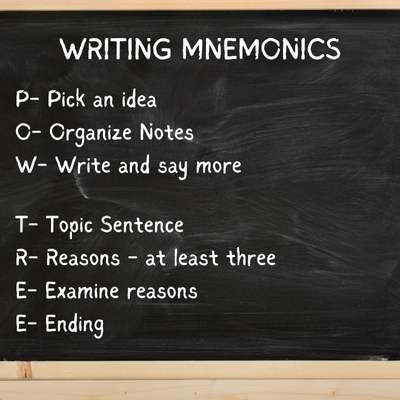
One of the distinguishing features of SRSD is its integration of mnemonic devices to help students internalize writing strategies. Mnemonics are memory aids that simplify complex tasks into easily recalled acronyms or phrases. For instance, two commonly used mnemonics in SRSD for writing are POW (Pick an idea, Organize notes, Write and say more) and TREE (Topic sentence, Reasons – at least three, Examine reasons, Ending). When combined, POW+TREE helps students structure persuasive essays by breaking down the writing process into manageable steps. These mnemonics promote metacognition and support students in planning, organizing, and revising their work (Harris & Graham, 2017). Students are taught how to use the strategies across various tasks until their use becomes second nature. Research has shown that such repetitive use enables students to independently retrieve and implement these strategies (Graham & Harris, 2018).
By embedding mnemonics in SRSD, educators make abstract writing concepts more concrete, fostering engagement and providing struggling writers a roadmap for success. SRSD with strategy instruction also builds students’ self-confidence and reduces anxiety around writing tasks (Harris & Graham, 2017). Students become confident in their abilities with a more positive attitude toward writing. They see themselves as writers capable of tackling challenges, even if they have struggled before.
References
Graham, S., & Harris, K. R. (2018). Evidence-based writing practices: Strategies for improved writing outcomes. Guilford Press.
Harris, K. R. (2024). The Self-Regulated Strategy Development instructional model: Efficacious theoretical integration, scaling up, challenges, and future research. Educational Psychology Review, 36(104).
For more information, contact Jennifer Askue-Collins ([email protected]), Program Specialist, T/TAC at VCU.
Categories Inclusive Practices, Math, Reading