Unpack your curricula in MS and HS with the SIM Course Organizer
As you plan how middle and high school teachers can unpack curricula in the coming year, consider the Strategic Instruction Model (SIM) Course Organizer Routine (Lenz, Schumaker, Deshler, Bulgren, 1998). This evidence-based practice helps new and veteran teachers work efficiently as a team to unpack a curriculum in just a couple of hours–a task that can often feel overwhelming. The Course Organizer Routine was designed as an efficient planning method that helps teachers organize complex curricula in a simple way and compensate for any learning strategies their students might be missing (Deshler & Lenz, 2004).
The Course Organizer Routine is an effective practice
Investing an hour or two in unpacking makes Hattie’s (2023) Visible Learning recommendations attainable: students acquire and use learner-owned strategies, understand their progress toward course goals, and experience a learning community with norms for collaboration and academic risk-taking. The Course Organizer Routine supports many high-leverage practices (HLPs) for students with disabilities (Aceves and Kennedy, 2024), including:
- HLP 12 Systematically design instruction toward a specific learning goal.
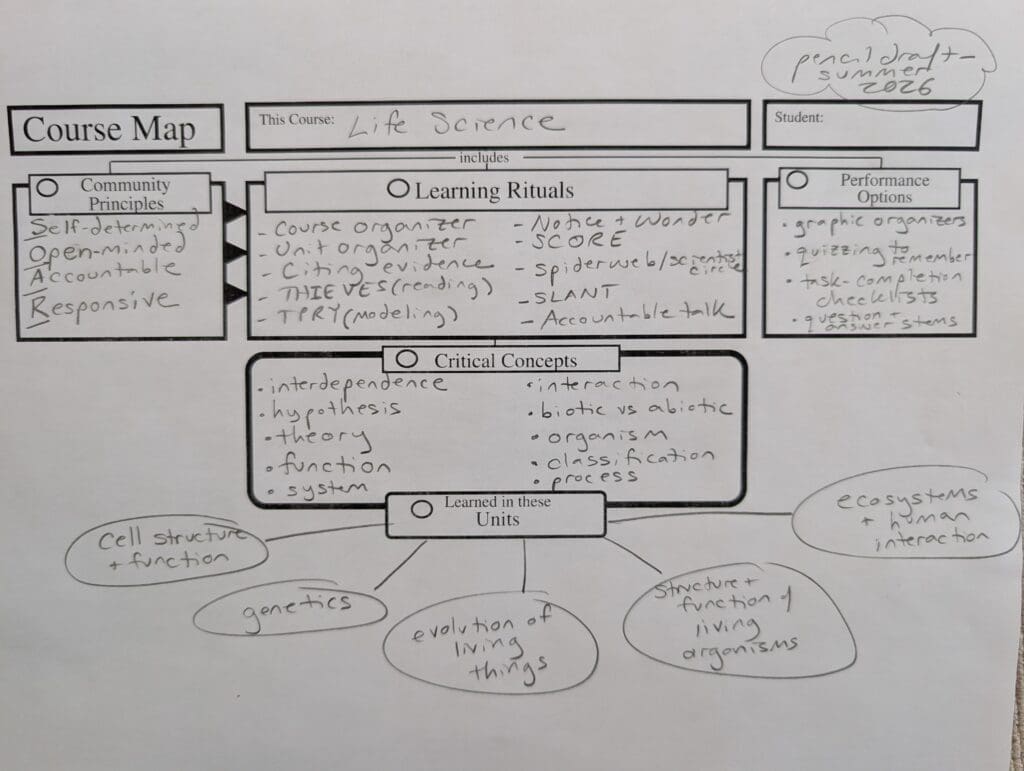
- The course questions and critical concepts chunk the curriculum into a series of manageable learning targets.
- The unit map provides an advance organizer to attach new learning.
- The learning rituals explicitly name learner-owned strategies to build agency.
- HLP 7 Establish a consistent, organized and responsive learning environment.
- The community principles set expectations.
- The learning rituals and performance options scaffold decision-making.
The Course Organizer Routine is Quick to Implement
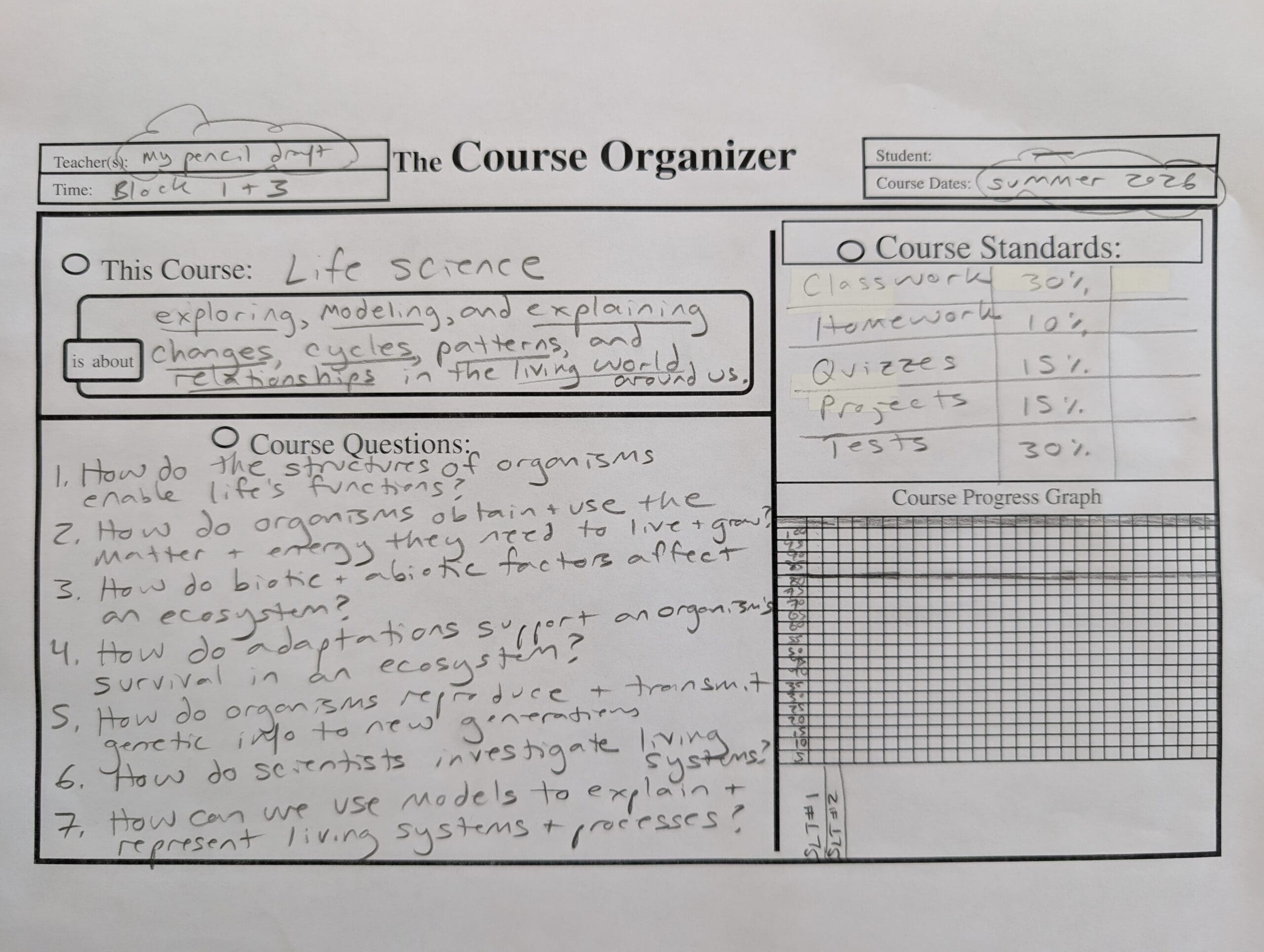
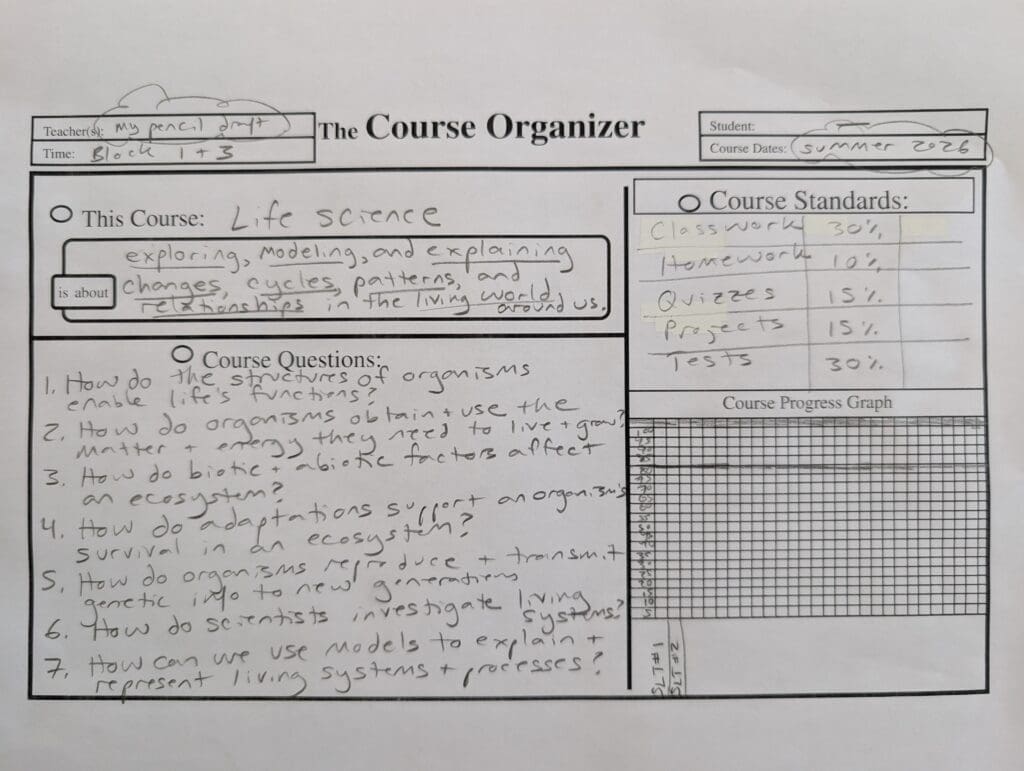
Teachers create a “pencil draft” of the Course Organizer Routine (see figures 1 and 2) to select the critical concepts and learner-owned strategies or routines that are the most worthwhile to focus on with students in the coming year.
At the start of the year, teachers use the notes they made in their pencil draft to co-construct a Course Organizer with students, teach the beginning-of-year routines, and build students’ ability to focus on big ideas and assess their own understanding.
The Course Organizer Routine Helps New Teachers
Many new teachers have taken non-traditional paths to our schools; adults, like children, need mental models to anchor new information. Our newest teachers may not have accurate models but instead recall how they were taught as students. They will need coaching in reviewing the tested and written curriculum to unpack the standards, identify the critical ideas, conduct task analysis, and anticipate student responses and misconceptions (Virginia Department of Education, 2026).
The Course Organizer provides part of this answer using evidence-based methods to help teachers— regardless of experience level—be more effective in using high-leverage practices for inclusive education and building student independence and agency.
Coaches and leaders are able to refer to the Course Organizer during regular course-alike (e.g., English or Algebra) planning meetings to ensure a guaranteed (every teacher does it) and viable (within the time available) curriculum that:
- focuses on critical skills and concepts,
- plans for student-involved assessment, and
- aligns the tested, written, and taught curriculum for all students.
For more information on how to get started, see the Resources section below.
Resources
- Attend a professional learning session for teachers at the Central Virginia SIM Network’s annual 2026 Leveling Up conference.
- Attend a professional learning session for coaches, lead teachers, and administrators hosted by the Central Virginia SIM Network in June 2026.
- Learn more about Course Organizers Here.
- Read these recent articles from the VDOE’s T/TAC at VCU:
References
Aceves, T. & Kennedy, M. (2024). High-leverage practices for students with disabilities, 2nd ed. Council for Exceptional Children and CEEDAR Center.
Deshler, D., & Lenz, K. (2004). Teaching content to all: Evidence-based inclusive practices in middle and secondary schools. Pearson.
Hattie, J. (2023). Visible learning: The sequel. Routledge.
Lenz, K., Schumaker, J., Deshler, D., & Bulgren, J. (1998). The course organizer routine. University of Kansas Center for Research on Learning. Virginia Department of Education. (2026, March 25). Preparing systemic and ongoing professional development using high quality instructional materials. [Webinar].
For more information, contact Susanne Croasdaile ([email protected]), Program Specialist, T/TAC at VCU.
Categories Inclusive Practices, Math, Reading