Manipulatives and math aids in the mathematics classroom: Is there a difference?
Supporting all students in the mathematics classroom starts with the use of evidence-based Tier 1 instruction. For decades, that foundation has been the use of the Concrete-Representational-Abstract, or C-R-A, framework, which is supported by the research and studies of Jerome Bruner and Helen Kenney (Bruner & Kenney, 1965). The framework advocates for providing instruction to all students, starting with concrete representations of mathematical concepts using formal or informal manipulatives and proceeding to pictorial representations of these manipulatives, ultimately making connections to the abstract representations common to mathematics (PaTTAN, 2020).
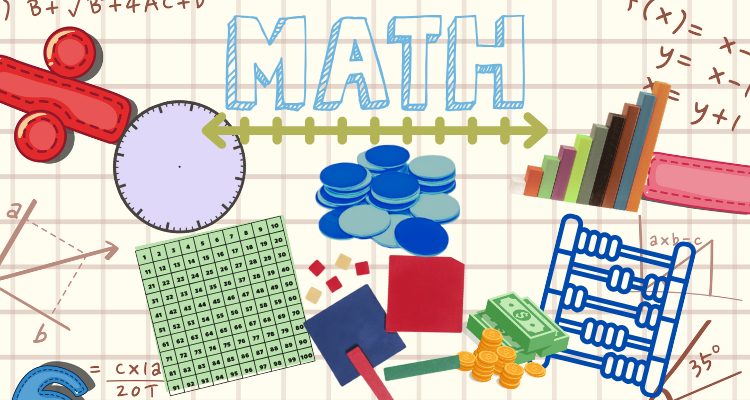
The concrete stage of this framework and the use of manipulatives is not new to the teaching and learning of mathematics. It has a history reaching back more than 200 years (Hand2Mind, 2020). Manipulatives are “concrete objects that can be viewed and physically handled by students in order to demonstrate or model abstract concepts” (Hand2Mind, 2020, para. 3). Manipulatives can include commercially available products such as Algebra Tiles, Cuisenaire rods, two-color counters, geoboards, or non-traditional objects such as buttons, pipe cleaners, cotton balls, popsicle sticks, and coins. The purpose of these tools is to help students develop their conceptual understanding of mathematical concepts and devise cognitive models and strategies through engagement and exploration (Hand2Mind, 2020). When a teacher designs instruction that progresses through the cyclical C-R-A framework and utilizes manipulatives, she is providing students with these learning opportunities and supporting them with inputting information in their short- and long-term memories through a variety of senses (e.g., visual, auditory, tactile, kinesthetic) that can later be retrieved (PaTTAN, 2020). In addition, the use of manipulatives supports students in understanding the “why” of procedural steps that tend to confuse students and lead to misconceptions across a variety of mathematical concepts (PaTTAN, 2020). When considering students with mathematics learning difficulties or disabilities, manipulatives provide a method for them to actually see the mathematics in action and make connections to the concepts and steps they are asked to replicate; this reinforces their understanding and leads to reduced misconceptions (PaTTAN, 2020).
What are math aids? Math aids are tools that can support students’ learning of mathematical concepts and support them during classroom instruction and assessments, including the Virginia Standards of Learning assessments (Virginia Department of Education, 2022). Furthermore, math aids frequently include manipulatives. However, the list of approved math aids does not include every manipulative a teacher might use as part of instruction. It is important to note that a student’s Individualized Education Program is responsible for identifying a student’s need for the use of math aids and including this accommodation in the student’s IEP or 504 plan (Virginia Department of Education, 2022). To learn more about which math aids students can use for testing in Virginia, visit the current approved list from the Virginia Department of Education, Explanation of Testing Accommodations for Students with Disabilities — Math Aids — Accommodation Code 19.
Just like saying, “A square is a rectangle, but a rectangle is not a square,” we can say, “Math aids can be manipulatives, but not all manipulatives can be math aids.”
For more information, contact Leslie Murphy Brown ([email protected]), Program Specialist, T/TAC at VCU.
Resources available from our lending library
Manipulatives and Assistive Technology
Mathematics manipulatives: Here is a list of currently available manipulatives: TTAC Library Math Manipulatives — 2020 update.pdf
LoTTIE (Low Tech Toolkit for Inclusive Education) Kit for math
Books
Delano Moore, S., & Rimbey, K. (2021a). Mastering math manipulatives, grades K-3: Hands-On and virtual activities for building and connecting mathematical ideas. Corwin Press.
Delano Moore, S., & Rimbey, K. A. (2021b). Mastering math manipulatives, grades 4-8: Hands-On and virtual activities for building and connecting mathematical ideas. Corwin Press.
Hand2Mind. (2012a). Hands-on standards: Common core edition, grade 1. Hand2Mind.
Hand2Mind. (2012b). Hands-on standards: Common core edition, grade 2. Hand2Mind.
Hand2Mind. (2012c). Hands-on standards: Common core edition, grade 3. Hand2Mind.
Hand2Mind. (2012d). Hands-on standards: Common core edition, grade 4. Hand2Mind.
Hand2Mind. (2012e). Hands-on standards: Common core edition, grade 5. Hand2Mind.
Hand2Mind. (2012f). Hands-on standards: Common core edition, grade 6. Hand2Mind.
Hand2Mind. (2012g). Hands-on standards: Common core edition, grade 7. Hand2Mind.
Hand2Mind. (2012h). Hands-on standards: Common core edition, grade 8. Hand2Mind.
Hand2Mind. (2012i). Hands-on standards: Common core edition, grade K. Hand2Mind.
References
Hand2Mind. (2020). Why teach mathematics with manipulatives? Hand2mind.com.
PaTTAN. (2020). Concrete-Representational-Abstract: Instructional sequence for mathematics. PaTTAN.
Categories Inclusive Practices, Math