Using the TPRY strategy “To Pry” open models
Have you been thinking about science instruction lately? Are you wondering how to help students “to pry” open visuals like diagrams, graphs, and tables? TPRY is the cognitive strategy you are looking for!
TPRY is a learner-owned mnemonic strategy that captures the Next Generation Science Standards (NGSS) practice of Developing and Using Models. Although it is based in Scientific and Engineering Practices and aligns well to the Science Standards of Learning, it’s also a cross-curricular strategy that students can use in other content areas such as History and Social Science.
What’s important about models?
Analyzing, building, and revising models is an important skill. Models include diagrams, cycles, tables, charts, graphs, equations…any representation that a student might use in sense-making. Sense-making is how students predict and explain the world; they are ways we record and communicate ideas about phenomena and systems (Schwarz, Passmore, & Reiser, 2017).
How does High Leverage Practice (HLP) 14 help with sense-making?
Sense-making is a higher-order thinking skill; people don’t learn complex higher-order thinking skills without explicit instruction. We just think they do because we don’t remember how we learned them!
Although sense-making is a heavy task, we can use HLP 14: Teach Cognitive and Metacognitive Strategies to Support Learning and Independence to reduce cognitive load. HLP 14 includes chunking multiple steps into a single process and reducing the load on working memory to free students up to think deeply about complex systems and ideas.
TPRY Models Strategy
The TPRY Models Strategy emerged from Central Virginia educators’ efforts to increase student independence by transforming teacher questions into student self-talk.
A few local coaches participated in Edel Maeder and Kate Soriano’s National Science Teachers Association 2022 webinar Engaging Students in Developing and Using Models. This informative webinar included three “all-purpose, back-pocket questions” for teachers to use with students to support sense-making:
1. What do you absolutely need to include in the model (e.g., parts/components) to explain the phenomenon?
2. What is the relationship or interaction between component X and component Y? How might you represent that?
3. How or why are the components interacting (i.e., mechanism) in this way? How might you represent that?
These questions highlight the critical features of developing and using models from the student’s perspective.
Translating these questions into self-talk and creating a mnemonic led to the TPRY Models Strategy:
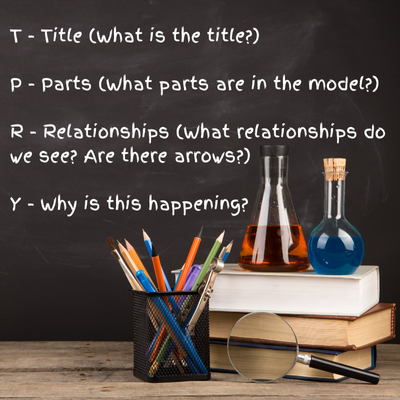
T – Title (What is the title?)
P – Parts (What parts are in the model?)
R – Relationships (What relationships do we see? Are there arrows?)
Y – Why is this happening?
Using the strategy instruction steps of HLP 14 to explicitly instruct students “to pry” open an existing model-such as the life cycle of a butterfly – or to create their own model reduces cognitive load, builds a learner-owned toolkit, and supports sense-making across the content areas.
Resources
Read about TPRY and explore examples: Try this UDL higher order thinking strategy
Read about HLP 14 and learn more: HLP 14
References
Maeder, E., & Soriano, K. (2022, January 27). Engaging students in developing and using models [Webinar]. NSTA. https://www.youtube.com/watch?v=DQKdVE39zuA&t=1244s Schwarz, C., Passmore, C., & Reiser, B. (2017). Helping students make sense of the world using Next Generation Science and Engineering Practices. NSTA. https://my.nsta.org/resource/105619
For more information, contact Susanne Croasdaile, ([email protected]), Program Specialist T/TAC at VCU.
Categories Inclusive Practices, Math, Reading