The communication catalyst: Empowering voices through the 4Ps of AAC
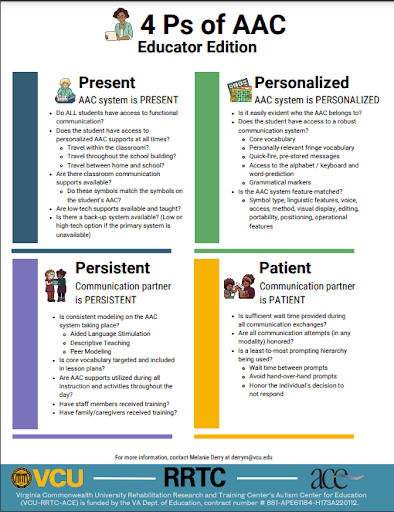
The world of Augmentative and Alternative Communication (AAC) has undergone a remarkable transformation over the past decade. We now have access to cutting-edge high-tech options and personalized access methods like eye gaze and head tracking. However, the challenge remains – many teachers and even some therapists aren’t equipped with the necessary experience and training to implement AAC best practices effectively. With 25-27% of students with complex disabilities unable to communicate utilizing oral speech (IRIS Center, n.d.), we must help students develop the skills to communicate their thoughts, wants, and needs.To help with this, Melanie Derry from VCU’s Rehabilitation Research and Training Center’s Autism Center for Education (VCU-RRTC-ACE) has compiled a comprehensive guide that distills the essential principles of AAC into two simple, user-friendly documents: “The 4Ps of AAC: Self-Advocate Edition” and “The 4Ps of AAC: Educator Edition.” In this article, we will focus on the Educator Edition of this document. The 4Ps stand for “Present,” “Personalized,” “Persistent,” and “Patient.” While the first two principles, “Present” and “Personalized,” are primarily focused on the AAC user, the latter two, “Persistent” and “Patient,” rely heavily on the communication partner, often the educator, to create the optimal conditions for success.
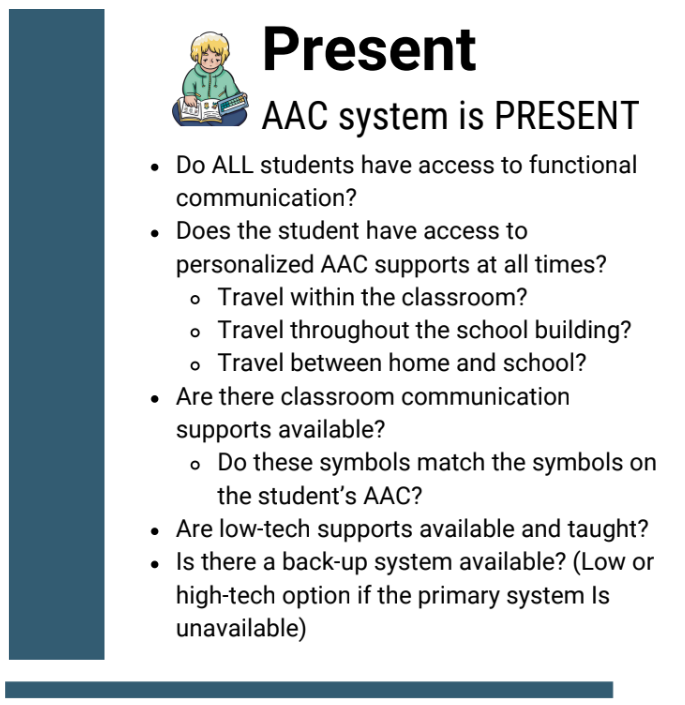
To have an AAC system “Present,” all students should have access to a communication system, take it with them everywhere they go, and have access to low-tech and backup access methods to high-tech devices. Imagine only having access to ten words or not having a voice at all. Wouldn’t you find that extremely frustrating? Unfortunately, this is a prevalent issue for those who are non-speaking. It is also common for AAC users to only have one high-tech device and no other backup methods of communication. What if the device isn’t charged? What if the user is in the rain or is in a swim lesson? In these instances, they will require access to a low-tech system that they are familiar with.
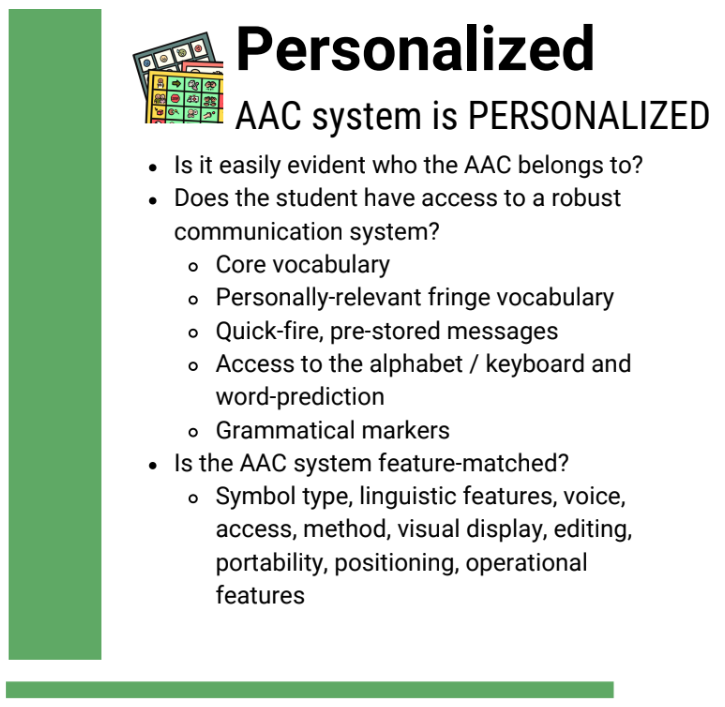
We’ve all been there, meticulously selecting the perfect stickers, graphics, or customizations to make our personal devices truly our own. This innate desire to personalize our technology is no different for AAC users. When looking at a “Personalized” AAC device, you should be able to tell who it belongs to immediately. The student should have access to phrases, names, and other messages that are relevant to them. The features of the device should match the individual user’s needs. You could even have the user choose their own voice! The rejection rate of AAC devices is estimated as high as 33% (Prior et al., 2013). Making a device more personalized may help limit device rejection and improve student social opportunities when engaging with non-AAC users.
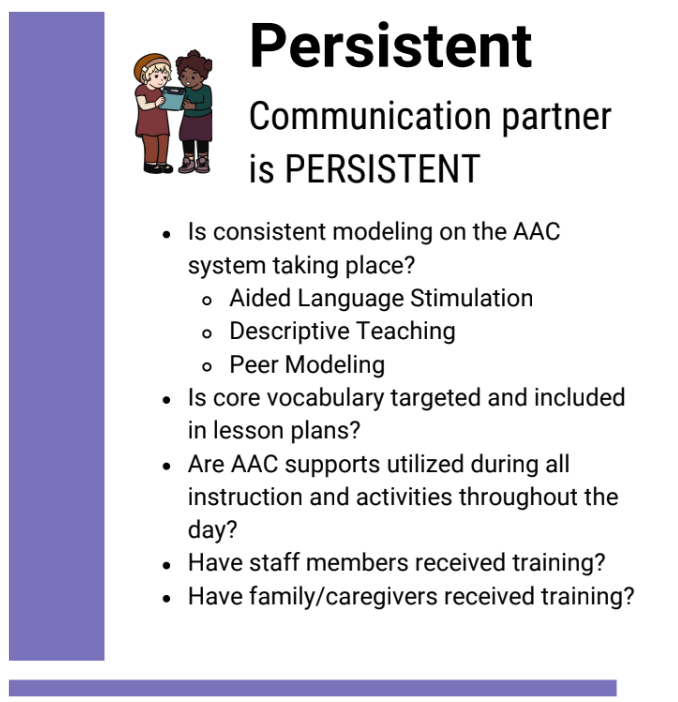
Communication partners come in various forms, including family members, educators, and peers, all of whom play a vital role in supporting an AAC user’s journey. Being a “Persistent” communication partner begins by making sure that all stakeholders have training on how to use the AAC system. Additionally, It means that the communication partners are modeling the use of AAC through different strategies, like descriptive teaching. By targeting core vocabulary and incorporating it into lessons and activities, communication partners can significantly enhance language acquisition and promote consistent communication system use throughout the day across all activities.
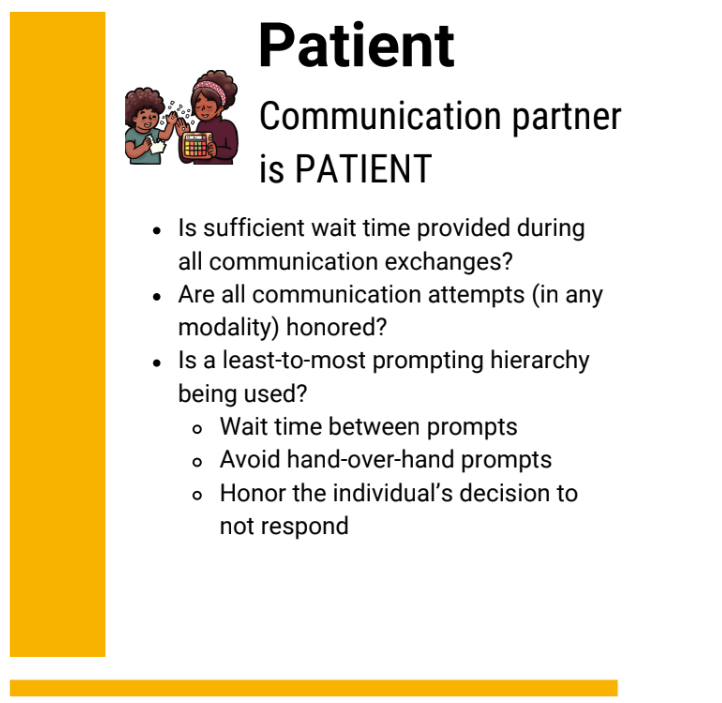
Our final “P” stands for “Patient.” Due to cognitive, physical, and AAC complexity, users of AAC often have a slower response rate than typical verbal communicators. Providing the appropriate wait time can be challenging for communication partners because providing extra time between communication exchanges does not feel natural. However, research suggests that providing 45 seconds of wait time resulted in better conversations and more in-depth responses from AAC users (Mathis et al., 2011). AAC users may express themselves through various means, including facial expressions, gestures, light-tech communication supports, high-tech communication devices, or even non-responses—all of which are valid forms of communication. It is essential for communication partners to prioritize and respect every mode of expression, regardless of how it is delivered. Additionally, we must strive to promote independence among AAC users by adhering to a least-to-most prompting hierarchy, allowing them to communicate effectively and autonomously.
By embracing these principles, we can create a supportive and inclusive atmosphere that enhances the communication experiences of AAC users, ultimately promoting their independence and engagement in all aspects of life. Together, we can make a meaningful impact on their ability to connect and communicate effectively.
You can download both versions of the “4Ps of AAC” can be downloaded via this link.
References
For more information contact Meghan Hyatt ([email protected]), Program Specialist T/TAC at VCU.
Categories Assistive Technology, Autism Spectrum Disorder, Early Childhood Special Education, Inclusive Practices, Intellectual Disabilities