Purposeful play in math classrooms
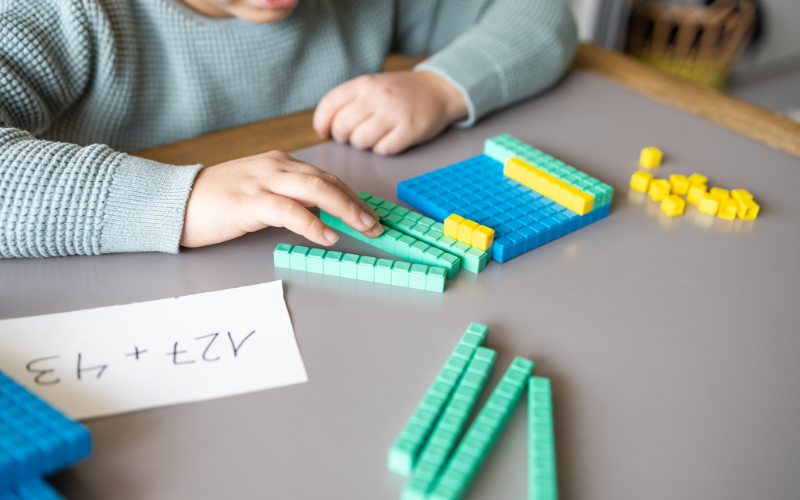
Mathematics play has gained prominence in educational discourse as a catalyst for fostering curiosity, critical thinking, and a love for the subject. It introduces an element of joy, experimentation, and discovery into the learning process. Playful learning environments benefit cognitive development, neuroplasticity, social adaptation, and achievement of learning goals in young children (Cohrssen et al., 2016). Purposeful play fosters learning and development through the incorporation of diverse exploration opportunities. In purposeful play, teachers interact with children, support concept development, and enhance the learning experience through teachable moments. Classrooms that emphasize purposeful play encourage children to challenge themselves, reflect on their understanding, connect with their interests, and develop self-efficacy as learners (Allee et al., 2023). A recent study found that child-centered play improved the executive functioning (i.e., working memory, inhibitory control, and cognitive flexibility) of Title 1 kindergarteners and moderately affected overall math growth (Allee et al., 2023). Executive functioning is correlated to school readiness and academic achievement because it helps students manage attention, engage in social activities, and problem-solve (Allee et al., 2023).
Teachers can employ purposeful play to allow for freedom of choice and discovery while aligning with specific learning goals in the classroom (Allee et al., 2023). Teachers verbally interact with children, scaffold concept development, and enhance the play experience by helping children connect the curriculum to their interests, needs, or talents. These strategies blend student choice with teacher-directed instruction to maximize learning and skill development.
There are many ways to foster a playful environment to incorporate purposeful play into a daily classroom routine. Math manipulatives, learning centers, block play, outside recess, and digital applications are some general activities that encourage playful learning. Games can increase efficiency and flexibility when applying concepts and strategies. The National Center for Intensive Instruction (NCII; 2016) notes that instructional games increase estimation, comparison of magnitude, number identification, and counting skills. Games should be carefully selected to align with curricular standards and student interests. Some games recommended by the NCII include Bingo, dominoes, and concentration (NCII, 2016). Manipulatives and games related to various grade-level curricula can be checked out from the T/TAC library. In addition to physical play materials, digital games can provide a school-home connection and give children further opportunities to practice and engage with math concepts. TERC (2017) has developed a collection of K-5 math games that are free and digitally accessible. These games were designed to reinforce mathematical concepts and fluency in entertaining and engaging ways. Incorporating play into daily routines can facilitate prosocial, cognitive, and academic benefits.
References
Allee, K. A., Clark, M. H., Killingsworth Roberts, S. & Hu, B. (2023). Exploring play, executive function, and academic achievement in two Title I kindergartens. Journal of Research in Childhood Education, 37(2), 197-215, https://doi-org.proxy.library.vcu.edu/10.1080/02568543.2022.2139784
Cohrssen, C., Church, A., & Tayler, C. (2016). Play-based mathematics activities as a resource for changing educator attitudes and practice. SAGE Open, 6(2). https://doi.org/10.1177/2158244016649010
National Center on Intensive Intervention. (2016). Principles for designing intervention in mathematics. Office of Special Education. U.S. Department of Education. https://bit.ly/4bcfHgw
TERC. (2017). Investigations 3. Investigations 3 games. https://bit.ly/3Og0WiG
For more information, contact Jennifer Askue-Collins, ([email protected]), Program Specialist