Resource refresh: Updated Virginia guidelines for early childhood inclusion
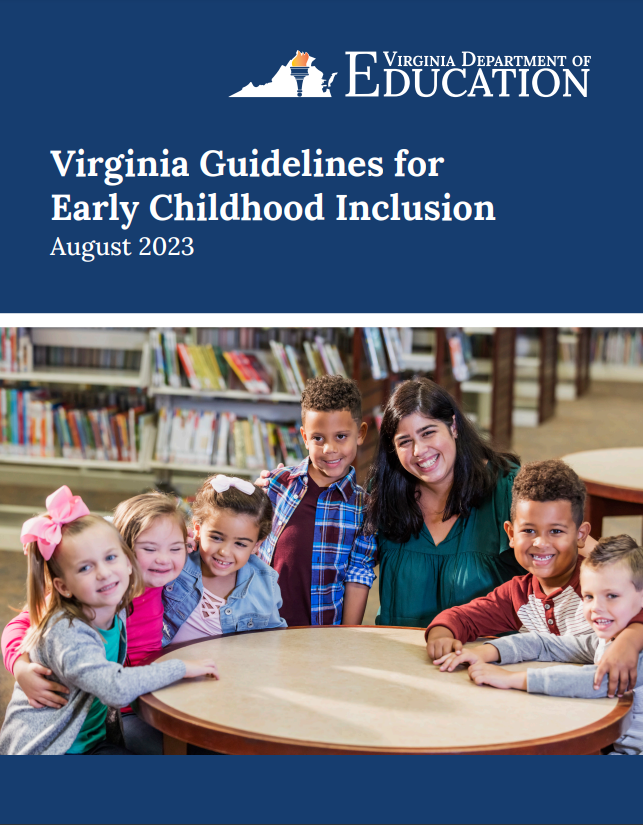
The Virginia Department of Education (VDOE) released an updated version of the Virginia Guidelines for Early Childhood Inclusion in August 2023. School divisions and early childhood communities can use this document to find, develop, and sustain inclusive opportunities for young children with disabilities in high-quality early childhood programs. The guidelines are presented in three sections:
1. Why inclusion?
2. What is inclusion?
3. How to implement inclusion
Why inclusion in early childhood?
The research supporting early childhood inclusion has been updated and a section on measuring quality in inclusive classrooms has been added to the updated guidelines. The guidelines provide evidence that inclusive preschool settings benefit preschoolers with and without disabilities and their families and teachers. For example, when included in an environment with children without disabilities, children with disabilities show greater cognitive, communication, and social skills gains (Virginia Department of Education, 2023). Children without disabilities show positive developmental gains and develop a greater understanding and empathy of a diverse student population. The legal support for inclusion in early childhood is discussed in the section also.
What is inclusion?
This section begins with defining inclusion and the features of inclusion in early childhood. The Virginia Department of Education (2023) defines inclusion in early childhood programs as:
• “including children with disabilities in early childhood programs, together with their peers without disabilities;
• holding high expectations and intentionally promoting participation in all learning and social activities, facilitated by individualized accommodations; and
• using evidence-based services and supports to foster their development, friendships with peers, and sense of belonging (p. 9).”
The VDOE relies on the joint position statement of the Council for Exceptional Children’s Division for Early Childhood and the National Association for the Education of Young Children (2009) to further define the characteristics of inclusion in early childhood. Access, participation, and supports are discussed as the characteristics that may be used to develop high-quality inclusive programs. The context for inclusion programs will vary by locality, and this section will guide school divisions in exploring the different options available in Virginia.
How do you implement inclusion?
Designing, implementing, and sustaining high-quality inclusive programs requires systemic change and planning. This section provides important information about models of inclusion in early childhood and funding options for inclusive services that can assist school divisions in planning and designing an inclusive program. The VDOE developed the Inclusive Placement
Opportunities for Preschoolers (IPOP) to increase the quantity and quality of inclusion for preschool children with Individualized Education Plans through a systems-change approach. The VDOE’s Training and Technical Assistance Centers (TTAC) are available to support the implementation of IPOP. Please contact the T/TAC at VCU for more information.
References
Division for Early Childhood of the Council for Exceptional Children & National Association for the Education of Young Children. (2009). Early childhood inclusion: A joint policy statement of the Division for Early Childhood (DEC) and the National Association for the Education of Young Children. https://www.naeyc.org/sites/default/files/globally-shared/downloads/PDFs/resources/position-statements/ps_inclusion_dec_naeyc_ec.pdf
Virginia Department of Education. (2016). Inclusive placement opportunities for preschoolers manual. https://ttaconline.org/Resource/JWHaEa5BS76DY3ONBvM4zA
Virginia Department of Education. (2023). Virginia guidelines for early childhood inclusion. https://bit.ly/doe-virginia
For more information, contact Nora Bryant ([email protected]), Program Specialist, T/TAC at VCU.