The Conversation Is Unsettled: Hosting an AI Common Book Event
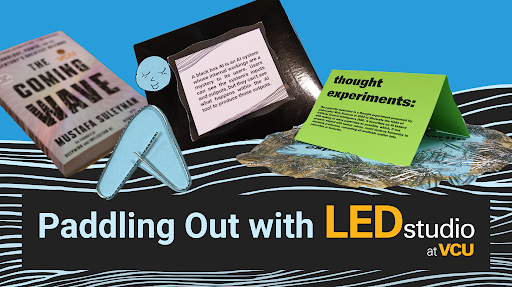
When the VCU Common Book was announced for the 2025-2026 school year as a book on AI, “The Coming Wave” by Mustafa Suleyman, I pitched that our department, LEDstudio, host an event for faculty to dive into that topic. I had really enjoyed participating in the book club style gatherings that Massey Cancer Center hosted when the book focused on the loneliness epidemic, featuring the stunningly beautiful graphic novel by Kristen Radtke, called “Seek You: A Journey Through American Loneliness.” The timing of those gatherings for faculty and staff, as we were coming out of the pandemic, felt like important steps toward bringing us all back together.
LEDstudio has done a lot of work with two faculty in the philosophy department who teach on the Ethics of AI. We created a series of videos for their course content, and one of them was giving a guest talk during this year’s Massey Cancer Common Book programming, James Fritz, PhD. So I asked if we could stream their Zoom talk at the end of a workshop led by instructional designers and media specialists, creating a space for faculty and staff to explore the technology while also diving deep into the subject matter over a shared meal.
I am so grateful to the people who contributed to our event and to the many events that happened across campus throughout the year. These were important conversations to have. As the sociologist Tressie McMillan Cottom, PhD (who used to teach at VCU!) reminds us, “When people try to sell you on the idea that the future is already settled, it is because it is deeply unsettled.” I don’t know what the future holds for any of us, but I am certain that the more we come together in our learning communities, the more powerful we will be in shaping a future we want.
Something I have always loved about the Common Book program is that the incoming students receive a copy of the book along with a letter from someone at the university, welcoming them to be part of difficult discussions about major societal problems. Before they even arrive on campus, the tone has been set. This is a space for critical thinking. A space for learning and growing. A space where we are all allowed to disagree in a respectful way. This year’s welcome letter by Andrew Arroyo, EdD, and Catherine Ingrassia, PhD says, “This book is a call to action. It challenges us to think critically about how AI should be developed and governed to ensure it benefits humanity. At VCU, we embrace such conversations, preparing students, not just to use AI, but to use it to shape our future responsibly. Welcome to the crucial discussion ahead!”
As the Associate Director of Media Production for LEDstudio, I knew our talented team would come together to make the event something special. Our wonderful instructional designers in LEDstudio came up with topics to lead at their own stations, so faculty and staff could go to what interested them most. Here is what they came up with!
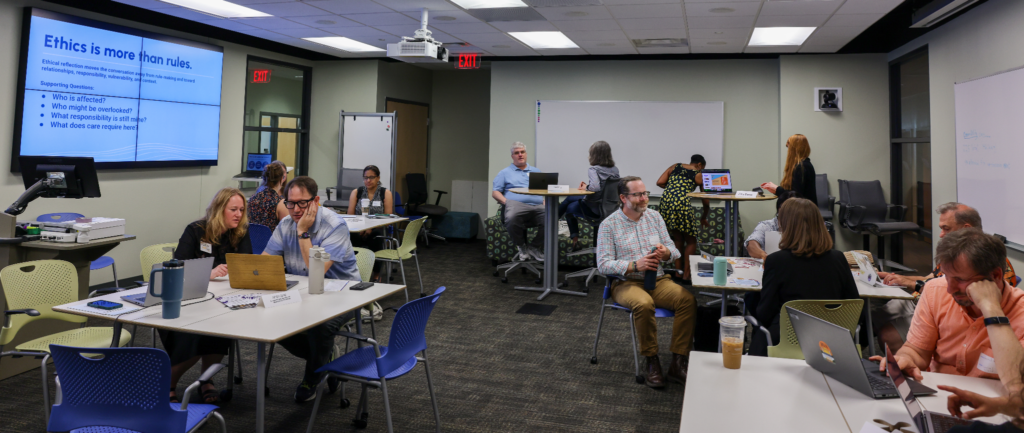
Your AI Use Statement: Ethics, Agency, and Your Circle of Influence
We may not control the coming wave of AI, but we do control how we respond to it in our own lives and work. This station invites participants to reflect on the kind of AI users they want to be and to begin shaping a personal AI use statement grounded in care, responsibility, and human dignity.
Gemini Gems: AI Workflows for Faculty, Research, and Teaching
Discover how Gemini Gems can streamline academic work in this hands-on workshop where you can learn how Gems support teaching, research, and everyday tasks. Leave with starter tools to begin using AI in your workflow, and discuss any questions, concerns, or issues you have.
Step into AI—Start Small with NotebookLM
Step into AI—start small with NotebookLM, a tool that keeps output grounded in one’s own (multimodal) sources with options of turning information into clear, personalized engagements/insights while preserving traceability. It gives agency to students to engage deeply with content rather than passively consume it.
Storytelling for Learning: Transforming Lessons into Experiences
Turn content into experiences learners can live. This station invites you to experiment with narrative structures that engage minds, encourage reflection, and help participants navigate complex ideas—whether exploring abstract concepts, emerging technologies, or real-world dilemmas
Visual Communication Using AI in Adobe Express
Elevate the visual presence of your research with the power of AI. Learn how to customize the attributes of a template and use generative AI to ethically create brand-new assets, without the steep learning curve of traditional design software.

Our new graphic designer made it all look so cool for us, along with contributions from the rest of the media team.
We were lucky to have great faculty join us. Jonathan Becker, JD, PhD, from the School of Education agreed to represent the faculty perspective on VCU’s new commUNity space, a virtual environment for collaboration, experimentation, and idea sharing across disciplines, which already has an active stream on the topic of AI. Jon shared the betterimagesofai.org resource with all of us under the whiteboard prompt to share representations of AI by artists.
Even though I had made a point to say that, like all good book clubs, you’re welcome whether you’ve read the book or not, I still wanted to pull something from the text as a starting point, so I set up a station of my own. I focused on the thought experiment mentioned in the book, known as The Paperclip Maximizer, by philosopher Nick Bostrom, to illustrate the risks of artificial intelligence and created a playful sculptural activity with paperclips.
Then it was time to eat! I am grateful that one of the university-approved caterers was kind enough to let me drop off black boxes with stickers defining “black box” technology in AI for the desserts to go into. I wanted us to lean into these difficult topics, because that’s what I love most about the Common Book program. And a little sugar can go a long way in supporting richer discussions!
All of the media specialists contributed to a slide deck that played at our event, featuring key takeaways from the Common Book program 2025-2026 events.