The Principles of Alignment in Course Design: Aligning MO’s with CO’s

What the heck are COs vs MOs? And why does they matter?
Well, you’ve already encountered COs-the acronym stands for Course Outcomes and they are on the short syllabi of the SON Courses you are assigned to teach. You’ve probably also heard them as Learning Outcomes, Course Learning Objectives, and a couple of different variations-they are all the same thing.
SON Courses are typically structured as a set of modules to break up course content and scale learning to meet course outcomes. Within each module, you will often have a focus with a set of tasks or goals that you want the student to be able to complete by the end of the module. These are your module outcomes. Each module outcome should align with reaching a wider course outcome
This is known as the principle of alignment; the application of different course elements coming together to facilitate the achievement of learners accomplishing and achieving the intended learning outcomes of the course. It is also the elimination of busy work. Every component of the course has a directive or purpose for students being able to meet outlined course outcomes.
You may have heard the term “Bloom’s Taxonomy of Verbs” and while it may sound like a fun skit from the days of Sesame Street, it is actually a tool for helping the course stay aligned and to write your own module outcomes so as to ensure your assigned work for learners is of value.
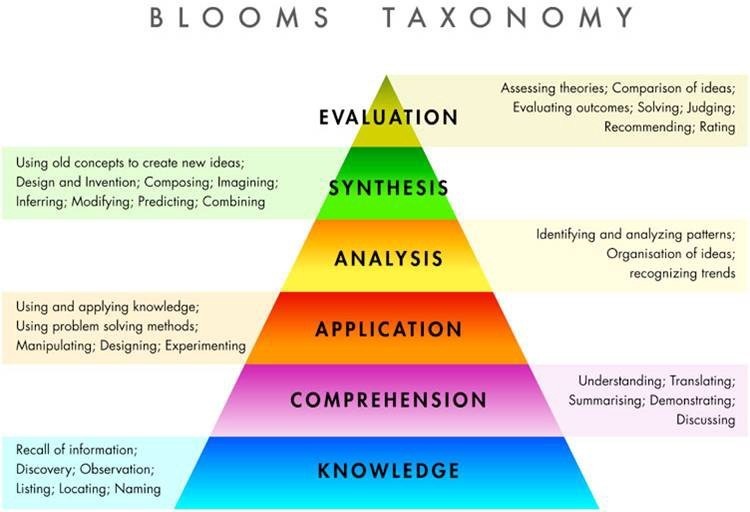
Time to think about verbs-no don’t run! You won’t have to diagram sentences like in 7th grade English. But verbs help formulate course outcomes. Everything a student does is an action.
Take a look at these course outcomes for 478: Leadership and Management in Health Care. Every single outcome begins with a verb:
- Discuss the principles of nursing leadership and management. (SLO 5, 7)
- Demonstrate an understanding of ethical and legal principles related to leadership and management in nursing practice. (SLO 3, 7)
- Develop leadership skills, strategies, and behaviors in the context of systems-based care. (SLO 7)
- Explore theories of organizational and systems leadership and management to the healthcare environment. (SLO 2, 5, 7)
- Evaluate the impact of healthcare policies and regulations on nursing practice and leadership. (SLO 7)
- Engage in self-reflection and ongoing professional development to enhance nursing leadership and management skills. (SLO 3)
In this class, learners will be discussing, developing, exploring, and evaluating, and these skills exist on a compendium of ability, growth, and maturity
New nursing students do not analyze. But they are discovering, observing, naming, sorting, and then practicing recalling that information. As learners progress, they start to recognize patterns, their recall of information gets stronger, and eventually (and excitingly) they begin to use old concepts to create new ideas.
This progression exists in a condensed version in your class. If say, you are introducing pathophysiology to a nursing student that has never taken a patho class, they are not going to jump straight into assessment, analysis, and providing solutions for a patient. They will start by naming, sorting, coding, and memorizing language to lay the foundation of what they need to know later on.
So, this is where Bloom’s taxonomy starts to come into play. It would make a lot of sense that module outcomes, especially in the first few weeks, stay in the lower end of the scale of Bloom’s taxonomy of verbs. As your class continues, those module outcomes will start to move up the scale. Or for more advanced graduate level courses you begin in the middle of Bloom’s taxonomy, with the goal of having students reach the very top of the scale. This is useful for your formative assessments (smaller activities/quizzes/exercises) and your large flagship Big projects known as summative assessments. Formative assessments tend to stay lower in Bloom’s taxonomy, while summative assessments tend to focus on the higher level ones.
There are many, many MANY lists of Bloom’s taxonomy of verbs to help you create outcomes, and can also help you make sure your formative and summative assessments align with those outcomes.
Here is a great PDF from Utica.
There’s been scant research on the use of Bloom’s Taxonomy within nursing education. Interestingly, the results have been mixed. Some feel that Bloom’s Taxonomy does not adequately address the complexity of patient experience and care, and that there may be other ways to determine measurable learning outcomes. There is also some research that indicates that alignment does not increase cognitive learning.
What may be useful however, is that having clearly defined module outcomes that outline course outcomes, will help your course meet AACN essentials. Here is a great blog post talking about just that at The Elevated NP: Empowering NP Educators to Teach, Lead, and Thrive.
With all of that being said, take a deep breath and don’t get too hung up on verb usage, outcomes, and alignment. It can get overwhelming and it might derail you from creating something that feels exciting for yourself and for students. The OLTS Team can help you get started with some mapping and as you start to work on building out a new course, the wording for the outcomes will become more clear. Sometimes reverse engineering them is a perfectly acceptable way to get them done.
Happy course-building! May your canvas login always work, your VCU Laptop stay at full battery, and Rodney the Ram sends you good tidings.
Research:
Dabney, B. W., & Eid, F. (2024). Comparing educational frameworks: Unpacking differences between Fink’s and Bloom’s taxonomies in nursing education. Teaching and Learning in Nursing, 19(4), 347–350.
Jia Z, Balinas JM. Teaching Strategies in Psychiatric Nursing Based on Bloom’s Taxonomy of Educational Objectives. Cureus. 2024 Apr 7;16(4):e57759. doi: 10.7759/cureus.57759. PMID: 38590977; PMCID: PMC11000043.
Su, W. M., Osisek, P. J., & Starnes, B. (2005). Using the revised Bloom’s taxonomy in the clinical laboratory: Thinking skills involved in diagnostic reasoning. Nurse Educator, 30(3), 117–122.
Image source: Menu, Sethi Bloom’s Taxonomy of Objectives. OER Resources. Creative Commons License
Categories Assessment and Measurement, Learning Objectives, Uncategorized