From Polls to Pixie Dust: LEDstudio’s OLC Accelerate 2024 Highlights
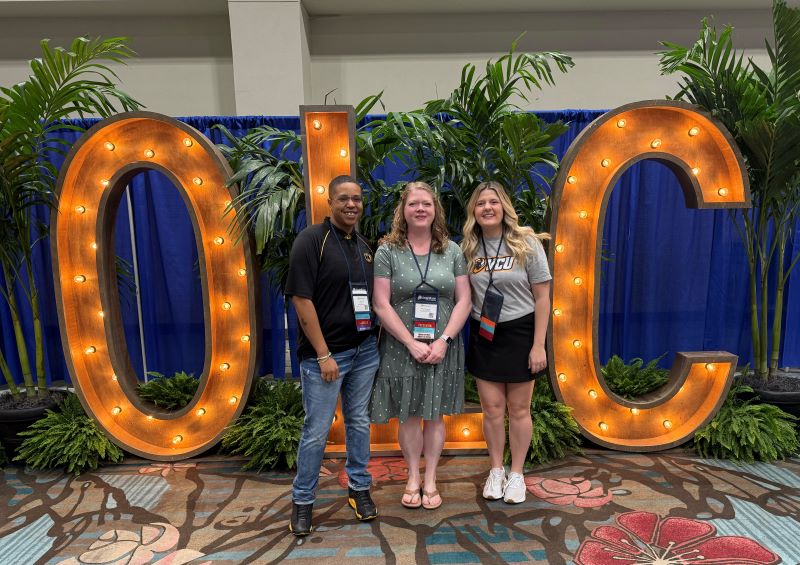
At this year’s OLC Accelerate 2024 Conference “30 Years of Magic: Envisioning a New Era of Digital Learning,” three instructional designers from the LEDstudio team—Cairo Jones, Rebecca Stooks, and Sydney Wilk—gave a presentation titled “Creating Harmony in the Classroom Using Harmonize and DesignPlus.” They offered attendees a glimpse into how LEDstudio leverages innovative tools to enhance teaching and learning at VCU.
Their presentation focused on highlighting how Harmonize goes beyond being a simple discussion platform, showcasing features like student polling and annotated assignments within Canvas courses. They also discussed the impact of custom DesignPlus templates, demonstrating how the tools have elevated the course design process and the student learning experience. They focused on how both of these tools help create student engagement.
Each of the three instructional designers attended various conference sessions as well. The conference took place in Orlando, Florida at the Walt Disney Swan and Dolphin and, below, each ID shares some of the conference “magic” in the form of takeaways and highlights.
To Infinity and Beyond: Cairo’s Adventure
At the conference, I had the opportunity to explore a variety of sessions that sparked my curiosity and inspired new ideas that I can’t wait to share with my team and the faculty we work with. Accessibility emerged as a key theme throughout the event, and I was particularly drawn to the innovative strategies that align with our Quest 2028 efforts to create more inclusive learning environments. One session, in particular, explored impactful ways to support neurodiverse faculty and students. It offered transformative insights into fostering diversity and empowering individuals with different learning and communication preferences. This session provided key insights into making every student and faculty member’s educational and/or teaching experience meaningful.
OLC Accelerate 2024 was a wonderful experience that paved the way to hear fresh perspectives, especially in the area of accessibility, Universal Design, and student support. I returned feeling energized and equipped with new tools to elevate course design and delivery to better meet the needs of all students. It’s exciting to think about how these initiatives can help us create learning experiences that reflect the true spirit of innovation and inclusivity.
A Whole New World: Rebecca’s Adventure
As someone with an English background, I was drawn to several sessions about writing and storytelling. They really opened up a “whole new world” of possibility for me. One of the most interesting sessions I attended was centered around AI and writing assignments. This is a concern we hear about frequently from the faculty we work with, so I was curious to hear other educators’ perspectives on this issue. The presenter, an English professor, demonstrated how he encourages students to use AI throughout the course of a given writing assignment, for brainstorming, outlining, editing, etc. His argument was that we can demystify the use of AI by giving students direct, intentional guidance on how to use it in meaningful and appropriate ways.
I also attended a session about instructional design as a sort of storytelling experience. The instructional designer who led the session shared how she, when working with faculty to develop courses, focuses on the concept of storytelling. Part of her philosophy is the idea that students–and humans in general–respond well to storytelling. She encourages faculty to use case studies and real-world examples wherever possible, essentially presenting teaching materials as a “story” that will engage students.
If You Can Dream It, You Can Do It: Sydney’s Adventure
What I really enjoyed about the conference was being able to attend a variety of sessions that piqued my interest. I knew I wanted to attend a session that gave me better insight on how to ensure each course meets accessibility standards. I had the pleasure of attending a session where two instructional designers demonstrated how they run each course through a screen reader to ensure that the content is accessible after it’s been created. I thought to myself, what a great way to go the extra mile! I enjoyed that this presentation shared free resources that I could bring back to VCU as well as real life examples on how to make content accessible.
Overall, the conference allowed me to connect with fellow higher education individuals and see how other schools navigate instructional design and content creation. I enjoyed meeting vendors we work with on a daily basis as well such as Harmonize and DesignPlus.
Categories article, conference