Transition planning and services
As a secondary educator, knowing when to start supporting students with disabilities on the post-secondary transition journey can be challenging. Do we begin in high school? Or, do we plan from the beginning with the end in mind? Morningstar and Clavenna-Dean (2018) wrote a book, Your Complete Guide to Transition Planning and Services, that guides you through the process. As a case manager or transition support specialist, daily tasks and responsibilities can consume your calendar. Yet, transition has to be a priority because students with disabilities continue to be less prepared for adulthood than their peers without disabilities (Newman, Wagner, Cameto, & Knokey, 2009). As educators, we desire our students to be productive citizens and participate in life outside of school. This includes furthering their education, training, work, and independent living.
First, we must understand that there needs to be a wide range of transition services for students with disabilities (Morningstar & Clavenna-Deane, 2018). Using age-appropriate assessments can guide you and your students through selecting services to help them reach their goals. Like their peers, students with disabilities are not monolithic; they have different strengths, interests, preferences, and needs. Their needs and services will vary even within the same disability category.
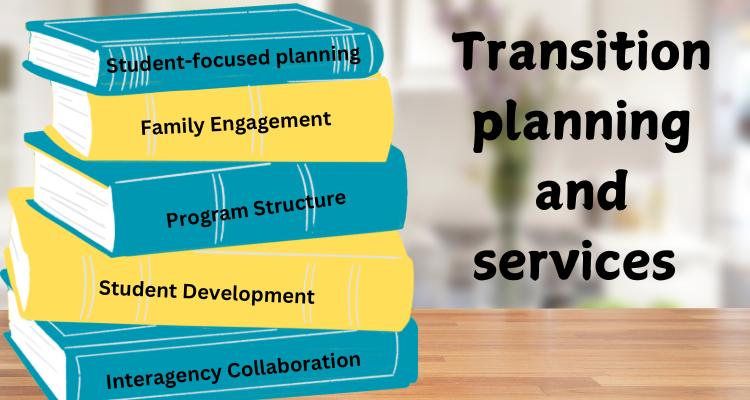
Kohler (2016) shares in Taxonomy for Transition Programming 2.0 five areas educators should prioritize in transition planning:
- Student-focused planning
- IEP development
- Planning strategies
- Student participation
- Family Engagement
- Family involvement
- Family empowerment
- Family preparation
- Program Structure
- Program characteristics
- Program evaluation
- Strategic planning
- Policies and procedures
- Resource development and allocation
- School climate
- Student Development
- Assessment
- Academic skills
- Life, social, and emotional skills
- Employment and occupational skills
- Student supports
- Instructional context
- Interagency Collaboration
- Collaborative framework
- Collaborative service delivery
As transition educators, we are part of a community committed to ensuring that students with disabilities have the opportunity to receive free, appropriate public education nearly 50 years after Congress enacted the Individuals with Disabilities Education Act. Our role is not just about individual tasks, but about being part of a collaborative effort. Kohler et al. (2016) share that post-school outcomes of students with disabilities improve when we focus on transition planning that incorporates student families, teachers, community, and organizations working together. We must look at each student individually, assess their strengths and areas of need, and identify their interests and preferences. Create space for students to develop their self-determination skills. Build parental relationships between students and school staff. Explore careers and work-related opportunities. Engage families in the transition process, and lastly, engage in strategic planning that incorporates all stakeholders from education, applicable agencies, and community partners vested in providing the student with the best possible outcomes. It is our collaborative efforts that make successful transition planning possible, and it is this sense of community that should inspire us in our work.
Digital Resources:
Transition Assessments https://transitionta.org/transition-assessment/?h=Assessments
Transition Assessments https://centerontransition.org/transition/assessment.cfm
Transition Planning https://iris.peabody.vanderbilt.edu/module/cou2/cresource/q1/p03/
Transition Planning https://centerontransition.org/transition/
TTAC Library Resources:
Morningstar, M. & Clavenna-Deane, M. (2018). Your complete guide to transition planning and services. Brookes.
References
Kohler, P. D., Gothberg, J. E., Fowler, C., and Coyle, J. (2016). Taxonomy for transition programming 2.0: A model for planning, organizing, and evaluating transition education, services, and programs. Western Michigan University. Available at www.transitionta.org.
Morningstar, M. & Clavenna-Deane, M. (2018). Your complete guide to transition planning and services. Brookes Publishing.
Newman, L., Wagner, M., Cameto, R., & Knokey, A.M. (2009). The post-high school outcomes of youth with disabilities up to 4 years after high school. A report from the national longitudinal transition study-2 (NLTS2) (NCSER 2009-3017). SRI International.
For more information contact LaTonja Wright ([email protected]), Program Specialist T/TAC at VCU.
Categories Transition PK-12