From Army Veteran to Army Docent
This blog is by Kevin Cale, M.A. in History in 2018.
Looking back over the years, I can honestly say that I have been a history nerd since elementary school. If my elementary school back in Michigan was still around, you could go to the library and find a book on the American Revolution and see that I signed it out for almost all of third grade. So, it was no surprise that my freshman year of college I signed up for a military history class sponsored by the Army Reserve Officer Training Program (ROTC). This led to my commissioning as an Army lieutenant upon graduation from college and a twenty-year career as an Army logistician followed by a career as a government civilian at Fort Lee, VA.
After several years working as a government civilian doing organizational design for transportation units, I knew that it was time for a change. That realization led me to the History M.A. program at Virginia Commonwealth University (VCU) starting in 2016. As a graduate student, I took a variety of classes including two internships (one at Petersburg Battlefield and the other at the Library of Virginia), and several involving Public History.
After graduating, I was trying to determine what I wanted to do with my life. As a new grandfather, I spent part of my time taking care of my new granddaughter, but something else was needed. Then in fall 2019 the soon-to-be open National Museum of the United States Army, located at Fort Belvoir, VA, advertised for Docents. This seemed perfect. The job combined my love of the Army and history into one. I signed up right away, was accepted into the program, and began the training.

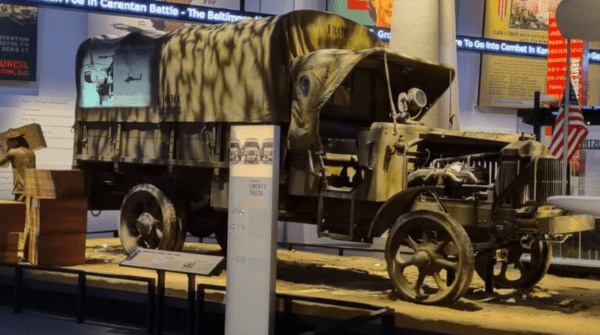
The National Museum’s mission is to interpret the Army’s history and culture and display its invaluable historical artifacts and art collection. According to Visitor Services there are 1,300 items in the museum’s ten galleries ranging from individual weapons (like swords, pistols, muskets, and rifles) to weapons systems and uniforms and knapsacks to load bearing equipment. These items were selected from an incredible 600,000 items available from the forty-seven museums that make up the Army Museum Enterprise. The museum board aimed to select items that help illustrate soldiers’ service and sacrifice and that could easily provide talking points for Docents like myself when communicating with the public.
During the training we were given the Docent Resource Book, which covered most of the items on display in the museum. It provided the Docents with a common baseline for each item, i.e., nomenclature, artifact history, historical significance, along with related artifacts, interpretative techniques, and several other facts to give us a good understanding of the items and be able to tell its story to visitors. Our goal as a Docent is to create an enriching and enjoyable experience for visitors and encourage a lifelong interest in the Army history and the stories of the Soldiers who served. We are to do this by actively engaging the visitors, answering their questions and providing an interpretation of what they are seeing and how it fits into the time frame of the gallery and the Army as a whole.
Most of this training took me back to HIST 651: Public History: Theory & Practice, with Dr. John Kneebone. During that class, we discussed the concepts of a what is a museum and the story or stories each one was trying to tell. We also talked about the processing of selecting what items went into a museum and how they were to be displayed, as well as what items were not included and what that means to the visitor. Because of that class I felt comfortable in understanding most of the choices that were made in the selection and presentation of various items.

The museum was originally scheduled to open on 4 June 2020. However, Covid delayed the opening until Veterans Day, 11 Nov 2020. I began first sessions a week later. Then in January 2021 the museum closed again due to Covid. This lasted until June when it reopened and has remained open since. Until recently we were required to wear a mask whenever we entered the building. Slowly the museum is getting more and more visitors. One reason is because of the easing of Covid restrictions, and the other is because people are increasingly finding out about the museum.
Our Docent community is close-knit. A good portion of us are retired Army with a strong interest in history. On slow days we gather in the main concourse and talk about our Army assignments or about things in the museum. We also discuss how we interact with the guests, helping us learn from each other about how we present items and their stories. When I deal with children under the age of about seven, I encourage them to do a scavenger hunt for child-friendly items, like a photo of a dog serving on the front lines, a stuffed carrier pigeon, the G.I. Joe and Army Barbie dolls, and the flight suit worn by the monkey Able when he went into space.

I have met many people from across the nation while serving as a Docent. I really enjoy interacting with them. Some people have no idea of various portions of the Army story, so it’s great to educate them. Others who visit have more knowledge than I do, so I pick their brains to learn.
The National Museum of the United States Army is located on Fort Belvoir and is free to the public. However, you need to go to the website, www.thenmusa.org, to get your free timed-entry tickets. If you want to see everything and read everything expect to spend at least three hours there. It is worth the visit. I am there twice a month, but it changes from month to month. So, keep your eyes open when you come to visit, and you might just see me!
Categories Featured Alumni