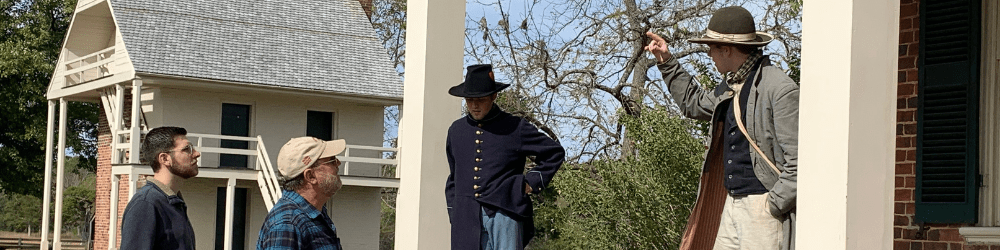
Historic Christ Church, New Discoveries of the Past

This blog is by Kayla Payne, certificate in public history December 2023.
Located in Weems, Virginia in Lancaster County is Historic Christ Church and Museum. Built by free, indentured, and enslaved craftsmen and designed and financed by the wealthy planter Robert “King” Carter in 1735, the Anglican parish still stands today and anchors a museum focusing on life in colonial Virginia. Robert Carter III, “King” Carter’s grandson, is noted for his Deed of Gift that, in the aftermath of the American Revolution, gradually emancipated between 500 and 600 slaves, one of the largest individual manumissions in the U.S. During my summer internship at Historic Christ Church, I gained valuable insights into this historic property and the practice of public history.
Although I was familiar with Robert Carter III and his Deed of Gift, I knew little about the rest of the Carters or Christ Church. When I met Robert Teagle, the executive director and my internship supervisor, I immediately recognized his deep knowledge of the site and the people, as well as the passion he, the staff, and volunteers dedicated to the church and museum. Their passion resonated with me. Being able to legitimately understand why one goes into this kind of work is something that helps an intern like me visualize how I want my future endeavors to look like, ones where I can be enthusiastically engaged with my work.
My tasks were varied, and with each one I was able to understand how even the seemingly simplest ones contribute to a greater purpose. I digitized binders and folders full of photos, postcards, letters, and documents, including the church vestry books so that they can be available on the Christ Church website for the public to use. Digitizing also meant these documents would continue to exist even if the physical object no longer did, ensuring its survival in the digital space.
I also helped out for their Hands on History Day where children visited Christ Church to participate in a day full of historic activities and crafts. I showed the kids how to play a variety of colonial games including hoop trundling, ball and cup, and the “game of graces,” played with two sticks and a wicker ring, which turned out to be the most popular amongst them. It was a fun day where instead of kids needing to sit at a desk and hear a lecture from their teacher, they actively participated in their own learning in an enjoyable way.
I gained further experience by transcribing letters. Historic Christ Church possesses several letters written by a Confederate POW who signed his name as “L. Carter,” and was held prisoner at Camp Chase, Ohio. His letters date from July 1864 to September 1865. The most immediate lesson I learned was that transcribing is tedious. It’s not a one-time, quick read through. My initial passes on the letters resulted in many blanks and words in brackets as I tried to make out the scribbled sentences.
Along with transcribing, I also investigated L. Carter’s identity. I combed through Camp Chase’s register of Confederate prisoners, going page by page to find any L. Carters. There was an L. E. Carter, a private of the 8th VA Infantry who was captured in July 1863; another private L. Carter from Virginia and an L. Carter from Alabama. I couldn’t be positive if any of these L. Carters was the one I was looking for. On top of that, my L. Carter was an apparent murderer.
He admits in a September 1865 (after the conclusion of the Civil War and his release from the prison camp) letter that at one point he had “killed two or three negros” in Fauquier County, Virginia. Worried that he would be punished, Carter wrote of his plan to flee to Mexico. On top of continuing to go through the prison records, I searched Virginia newspapers to see if there were any mentions of slain black people in the Fauquier County area. Yet I couldn’t find information that could connect with this specific individual who was still just a broad idea of a person.

I had spent so much of my time focusing on L. Carter that I (nearly) ignored another source that was there the entire time: the recipient of his letters. L. Carter addressed his correspondence to his sister, an “N. Goldsburough.” As I looked into the Goldsburoughs, I learned that they were a prominent Maryland family in Talbot County. I found a Goldsborough family tree, and after scanning through names and dates, saw that Nicholas Goldsborough married Lavinia Turner Carter Goldsborough. Lavinia hailed from a Virginia family and had several siblings including one named Matthew Loughborough Carter who apparently actually reached Mexico but died in 1866.
There is still much to learn about L. Carter’s life, crimes, and victims, and more I can do to sharpen my personal research practices. There’s never just one path to an answer. History can branch out from its original source and make connections not initially apparent. It’s fun to make those new discoveries, not only in research but also with yourself.
Categories Intern Insights