The Wright Center Bids Fond Farewell to Amy Olex after 12 Years of Bioinformatics Innovation
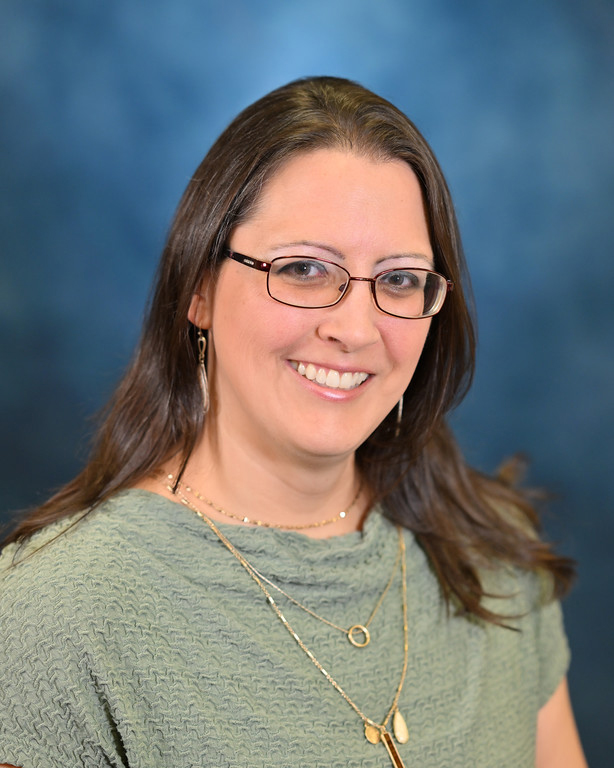
After twelve years at the Wright Center, Amy Olex, Ph.D., is moving on to a new leadership chapter at VCU. A senior scientist at the Wright Center and Project Manager for the Massey Comprehensive Cancer Center’s Bioinformatics Shared Resource, Olex was instrumental in building the Wright Center’s bioinformatics infrastructure, educating hundreds of clinicians and researchers, and providing the data-driven foundations for landmark studies in precision medicine.
On May 25th, she will join the Stravitz-Sanyal Institute for Liver Disease and Metabolic Health as Lead Bioinformatics Data Engineer.
A Legacy of Global Impact
While Olex does not hold a faculty title, her scholarly and policy impact is substantial. Over the course of her career, she co-authored 66 peer-reviewed publications and a book chapter. Her tenure at the Wright Center alone saw the publication of 57 papers, including 8 on which she served as first author.
Her impact extends beyond academic papers and into the realm of international health policy through her work with the National COVID Cohort Collaborative (N3C). Joining the initiative at its inception in 2020, Olex was a core contributor to an unprecedented effort across the CTSA network to harmonize billions of rows of EHR data into a single, massive dataset.
“In the early days of COVID, everyone had this aspiration to do something to help,” says Evan French, M.S., Data Team Manager at the Wright Center. “Amy jumped into N3C with both feet in Spring 2020 and immediately began organizing a team of clinicians, informaticists, and statisticians around the specific goal of understanding how COVID was affecting some of the most clinically vulnerable populations.”
This initiative resulted in what French describes as a “prolific string of publications.” As a leader of the Immunocompromised and Suppressed Domain Team, Olex served as a vital “door opener”—training researchers to access and navigate the enclave while managing the underlying data infrastructure. Though she often worked as a facilitator rather than a lead author, her contributions were so foundational that she is acknowledged as a “core contributor” on nearly every paper the N3C produced. That work has had measurable global reach: N3C research she supported has been cited in policy documents across six countries, informing the guidelines of organizations including the United Nations and the U.S. Centers for Disease Control.
The Harrell Collaboration: A VCU First in PDX Innovation
Closer to home, Olex identifies her decade-long collaboration with Chuck Harrell, Ph.D., an Associate Professor in the Department of Pathology, as one of her most meaningful contributions to VCU.
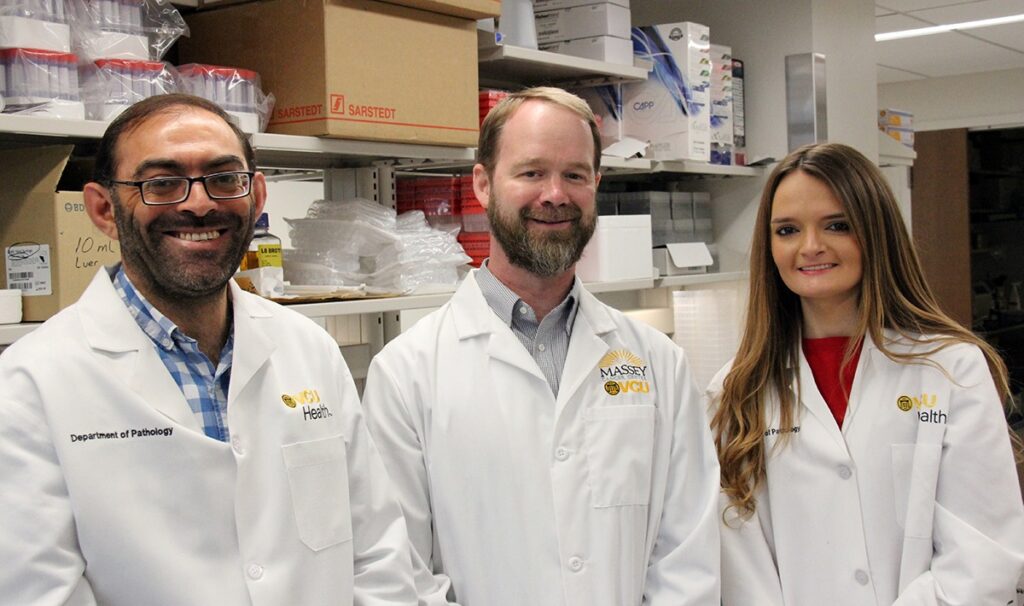
“I’ve been working with Chuck for 11 years. I’ve been at the Wright Center for 12.” Olex reflects. “He was one of my very first collaborators.” Harrell’s lab specializes in breast cancer research, specifically utilizing Patient-Derived Xenograft (PDX) models—human tumor cells grown in immune-suppressed mice.
Olex’s role in Harrell’s research was central to a major technical hurdle: when tumor tissue is grown in a mouse, the resulting genetic data is a messy mix of both species. “The pipelines that I developed for Chuck were the first at VCU to be able to bioinformatically and computationally separate human and mouse genetic material,” she explained at a recent Wright Center presentation.
When asked to describe her impact on his research lab, Harrell was effusive. He recalled recognizing Olex’s value almost immediately after joining the VCU faculty—someone who would become, in his words, a critical member of his research team. “While initially her role was to perform bioinformatic analyses,” Harrell said, “she quickly became an unofficial co-mentor to nearly all of the students that have been part of my lab for the past decade.”
In 2023, a NCI U54 grant expanded the collaboration further, broadening PDX development across multiple cancer types and growing Olex’s role to encompass the full range of genomic and proteomic data generated by the project.
Summing up her overall contribution, he was direct: “Amy was a huge part in the success of our group. She contributed to 13 publications, over $10 million in research funding from our team, and directly contributed to 10 PhD thesis projects.”
Circling Back: The Road to the Ph.D.
While Olex was busy building these high-level pipelines for VCU investigators, she was also quietly advancing her own academic journey. In 2016, she enrolled in VCU’s Computer Science Ph.D. program, taking one class per semester while maintaining her full-time role at the Wright Center.
She worked with her dissertation advisor, Bridget McInnes, Ph.D., who understood that for a working mother and senior scientist, the Ph.D. was “the extra thing, not the primary thing.” McInnes’s focus on natural language processing allowed Olex to build bridges between computer science and clinical applications—a theme that has defined her entire career.
Completing a doctorate while working full-time required extraordinary discipline. Olex frequently spent her weekends at the local skating rink, typing away on her dissertation while her children skated laps. She finished in six years—faster than her own projection—and along the way found herself at a technological frontier: when she began her dissertation work, Google’s BERT—now recognized as the first large language model to reshape the field—had just been released in 2017. Olex was among the earliest researchers to work with it, fine-tuning those early models for clinical text applications years before “LLM” entered everyday vocabulary.
Olex the Educator: Cultivating a Bioinformatics Community
This breadth of experience—from data management to cutting-edge natural language processing—informed her second great contribution to VCU: her role as an educator. Shortly after joining the Wright Center, Olex was tasked with helping investigators and researchers understand how bioinformatics could drive drug discovery and precision medicine.
In 2017, Olex launched the “Bioinformatics 101” seminar series, offering free sessions to anyone—inside or outside VCU—for five years, working to saturate the campus with bioinformatics literacy.
Olex eventually distilled her cumulative expertise into CCTR 691, a comprehensive three-credit course for clinical and translational science students that distills her 12 years at the Wright Center into an immediately applicable curriculum.
The impact of the course is best seen through the feedback of her students. “I started this course without any understanding of informatics at all, and now feel like I could listen to a lecture or read a paper and understand the vocabulary, concepts, and the point,” wrote one student in 2024.
For Olex, making complex topics approachable is the ultimate goal. “I’m not just teaching theory,” she says. “I teach specific skills that you can apply immediately to your work. I’m focused on what is going to be an immediate value add to your workflow today.”
At the Crossroads: A Philosophy of Translational Science
Throughout her career, Olex has been most at home at the crossroads of disciplines—between computer science and clinical medicine, between data infrastructure and research outcomes, between the specialist’s deep knowledge and the generalist’s ability to communicate across silos. The Wright Center, she says, was the place where she got to live that instinct at scale.
“Translational research to me is trying to understand where the other person is coming from, what’s important to them, what their priorities are—and then taking what’s important to me and folding it into their paradigm,” she says. “I don’t know of anywhere else where I would have been able to get all of that experience in one job. The Wright Center really put me in a unique position.”
What Comes Next: Staying in the VCU Family
The move to Stravitz-Sanyal is about the opportunity to build from the ground up once again. Olex spent years facilitating other people’s research; now, she will be architecting the multimodal bioinformatics infrastructure for a young institute with global ambitions.
“I’m not disappearing,” Olex says. “I think a lot of the stuff that I’ll be building at Stravitz-Sanyal will be applicable beyond and have an impact on VCU as a whole. You have all shaped my career, and I’m so grateful that you primed me for this new challenge.”
Wright Center Director F. Gerard Moeller, M.D., offered his own send-off: “Thank you, Amy, for your tireless commitment to your discipline, but also to your commitment to the whole spectrum of translational science. Your work raised the bar for our center every day. We will miss you and wish you all the best.”
Please join us in thanking Amy Olex, Ph.D., for her extraordinary service, her mentorship, and her unwavering commitment to the VCU research community.
Categories Data Science, Impact, Research, Staff
Comments
So proud of you. The work that you’ve done over the years has consistently amazed and impressed me. I can’t wait to see the next step! Love you always