Stop, Think, Act: A practical guide to promoting self-regulation skills in early childhood settings
The two most important skills for helping young children succeed in school and life are self-regulation and co-regulation. As early childhood educators, we understand the importance of developing these skills by creating a supportive, relationship-centered environment where teachers actively guide and support students. This approach ensures that throughout a young child’s developmental stages, they learn how to manage their emotions, thoughts, and behaviors effectively.
Co-regulation represents a significant shift from traditional behavior management to relationship-based emotional support in early childhood. It is defined as the responsive, warm interactions between a caring adult and a child, providing essential external scaffolding such as coaching, modeling, and a supportive environment that helps a child manage intense emotional arousal, attention, and behavior (Rosanbalm & Murray, 2017). The ability to effectively co-regulate with a child begins with prioritizing one’s own regulation. Educators can manage their personal emotional state by employing strategies such as mindfulness to remain calm and to convey that calmness to a child who is dysregulated (Lobo & Lunkenheimer, 2020). The main goal is to help the child internalize these external strategies and gradually develop full self-regulation.
Creating a nurturing early childhood classroom environment is essential for promoting the development of a child’s self-regulation and co-regulation skills. A safe, supportive, and predictable environment acts as the primary learning ground for developing emotional control, especially when paired with the consistent presence of a caring adult for guidance and intervention.
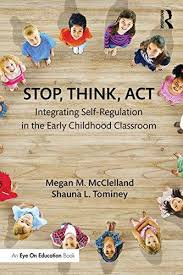
The book Stop, Think, Act (McClelland & Tominey, 2016) asserts that self-regulation, the ability to “stop, think, and then act,” is a trainable and malleable skill. The authors base this idea on research, highlighting three core Executive Functions (EFs) that serve as the cognitive foundation of the self-regulation process:
- Attentional Flexibility: The ability to smoothly switch focus and adjust behavior in response to changing task demands, such as transitioning from play to instruction.
- Working Memory: The ability to hold and mentally manipulate information over short periods, like remembering multi-step directions.
- Inhibitory Control: The ability to stop an automatic response and resist impulses, such as waiting one’s turn or refraining from blurting out an answer.
These cognitive skills are closely connected with emotional control, requiring teachers to support what the authors identify as both the cool (cognitive) and hot (emotional) parts of self-regulatory development.
Stop, Think, Act (McClelland & Tominey, 2016) outlines a practical framework for embedding self-regulation practices across daily routines by shifting the focus from passively managing behavior to actively teaching children self-management skills. Each chapter moves from theory to practice by integrating examples, learning checkpoints, and strategies that can be implemented immediately. The authors explore the following areas:
- Environmental Setup: The environment should be designed to promote self-regulation by establishing clear, concise rules and predictable routines. Using visual supports and dedicated calming spaces helps children anticipate transitions and manage uncertainty.
- Curriculum & Activities: Self-regulation practices are embedded into daily activities rather than being taught in isolation:
- Circle Time Games: Activities like “Simon Says” or “Red Light, Green Light” actively develop inhibitory control.
- Academics: Embed working-memory tasks into lessons, such as having students retell a story or follow multi-step directions.
- Transitions: Structured waiting activities, songs, and chants help children manage the emotional challenge of changing activities throughout the day.
- Gross Motor Play: Outdoor play provides natural opportunities to practice all three core executive functions through rule-based games and turn-taking.
- Family Engagement: Practical ideas for involving families are provided. The authors emphasize the importance of maintaining a consistent approach between school and home to maximize developmental progress.
Providing a structured environment, clear visual cues, and explicit instruction within the Stop, Think, Act (McClelland & Tominey, 2016) framework makes the classroom a predictable and supportive space by ensuring that educators regularly model and support self-regulation, meeting the immediate needs of young children across all educational settings and building a foundation for lifelong success.
Below are additional resources to support early childhood educators and the families they serve, with a focus on co-regulation and self-regulation. The book featured in this article is available for checkout through the TTAC at VCU’s library system.
Resources
Fox, L., Lentini, R. H., Richter, M., Penn, C., Chandler, L. K., & Dunlap, G. (2014). The pyramid model for supporting social emotional competence in infants and young children. Young Children, 69(1), 10-17.
Hemmeter, M. L., Ostrosky, M. M., & Fox, L. (2020). Unpacking the pyramid model: A practical guide for preschool teachers. Paul H. Brookes Publishing Co.
The Virtual Lab School: Promoting Social-Emotional Development: The Preschool Teacher
References
Lobo, Y. B., & Lunkenheimer, E. (2020). Mindfulness in the early childhood classroom: A strategy for teacher co-regulation with students with challenging behavior. Early Childhood Education Journal, 48(4), 481-490.
McClelland, M., & Tominey, S. (2016). Stop, think, act: Integrating self-regulation in the early childhood classroom (1st ed.). Routledge. https://doi.org/10.4324/9781315798059
Rosanbalm, K. D., & Murray, D. W. (2017). Promoting self-regulation in early childhood: A practice brief. Office of Planning, Research and Evaluation, Administration for Children and Families, U.S. Department of Health and Human Services.
For more information, contact Adrienne Quarles-Smith ([email protected]), Program Specialist, T/TAC at VCU.
Categories Early Childhood Special Education