A blueprint for growth: How routines develop foundational skills in early childhood
Early childhood classrooms are lively centers of exploration and learning. For all children, especially those with disabilities, carefully organized routines within routines are highly beneficial. Intentionally implementing a system provides a predictable framework that encourages independence, reduces anxiety, and enhances learning opportunities throughout the day.
First, let us clarify the difference between a daily schedule and a routine. A schedule provides an overview and includes the day’s main activities; while a routine details the steps needed to complete each part of the schedule (HeadStart.gov, 2025). A daily schedule helps children understand what to expect next, providing comforting predictability that eases transitions and helps them anticipate activities. This predictability is essential for young children with disabilities. Knowing the sequence of events, such as arrival, circle time, centers, snack, outdoor play, story time, and departure, reduces stress by conserving mental energy and allowing children to focus on learning rather than navigating uncertainty (Brown et al., 2012).
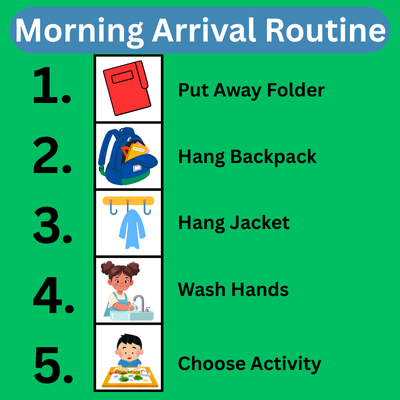
Routines and activities allow children to practice and learn new skills meaningfully, enabling them to apply these skills across various settings (University of Florida Anita Zucker Center for Excellence in Early Childhood Studies, n.d.). The strategy of embedding “routines within routines” is especially effective. Consider the arrival routine; instead of children simply walking in the door, a series of steps can guide their first few minutes. For example, a child with a communication delay might follow a layered approach that includes hanging up their backpack, placing their folder in the basket, choosing a welcome activity, and then finding their seat. This detailed sequence, supported by visual schedules or pictures, offers clear, actionable steps. These routines within routines create a level of predictability that helps children master smaller sequences, build confidence, and develop a sense of achievement.
For children with disabilities, routines within routines offer several key benefits. First, they provide repeated opportunities for skill-building, reinforcing motor and organizational skills through consistent practice. Second, these routines promote independence by allowing children to initiate and complete tasks with less adult support, thereby building self-efficacy. Finally, they establish a predictable environment for practicing social skills, such as turn-taking and sharing, making these moments a natural part of the day (Child Care Education Institute, 2020). Visual supports like picture schedules are essential for making these abstract routines concrete and understandable, helping children participate more actively and reducing frustration.
The thoughtful implementation of routines within routines is more than just about structure; it is about empowerment. It is about creating a predictable and supportive environment where all children, especially those with disabilities, can thrive. By breaking down the day into manageable, predictable segments, educators can build a foundation for independence, reduce anxiety, and make the most of every moment for meaningful learning and growth.
Additional resources are available for checkout through TTAC’s library system:
Grisham-Brown, J., Hemmeter, M. L., & Pretti-Frontczak, K. (2017). Blended practices for teaching young children in inclusive settings (Second edition.). Brookes Publishing.
Horn, E. M. (2016). Six steps to inclusive preschool curriculum : A UDL-based framework for children’s school success (1st ed.). Brookes Publishing.
Sandall, S. & Schwartz, I. (2024). Building blocks for teaching preschoolers with special needs (4th ed.). Paul H. Brookes Publishing.
References
University of Florida Anita Zucker Center for Excellence in Early Childhood Studies. (n.d.). 3R’s of early learning: Relationships, repetition, routines. https://ceecs.education.ufl.edu/atoz/3rs/
Brown, W. H., Odom, S. L., & Conroy, M. A. (2012). An initial evaluation of the effects of the Early Childhood Friendship Project on the social interactions of preschool children with disabilities. Journal of Early Intervention, 34(2), 101-118.
Child Care Education Institute. (2024, June 13). The benefits of routines in early childhood education. https://www.cceionline.com/the-benefits-of-routines-in-early-Childhood-education
HeadStart.gov. (2025, February 3). The importance of schedules and routines. https://headstart.gov/about-us/article/importance-schedules-routines
For more information, contact Adrienne Quarles-Smith ([email protected]), Program Specialist, T/TAC at VCU.
Categories Early Childhood Special Education