Rewiring Education: How Neuroscience Is Transforming University Teaching (Part 1)
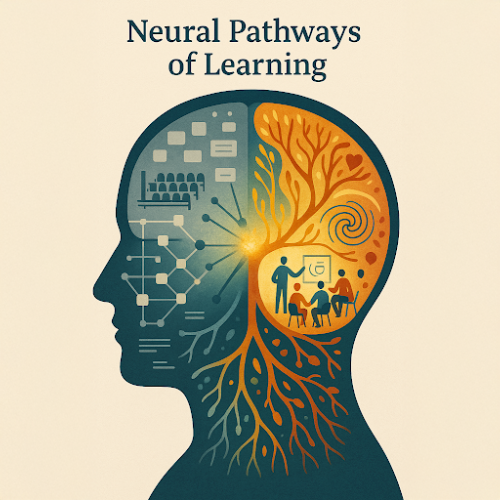
This is the first in a 5-part series exploring how insights from brain science can revolutionize teaching and learning in higher education.
The Century-Old Classroom vs. The Modern Brain
Picture two university classrooms. In the first, a professor stands at the front, delivering a meticulously prepared 90-minute lecture. Students dutifully transcribe notes, occasionally glancing at slides dense with information. The room is quiet except for the professor’s voice and the clicking of laptop keys.
Now picture a second classroom. Here, students begin by discussing a complex problem in small groups. The professor circulates, listening and posing questions. After ten minutes, the whole class debates various approaches. Next, students individually apply a concept to a novel situation, then compare results with peers. The session concludes with students reflecting on what they learned and identifying what remains unclear.
Both classrooms cover identical content. But neuroscience research reveals something striking: students in the second classroom will likely retain significantly more information and develop a deeper understanding than those in the first.
Why? Because the second classroom aligns with how our brains actually learn.
The Neuroscience Revolution in Education
For over a century, university education has operated largely on tradition and intuition rather than evidence about how the human brain learns. We’ve expected students to absorb knowledge through passive listening, marathon study sessions, and high-stakes exams—practices that often work against our brain’s natural mechanisms for learning.
But this is changing. As Dr. Judy Willis, both a neurologist and classroom teacher, explains: “Understanding how the brain appears to process, recognize, remember, and transfer information at the level of neural circuits, synapses, and neurotransmitters gives educators the tools to help students experience success and renewed confidence” (Willis, 2012).
Recent advances in neuroscience research are revealing fascinating insights about learning that contradict many traditional teaching practices:
- The brain physically changes as it learns. When we learn something new, our brain creates and strengthens neural pathways. The more we engage with information in meaningful ways, the stronger these pathways become.
- Emotional state significantly impacts learning. Stress hormones can either enhance or impair memory formation depending on their levels. Moderate stress improves attention and memory, while high stress can shut down higher-order thinking.
- Memory isn’t a single system. Different types of information are processed and stored through different neural mechanisms, each responding to different teaching approaches.
- The brain needs multiple exposures to information. Rather than covering content once and moving on, spaced repetition with varied approaches dramatically improves long-term retention.
- Active engagement creates stronger neural connections than passive reception. When students actively grapple with concepts, multiple brain regions activate simultaneously, forming richer associations.
These findings help explain why some traditional teaching methods leave students struggling despite their best efforts. More importantly, they point to evidence-based alternatives that can dramatically improve learning outcomes.
Beyond Intuition: The Evidence for Change
The gap between neuroscience research and educational practice is narrowing thanks to researchers who are testing brain-based teaching approaches in real classrooms.
Dr. Mariale Hardiman at Johns Hopkins University conducted a randomized control trial with fifth-grade science students to evaluate the impact of teaching methods on long-term retention. Her study compared conventional teaching methods with approaches that engaged multiple neural systems. When tested 5-6 weeks later, students in the brain-based learning groups showed significantly better retention of content, with initially lower-performing students benefiting the most, demonstrating approximately 40% better retention rates (Hardiman et al., 2014).
This research suggests that redesigning our teaching approaches based on neuroscience principles isn’t just theoretically sound—it produces measurable improvements in learning outcomes.
What Makes Teaching “Brain-Friendly”?
At its core, brain-based teaching means aligning our instructional practices with how the brain naturally processes, stores, and retrieves information. While we’ll explore specific strategies in upcoming articles in this series, brain-friendly teaching generally incorporates these elements:
- Creating an emotional connection to learning
- Designing optimal physical and psychological learning environments
- Providing the “big picture” before details
- Teaching in shorter segments with active processing
- Incorporating multiple sensory pathways
- Using formative assessment to adjust instruction
- Building in spaced repetition and retrieval practice
Importantly, these approaches apply across disciplines and teaching modalities. Whether you teach literature or physics, in person or online, the brain’s fundamental learning mechanisms remain the same, and your teaching can leverage them.
Why Change Is Hard (But Worth It)
If neuroscience offers clear guidance for more effective teaching, why hasn’t higher education fully embraced these approaches? The answer lies partly in institutional inertia, but also in the very brain mechanisms we’re discussing.
Changing established teaching patterns requires creating new neural pathways in our own brains as educators, and that takes effort. As Dr. Willis notes, “The brain doesn’t learn from what we teach; it learns from how we teach” (Willis, 2012). This applies to faculty as much as to students.
The good news is that even small shifts toward brain-based teaching can yield notable improvements in student engagement and outcomes. In the next article in this series, we’ll explore how the brain’s emotional systems influence learning and how faculty can create emotional connections that enhance retention and transfer.
Looking Ahead: The Future of Brain-Based Teaching
As neuroscience research continues to advance our understanding of learning, the opportunity to transform education grows. Universities that embrace brain-based teaching approaches will likely see not only improved academic outcomes but also greater student engagement, reduced failure rates, and stronger development of critical thinking skills.
The most exciting aspect of this educational evolution isn’t just that it improves metrics—it’s that it makes learning more enjoyable and meaningful for both students and faculty. When we teach in ways that align with how the brain naturally learns, we remove unnecessary obstacles and free students to experience the intrinsic joy of learning.
In Part 2 of this series, we’ll explore “The Emotional Brain in Learning” and how faculty can leverage emotional connections to enhance memory and engagement.
References
Hardiman, M., Rinne, L., & Yarmolinskaya, J. (2014). The effects of arts integration on long-term retention of academic content. Mind, Brain, and Education, 8(3), 144-148.
Willis, J. (2012). A neurologist makes the case for teaching teachers about the brain. Edutopia. Retrieved from https://www.edutopia.org/blog/neuroscience-higher-ed-judy-willis
Categories article, Brain Science, Neuroscience, Science of Teaching and Learning