
FIRST Robotics Day at the VCU College of Engineering champions STEM education
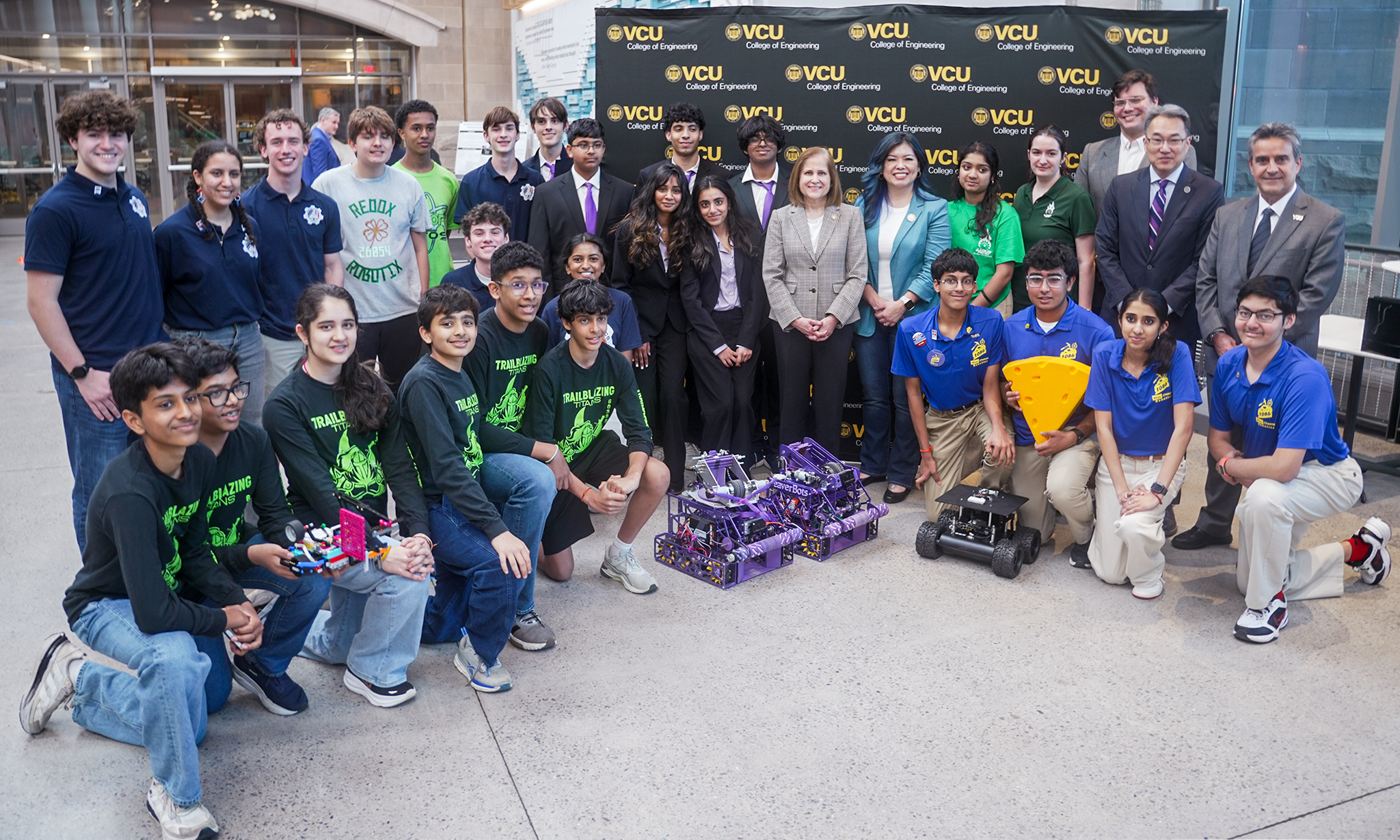
Students, educators, legislators and industry leaders gather to highlight robotics education in the Commonwealth of Virginia
For Inspiration and Recognition of Science and Technology (FIRST) Robotics Day on March 31 highlights Virginia Commonwealth University’s (VCU) 26-year commitment to advancing STEM education. Hosted by the VCU College of Engineering and FIRST Chesapeake, state legislators, corporate leaders, educators and student robotics teams celebrated FIRST Robotics Day with an event at VCU’s Engineering Research Building.
“Fifteen years ago, my son was the captain of a FIRST robotics team. I know firsthand the transformative impact events like this have on a young person’s educational career,” said Azim Eskandarian, D.Sc., the Alice T. and William H. Goodwin Jr. Dean of the VCU College of Engineering. “Like FIRST, VCU Engineering focuses on learning through hands-on opportunities and supports these teaching methods with degrees that address the needs of industry, like our new robotics minor.”
In his remarks, Eskandarian highlighted the VCU College of Engineering’s commitment to experiential learning through several new initiatives in robotics and autonomous systems engineering, including the college’s Robotics and Autonomous Systems (RAS) Research Team and summer industry internships. Students can earn up to six credits, or the equivalent of two technical elective course credits, toward their degree through the summer program, which includes a structured evaluation process developed in collaboration with industry partners. Two endowed scholarships, the Karl Linn Scholarship and the FIRST Robotics Scholarship, also allow some FIRST Robotics participants to continue their education at the VCU College of Engineering.
A Legacy of Partnership
Since the launch of the NASA/VCU FIRST Robotics Competition, VCU has played a pivotal role in bringing FIRST Robotics to Virginia. The program was created through a partnership between then-VCU President Eugene Trani, Motorola, NASA Langley and FIRST.
Ghazala Hashmi, the lieutenant governor of the Commonwealth of Virginia, emphasized the importance of STEM education for Virginia’s future.
“While we may be acknowledging the innovation and the technology and the creativity of robotics, what we are here to celebrate really are the people, all these wonderful students who are working so hard and all of their teachers and their mentors. We’re also celebrating the power of education and innovation,” said Hashmi. “The work that each of you are doing today, as you focus on learning to think critically, to adapt, to solve complex challenges, are all the vital skills that are so essential to prepare you to lead us too, and some of the careers for which you are now preparing for we haven’t even imagined it to being yet.”
Virginia FIRST Robotics Day was first designated in 2024 through legislation proposed by students from the FIRST Robotics Competition team 422 at the Maggie Walker Governor’s School. The resolution recognizes robotics as “one of the most effective, compelling and engaging means for teaching and reinforcing fundamental science, technology, engineering and mathematics concepts.”
A Bright Future for Robotics
Projected to grow at nearly 20% over the next few years, the robotics industry is set to reach $27 billion worldwide, according to a Virginia General Assembly resolution.
“FIRST Chesapeake is incredible. The more I learned about it, the more I realized this isn’t just about robotics. This is about building skills, building confidence and building pathways,” said Eric Lin, director of the Virginia Department of Small Business and Supplier Diversity. “You’re taking imagination and turning it into innovation. That’s powerful because programs like FIRST aren’t just extracurricular activities; they’re real-world learning environments. You’re learning how to solve problems, how to work in teams, how to fail, adapt and try again. Those are the exact same skills used by engineering firms, startups, government agencies and small businesses across the country.”
More than 1000 Virginia FIRST robotics teams are providing hands-on education for students. This includes 286 FIRST Tech Challenge teams, 120 FIRST Robotics Competition teams, 494 FIRST LEGO League teams and 171 FIRST LEGO League Explore teams. Meeting across the commonwealth in school classrooms, maker spaces, libraries and anywhere innovation happens, groups have gathered every weekend since August 2025 for the current competition cycle.
“Two weeks ago, my mother judged her first FIRST event,” said Alex Bryant, president of FIRST Chesapeake. “Every team she talked to gave her goosebumps…She walked away asking when the next [event] was and when she could come back, because she had spent her weekend the most thoughtful, grounded, generous young people that she had ever met…Students who were thinking ethically, students who lead with integrity and students who make everyone they interact with optimistic about the future…That’s not extracurricular, that is education. That’s the kind of education that sticks, the kind that transfers. The kind that shapes the character of a person for the rest of their lives.”
FIRST Chesapeake is a 501 (c) 3 nonprofit organization that operates the FIRST Robotics program in DC, Maryland and Virginia. We work as a community to prepare young people for a STEM future and aim to ensure our programs have a lasting, positive impact on participants across all demographic groups.FIRST® is a global robotics community dedicated to preparing young minds for the future, engaging teams of elementary, middle and high school students globally in various robotics challenges. Through its programs, FIRST aims to cultivate STEM skills, innovation, and teamwork among the next generation of innovators and problem solvers.
The VCU College of Engineering offers innovative undergraduate and graduate degree programs tailored to meet the demands of the rapidly evolving engineering field. As part of a premier research university, students are given the opportunity to perform real-world research in our state-of-the-art facilities as soon as they enroll. Browse videos and recent news to discover how the College of Engineering at Virginia Commonwealth University prepares the next generation of scientists and engineers for the challenges of the future.
Categories General College, Student Stories