
Building a Biotech Hub, Part II: How Machine Learning is Redefining Pharmaceutical Manufacturing
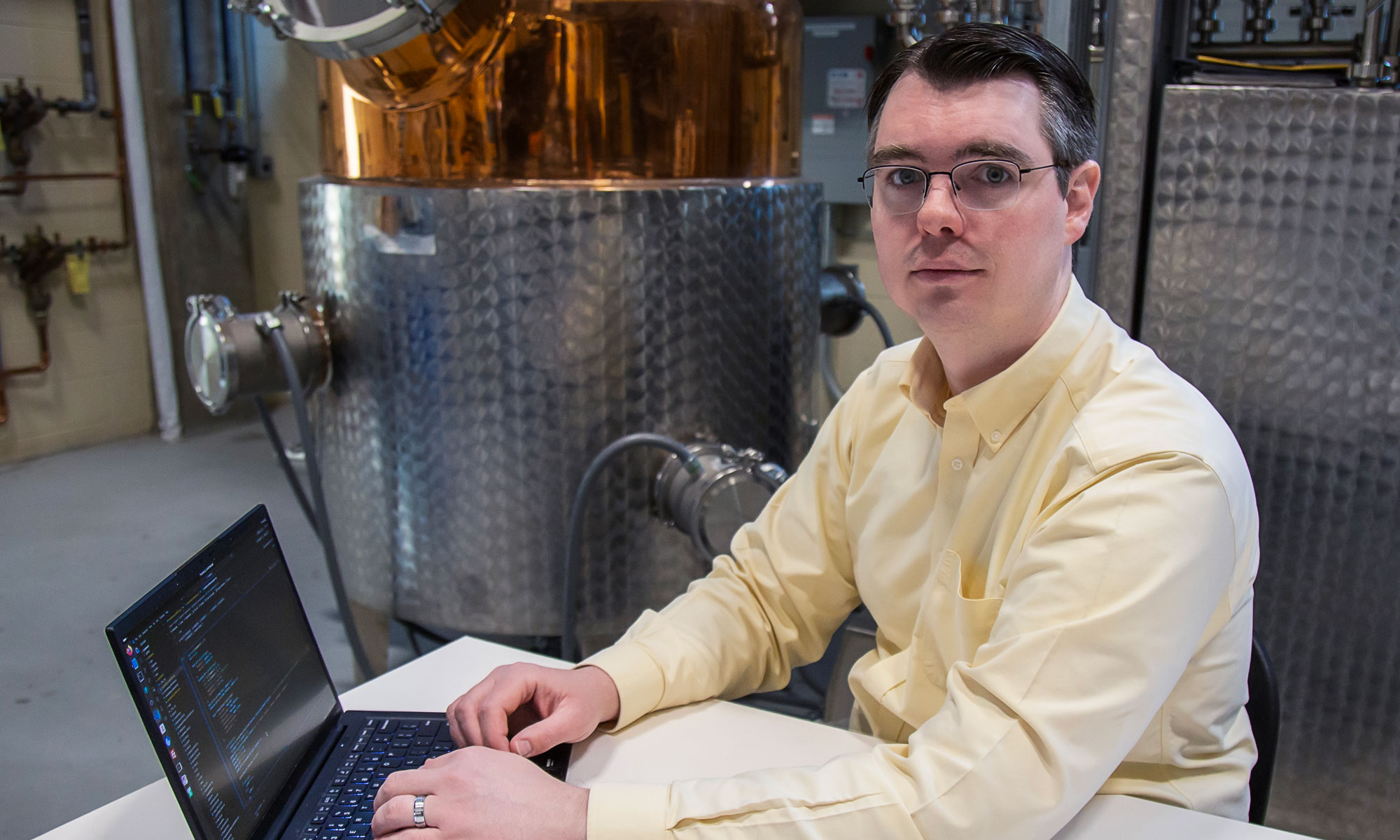
Charles McGill, Ph.D., is amongst the faculty leading innovation at VCU Engineering, using machine learning to explore a vast universe of chemical possibilities.
Charles McGill, Ph.D., isn’t just improving pharmaceutical manufacturing—he and other Virginia Commonwealth University (VCU) College of Engineering faculty members are upending decades of tradition to find a better way forward.
Historically, the development of a new or altered manufacturing process for small molecule pharmaceuticals is so expensive and slow that many companies are afraid to take big swings, sticking instead to known methods in order to avoid unforeseen failures.
McGill, an assistant professor in the VCU College of Engineering Department of Chemical & Life Science Engineering, is using machine learning (ML)—a branch of artificial intelligence (AI) that enables computers to learn from data, identify patterns and make decisions or predictions with minimal human intervention—to break this cycle.
By acting as a “first-pass evaluation,” McGill’s AI models allow researchers to explore a vast universe of chemical options, from new solvents to optimized temperature settings—all before a single drop of liquid is touched in a lab.
“I see machine learning as a way to evaluate a wider scope of options,” says McGill, who originally got his start in optical fiber manufacturing before pivoting to computational chemistry and later machine learning chemistry in graduate school. “It gets us to a place where we’re able to free up the development process, creating faster, cheaper and more optimal pipelines.”
For pharmaceutical manufacturing companies, a more streamlined development process means organizations can easily pivot, lowering the barrier to entry for new processes and providing teams with significantly more flexibility in their planning and execution.
McGill’s work focuses on two critical pillars of small molecule pharmaceuticals:
- Property Prediction: Utilizing tools like ChemProp (an open-source software that McGill was a lead developer of while working with the William Green Group at MIT), his team can predict how molecules will behave. This has already been used globally to explore new classes of antibiotics and the solubility of druglike molecules.
- Process Optimization: McGill is currently focusing on separation and purification, specifically distillation. By building models for vapor-liquid equilibrium, his group helps determine the most efficient ways to purify a drug—a step that is often the most resource-intensive part of manufacturing.
McGill’s research is made possible thanks to key collaborations, including work with Director of Pharmaceutical Engineering Thomas D. Roper, Ph.D., Engineering Foundation Professor in the Department of Chemical & Life Science Engineering, and Qingguo Xu, D.Phil. from the VCU School of Pharmacy. Several undergraduate students have contributed to the research, as well as doctoral student Zaher Alam, who is pursuing his Ph.D. in Chemical & Life Science Engineering from VCU, focusing his work on computation and machine learning implementation in the pharmaceutical industry. Starting in January 2026, Alam is also joining Johnson & Johnson for an internship with the Process Science Modeling and Data (PSMD) Team, where he will work on distillation modeling and complex thermodynamics.
McGill utilizes the VCU High Performance Research Computing core facility for his work: a centralized university resource administered by the College of Engineering that provides the massive computing power necessary to run complex simulations. It would be impossible for a single lab to maintain this magnitude of computing on its own.
This type of facility doesn’t just benefit faculty; it serves as a training ground for students to learn how to manage the “big data” challenges that are now standard at industry giants like AstraZeneca, Eli Lilly and Merck. As pharmaceutical companies pour billions of dollars into Virginia’s manufacturing landscape, the need for a knowledgeable workforce has never been higher. McGill is at the forefront of this mission, ensuring VCU students aren’t just engineers, but leaders in the digital transformation of the industry.
“Chemical engineering students enter a variety of fields, like energy or petrochemicals,” says McGill. “While pharmaceuticals isn’t always on an undergraduate’s radar, VCU’s location at the heart of Virginia’s growing pharmaceutical hub gives our students a distinct advantage. Because of our deep industry connections, they are more aware of—and better prepared for—these opportunities. It’s an exciting time for chemical engineers to be engaging with this industry.”
The Department of Chemical and Life Science Engineering provides undergraduate and graduate students with the opportunity to perform real-world research as soon as they enroll. From delving into the intricacies of pharmaceutical manufacturing to exploring the effects of climate change through heat studies, our students pursue a diverse range of cutting-edge research topics. Browse videos and recent news from the Department of Chemical and Life Science Engineering to discover how the College of Engineering at Virginia Commonwealth University prepares the next generation of scientists and engineers for the challenges of the future.
Categories Chemical & Life Science Engineering