
Building a Biotech Hub, Part I: How VCU’s Industry Veterans are Working to Reshape Virginia’s Pharmaceutical Manufacturing Landscape
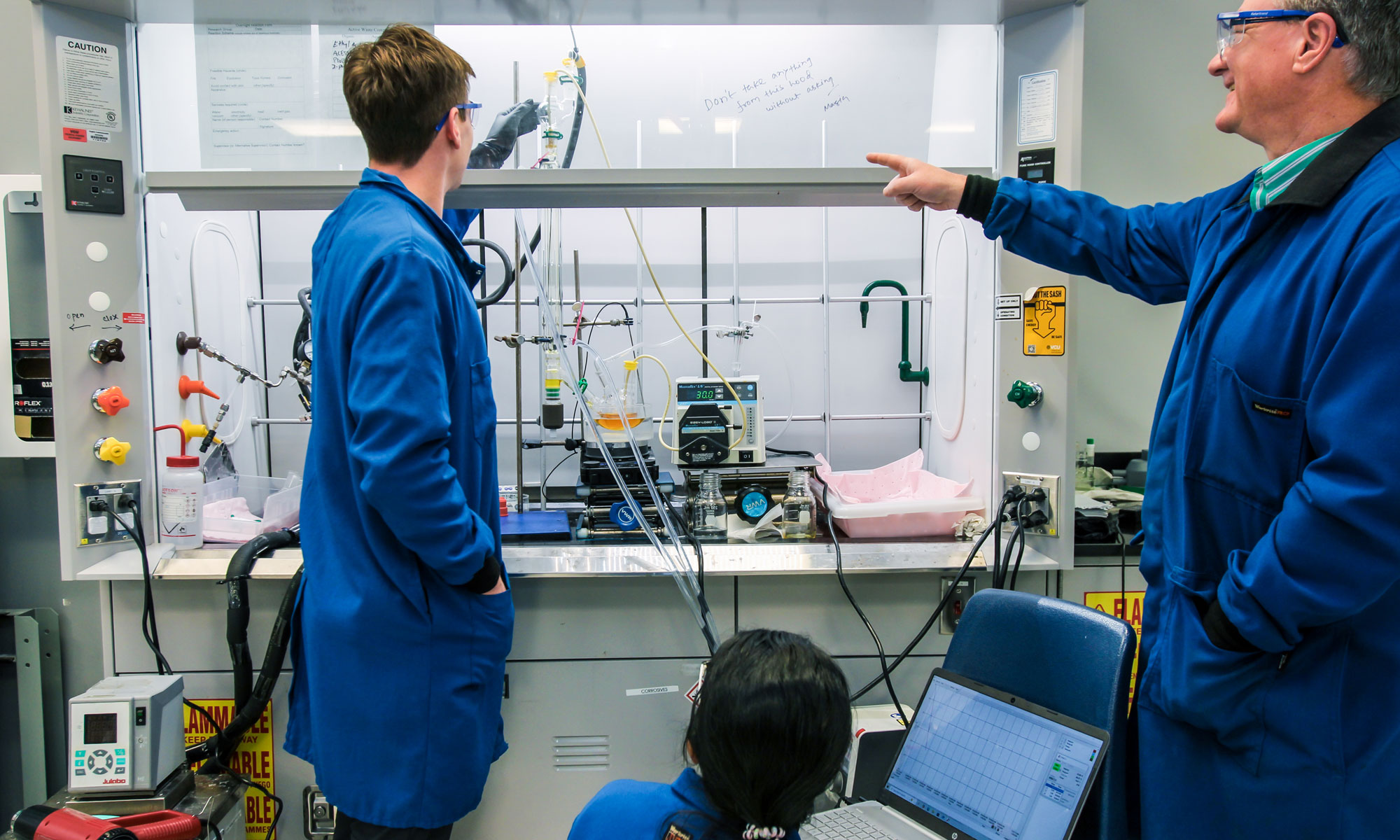
Thomas D. Roper, Ph.D. is utilizing his years of experience in the pharmaceutical industry to help rewrite the narrative surrounding pharmaceutical manufacturing in the U.S.
For decades, the path of a small molecule—from a chemist’s initial discovery to large-scale manufacturing of small molecule pharmaceuticals—was a journey defined by high costs and manual labor. Today, the Virginia Commonwealth University (VCU) College of Engineering’s Thomas D. Roper, Ph.D. is utilizing his years of experience in the industry to help rewrite the narrative.
Roper is both the graduate program director of Chemical & Life Science Engineering and the director of Pharmaceutical Engineering. A 1986 graduate of VCU himself—a bachelor’s degree in chemistry, followed by a Ph.D. in organic chemistry from the University of Virginia and a post-doctoral associate position at Harvard University—Roper spent the first 22 years of his career in the pharmaceutical industry at GSK Pharmaceuticals (formerly GlaxoSmithKline). Having held positions such as the U.S. Head of API Chemistry and Analysis and Global Head of Exploratory Development Sciences, Roper was part of a division responsible for developing all manufacturing routes for small molecules for all compounds produced in the U.S.
When the opportunity arose to return to VCU as a faculty member in the College of Engineering, Roper was eager to help students understand the critical importance of how the pharmaceutical industry works. Little did he know that during his tenure, pharmaceutical leaders AstraZeneca, Eli Lilly and Merck would partner with the VCU College of Engineering and other Virginia universities to form the Virginia Center for Advanced Pharmaceutical Manufacturing, a robust talent engine aimed at expanding Virginia’s life science and biopharma ecosystem through education.
“Coming to VCU was my chance to give back to the university and help students by imparting any experience and knowledge I had regarding how industry actually works,” says Roper. “At the time, I had no inkling that these major manufacturing facilities would be built here. I’m constantly pleasantly surprised and encouraged by what’s happening in the state of Virginia.”
Today, Roper’s work—all centered around the advanced pharmaceutical manufacturing of small molecules—is helping VCU position itself at the center of Virginia’s burgeoning pharmaceutical corridor.
His research first focused on producing pharmaceuticals continuously, then transitioned to more engineering-intensive topics such as reactor modeling, where his team implemented modern techniques such as Process Analytical Technology to monitor the performance of the reactors and reactions. They built on this research by developing automated systems that would produce molecules with a push-button start and push-button stop. Most recently, they moved into machine learning in order to help optimize their work processes.
Beyond his technical research, Roper’s work addresses a national strategic priority: competitiveness and availability in the pharmaceutical industry.
Because labor accounts for the largest portion of domestic drug costs, Roper’s focus on reducing human effort through technology is the key to competing with lower-cost international markets. This vision extends beyond the Ph.D. level; by collaborating with local community colleges and Virginia State University, he is helping build a local workforce pipeline that supports the entire manufacturing hierarchy. This helps to ensure that as giants like AstraZeneca and Eli Lilly move into the region, these organizations are able to find a skilled, home-grown talent pool ready to get to work.
“By using automation and machine learning, we’re hoping to be able to run the processes with the correct quality systems, but have more of them automated,” says Roper. “We’d like to have more of an ‘assembly line mentality’ to putting these molecules together and purifying them.”
Roper partners with a number of VCU faculty members on his research, including Frank Gupton Ph.D., the Floyd D. Gottwald, Jr. Chair in Pharmaceutical Engineering at the Department of Chemical & Life Science Engineering, and Charles McGill, Ph.D., assistant professor in the Department of Chemical & Life Science Engineering, as well as Edwin J. C. G. Van den Oord, Ph.D. and Qingguo Xu, D.Phil. from the VCU School of Pharmacy. He also currently has a team of six graduate students assisting in his projects and is always eager to find ways for more students to get involved.
“Our goal is to involve as many students as possible in pharmaceutical research. There are opportunities for undergraduates and graduate students at both the master’s and Ph.D. levels to engage in this work. One of the most positive things about VCU is that if a student has the desire to pursue undergraduate research, we can usually make that happen for them,” Roper said.
The Department of Chemical and Life Science Engineering provides undergraduate and graduate students with the opportunity to perform real-world research as soon as they enroll. From delving into the intricacies of pharmaceutical manufacturing to exploring the effects of climate change through heat studies, our students pursue a diverse range of cutting-edge research topics. Browse videos and recent news from the Department of Chemical and Life Science Engineering to discover how the College of Engineering at Virginia Commonwealth University prepares the next generation of scientists and engineers for the challenges of the future.
Categories Chemical & Life Science Engineering