
Koerner Family Foundation presents fellowships to three VCU College of Engineering doctoral researchers
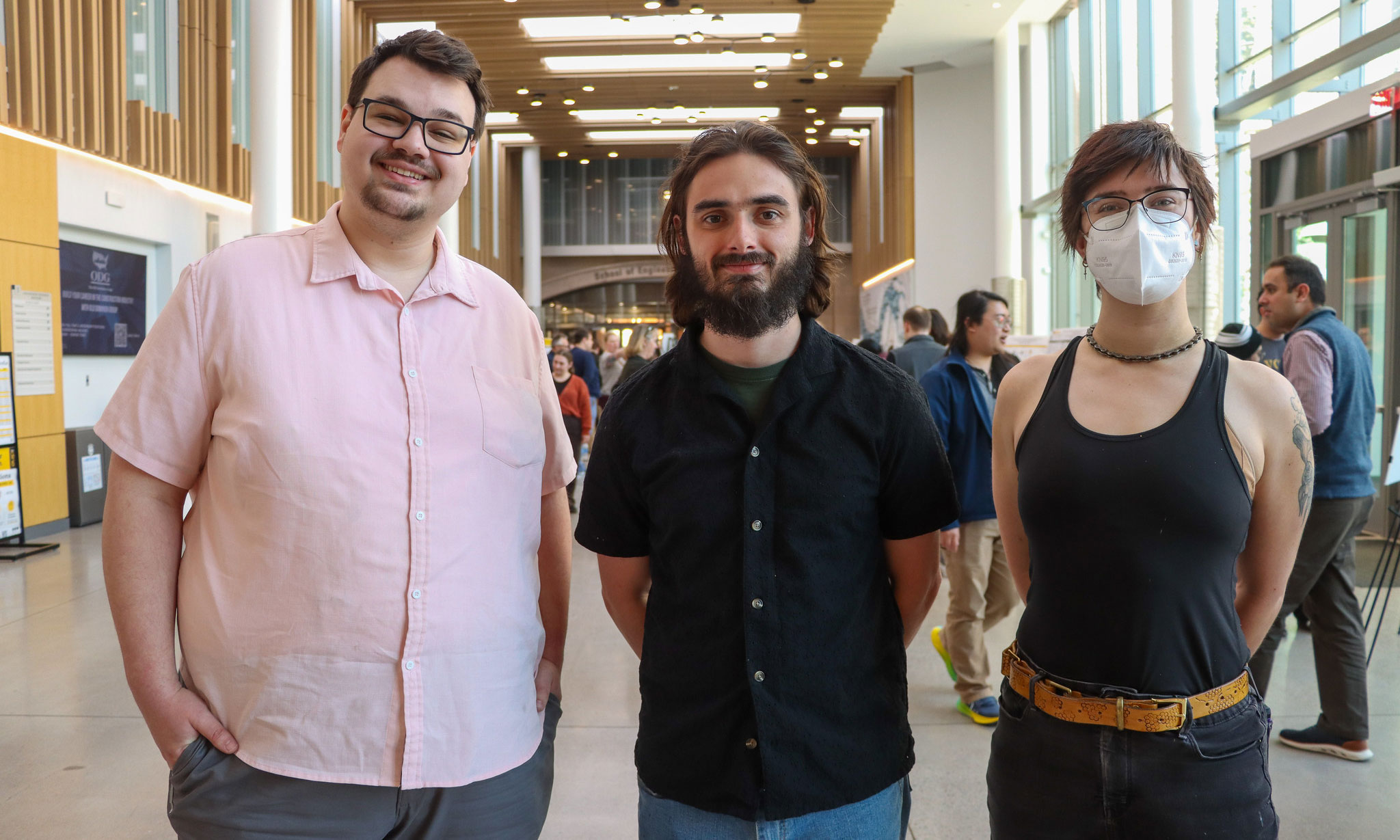
From left: Logan Schorr, David Bordenkircher and Leia Troop
Their research is advancing science and engineering. Now, these three Virginia Commonwealth University (VCU) College of Engineering doctoral researchers have been named Koerner Family Foundation Fellows: David Bordenkircher, Logan Schorr and Leia Troop. The fellowship provides financial support to outstanding doctoral students pursuing research careers in science and engineering. Honorees will be recognized during the VCU College of Engineering Research Showcase on Wednesday, March 25, 2026.
“The Koerner Family Foundation wants to inspire future generations of research oriented engineers. We recognize the role of academic engineering R&D at VCU for contributing innovation and for developing American talent. We hope that our fellowship awards will provide support and motivation to young engineers completing research and publishing their work,” said Michael R. Koerner, president of the Koerner Family Foundation.
Each fellow’s research explores solutions to complex engineering challenges — from regenerative medicine to intelligent sensing and safer manufacturing.
David Bordenkircher, a Ph.D. student in electrical and computer engineering, researches information-theoretic sensor management for improved target tracking. His work explores mathematically optimal ways to control and coordinate sensors so their measurements are as informative as possible.
In systems such as radar-based sensing, networks of sensors must often operate under power and bandwidth constraints. Bordenkircher’s research aims to improve methods used to select and combine sensors so systems can produce more reliable estimates of a target’s position.
Logan Schorr, who completed his Ph.D. in mechanical engineering in fall 2025, studies how collaborative robots can automate critical steps in metal additive manufacturing.
These manufacturing processes use fine metal powders to create complex parts but can pose safety risks during post-processing, when excess powder must be removed from finished components. Schorr’s research develops tools that allow collaborative robots to perform tasks such as powder cleanup and part handling, improving safety while enabling greater automation in additive manufacturing workflows.
Leia Troop, a Ph.D. candidate in biomedical engineering, studies musculoskeletal tissue engineering and mechanobiology. Her research focuses on engineering anterior cruciate ligaments (ACLs) by recreating the physical environment of the human body in the lab.
Using three-dimensional cell cultures and mechanical loading that mimics everyday movement, Troop encourages cells to organize collagen into strong ligament tissue. The goal is to develop implantable ligament replacements that could address limitations associated with current ACL reconstruction methods, which often rely on cadaver tissue or grafts from the patient’s own body.
The VCU College of Engineering offers innovative undergraduate and graduate degree programs tailored to meet the demands of the rapidly evolving engineering field. As part of a premier research university, students are given the opportunity to perform real-world research in our state-of-the-art facilities as soon as they enroll. Browse videos and recent news to discover how the College of Engineering at Virginia Commonwealth University prepares the next generation of scientists and engineers for the challenges of the future.
Categories Biomedical Engineering, Electrical & Computer Engineering, Graduate Student Stories, Mechanical & Nuclear Engineering, Student Stories