Celebrating the People Behind the Science: VCU’s Wright Center Marks Clinical Trials Day
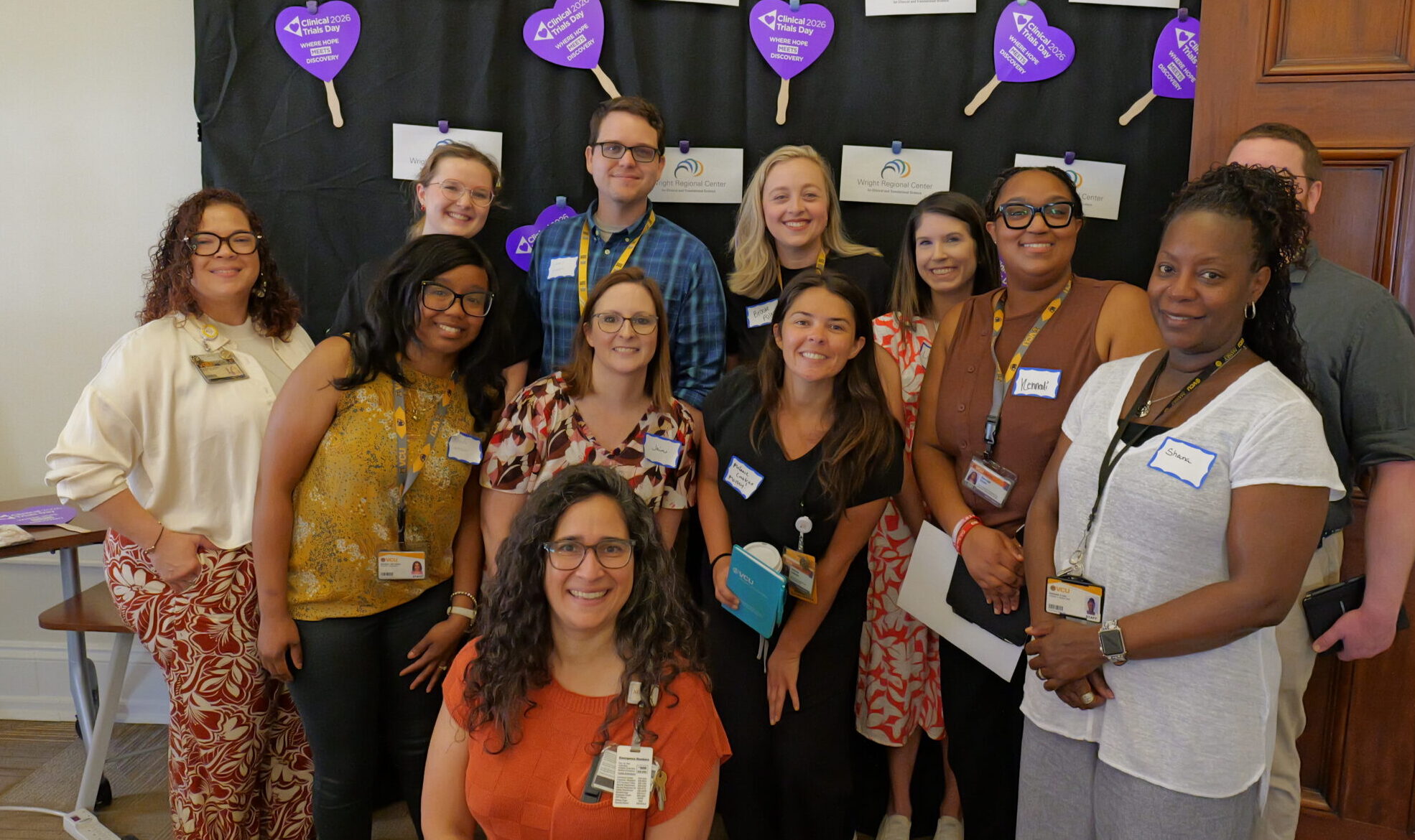
Every year on May 20, the global research community observes International Clinical Trials Day, commemorating the date in 1747 when Scottish physician James Lind conducted what is widely recognized as the first controlled clinical trial — a systematic test of scurvy treatments aboard a British naval vessel. This year, the C. Kenneth and Dianne Wright Center for Clinical and Translational Research marked the occasion by turning the spotlight on an overlooked and under-recognized segment of the clinical research workforce: clinical research professionals (CRPs) who operationalize the research.
On May 20, the Wright Center hosted a breakfast appreciation open house at its home in the Richmond Academy of Medicine Building at 1200 East Clay Street, in the heart of VCU’s MCV campus. More than 70 attendees passed through over the course of the morning, and the conversations that unfolded were anything but routine. Researchers, coordinators, regulatory specialists, data managers, and administrators shared stories about what draws them to this work — and what keeps them going.
So who exactly is a clinical research professional? Organizations like the Society of Clinical Research Associates (SOCRA) define CRPs as those whose practice is guided by one or more aspects of the principles of Good Clinical Practice and are essential to the entire lifecycle of clinical and translational research — from study activation and patient accrual to ongoing study conduct, data collection and completion. They often serve as the human connection between a clinical trial and the participants who enroll in it, conducting study visits, managing regulatory submissions, protecting study participant rights, and ensuring protocol and regulatory compliance.
“Clinical research is more working with patients, working with physicians, trying to coordinate everything,” said Falgun Patel, MBBS, a senior clinical research coordinator with VCU’s School of Medicine Clinical Research Office, who is currently working on a gene therapy study for Duchenne muscular dystrophy in children. Patel described coordinating visits for families who traveled internationally — navigating visas, housing, transportation, and tightly regulated visit schedules — all to give children a chance at this transformative treatment that has the possibility to change their lives. “As clinical research coordinators, we are honored to be a part of their extraordinary story,” he added.
The scale of clinical research at VCU underscores why this workforce matters. The Wright Center’s OnCore infrastructure, which supports clinical trials and research studies across the institution, recorded 1,271 studies in 2025 alone — 809 of which were clinical trials.
The event was organized by Shirley Helm, M.S., CCRP, Senior Administrator for Network Capacity and Workforce Strategies at the Wright Center, who works to bring VCU’s CRP community into sharper focus with increased visibility. Collaborating with VCU Human Resources, Helm and a Wright Center workforce development team member, Catherine Brown, MEd, CCRP, identified clinical research professionals spread across disparate job lines throughout the university, and built the CRP Network — a Community of Practice that now counts 359 subscribers to its listserv. The network provides a shared platform for communication, professional development, onboarding resources, and institutional identity for a workforce that has historically operated without one. Development of the CRP Network has been highlighted at the national level – through poster and presentations at Association of Clinical and Translational Science national conferences. The poster — on display at the celebration — illustrated the five-step process of untangling the “institutional maze” of CRP employment data, and the operational capabilities that resulted.
CRP workforce development is a core part of the Wright Center’s mission. “The goal of the CRP Workforce Development program is to create, maintain, sustain, and retain a research workforce that is not only competent and efficient but also serves as role models in clinical research best practices,” the center’s website states.
At Wednesday’s celebration, that mission was evident in every conversation. Attendees were asked to share their “why” — their personal mission statement for the work they do. The answers were remarkably consistent in spirit, if varied in expression.
“It gives me a chance to connect with those who would like to find hope in research,” said Mehreen Qureshi, MS, CMA, research manager at VCU’s School of Medicine Pediatric Research Office.
Michelle Liendo, MSHI, CCRP, PMP, Director of Clinical Research Operations at VCU Massey Comprehensive Cancer Center, described what sustains her: “You have stories of somebody with a prognosis of a year of life — they get on a trial, and it extends that.”
Rose Williams, CCRP, the Wright Center’s research navigator, stated simply: “The only way that we can produce innovative drugs and interventions is through clinical research.”
Brooke Whitaker, a workforce development manager with Massey’s Clinical Trials Office who has been with Massey for nearly a decade, spoke to the growing visibility of the field. “I am so happy that we are celebrating Clinical Trials Day,” she said, noting that awareness of clinical trials — in communities, in clinics, and among patients — has grown considerably over the course of her career.
When asked to distill that purpose into a single word, attendees offered a constellation of answers: Hope. Discovery. Passion. Innovative. Impactful. Transformative.
“No matter what your role is,” said Antoinette Wade, a workforce development manager with Massey’s Clinical Trials Office, “you’re contributing to research and making a difference.”
Ashley Lukwago, a clinical research coordinator with VCU’s Nephrology Division, echoed that sense of collective purpose. “It’s a really good opportunity to be a part of something bigger than myself,” she said.
Lauren Harris, Ed.D., Senior CTSA Operations Manager at the Wright Center, framed it with characteristic directness. “I like to say that I save the world,” she said, only half joking. Her deeper motivation is personal: her mother had multiple sclerosis, and Harris has spent her career thinking about what access to clinical research might have meant for her mother. Harris’s one word for the field: “transformative.”
For Sarah Farthing, MS, CCRP, research manager at the Healthy Lifestyles Center within the Department of Pediatrics, the reward lies in the chain reaction that good research sets in motion. “Making a difference and seeing the results of that trial — and the next question it’s going to lead to,” she said, describing the collaborative momentum that drives her team forward. It’s a fitting note on which to mark Clinical Trials Day: in clinical research, each answer can also be a new beginning.
Categories Clinical Research, Clinical Trials, Impact, Research, Staff, Translational Workforce Development