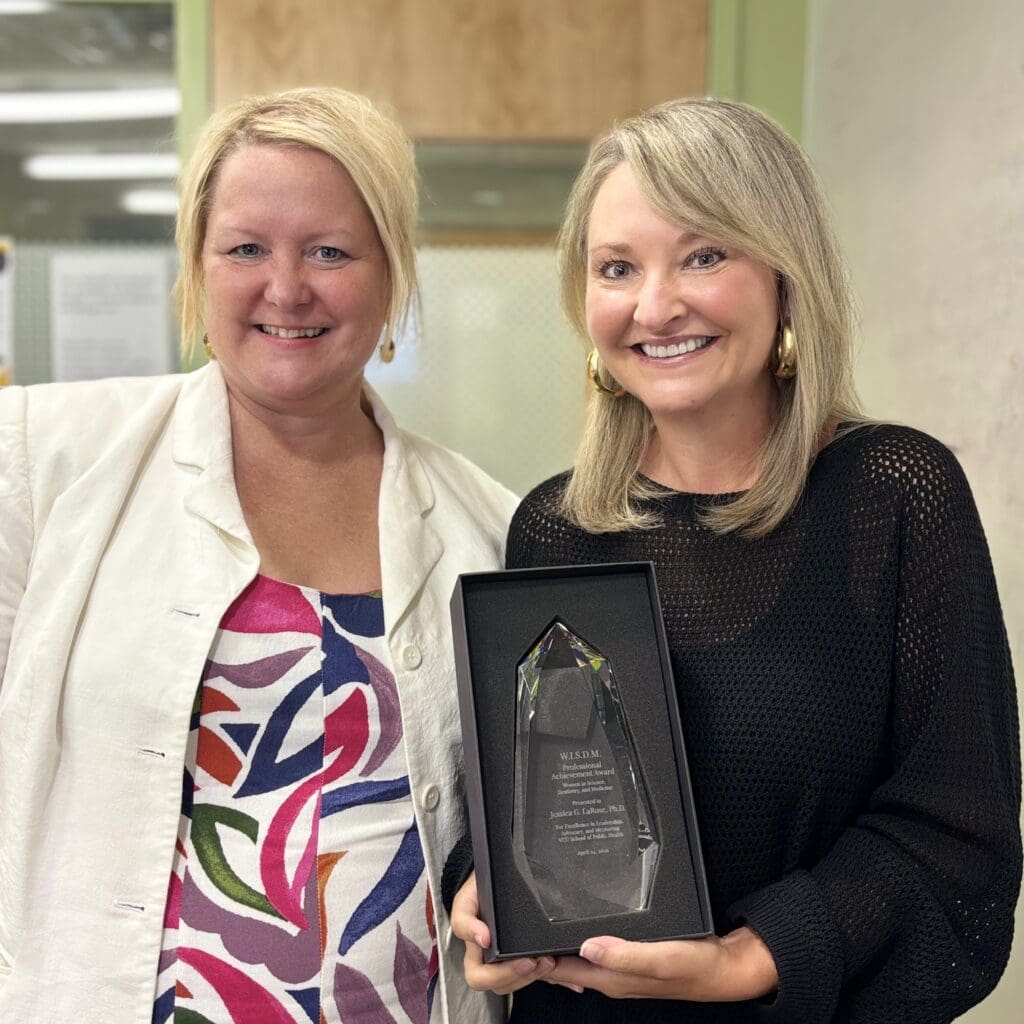
Dr. Jessica LaRose receives WISDM award

Jessica LaRose, Ph.D., professor and chair of the Department of Social and Behavioral Sciences, received the School of Public Health’s 2026 Professional Achievement Award at VCU’s Women in Science, Dentistry, and Medicine Annual Leadership Conference this April. This award honors her achievements in leadership, scholarship, and mentorship in service to her department and the School of Public Health.
Dr. LaRose came to VCU’s School of Medicine as assistant professor in 2012 and has been a full member of Massey’s Cancer Prevention and Control program since 2014. She is a clinical psychologist with a specialization in behavioral and preventive medicine and dual training in pediatric and adult populations. Broadly, her program of research focuses on two areas: 1) understanding the interplay of behavioral, psychological, social, and environmental drivers of chronic disease risk, and 2) applying these findings to the development of novel and sustainable interventions to promote physical and psychological health among underserved populations. Dr. LaRose is an internationally recognized scholar with formal training and expertise in community-engaged research and the design and conduct of behavioral clinical trials. Her methodological expertise spans the translational continuum from early phase efficacy testing to implementation in community contexts; in addition, she is known for her work specific to recruitment and retention of underserved populations in behavioral trials, and the use of digital tools to enhance the reach and sustainability of behavioral interventions. Dr. LaRose’s program of research has been continuously funded since 2007—currently, she is PI or MPI on four NIH-funded studies and serves as MPI of the NCI-funded VA-ACCERT Center.
Dr. LaRose is also deeply committed to mentoring the next generation of scientists and practitioners—over the last decade alone she has mentored over 40 individuals, including graduate students, postdoctoral fellows, and early career faculty—all but one of whom are women and more than half of whom are from underrepresented backgrounds. Her contributions to mentorship have been recognized by several awards, including Outstanding Mentor of the Year in the Massey Cancer Prevention and Control program in 2023 and the Outstanding Mentor Award for the Young Adult SIG of the International Society of Behavioral Nutrition & Physical Activity in 2024. Prior to transitioning to her role as chair, she also developed and taught doctoral level courses in intervention development and implementation, community-engaged intervention design and methods, research methods, and grant writing.
I am incredibly appreciative of the way Dr. LaRose adapted her mentorship approach to meet my evolving professional development needs as I moved from graduate student to early career faculty member. I am even more appreciative of the way Dr. LaRose has not changed her level of respect toward me throughout that transition; I have always felt genuinely valued, included, and encouraged.
– Autumn Lanoye, Ph.D., L.C.P.
Autumn Lanoye, Ph.D., has worked with LaRose since the latter first came to VCU in 2012. Beginning as a graduate research assistant in LaRose’s lab, she is now a department colleague and co-investigator. Lanoye emphasizes the importance of having a mentor who connects on both a professional and human level. “Dr. LaRose has really helped me to reflect on the Venn diagram between my personal values and the values of academia as an institution,” says Lanoye. “It feels really validating to have a mentor who understands that ‘academic’ is only one element of my identity. On top of that, consciously recognizing and appreciating when I am engaging in work that exists in the area of overlap has helped me to feel fulfilled and less likely to burn out.”
Karly Casanave-Phillips, Ph.D., has worked with LaRose since 2023, first as a postdoctoral fellow and currently as senior research scientist for LaRose’s OPT for Health Lab. Her appreciation for her mentor’s support is clear: “Despite being the busiest person I know, [LaRose] always prioritizes her mentees and our growth, never failing to remind us that we are humans first and professionals second. She genuinely wants to support us in pursuing our dreams, no matter what they may look like.”
Dr. LaRose is a standing member of the LCBH study section at NIH, serves on several editorial boards, and is also actively engaged in service at all levels at VCU, including the department, the School of Public Health, and the university. She served as interim department chair from 2022-2025, leading the transition of what was then the Department of Health Behavior and Policy within the School of Medicine to the current Department of Social and Behavioral Sciences within the new School of Public Health. Consistent with her training and expertise, her leadership style as chair is grounded in a servant leadership approach—drawing from strengths-based models and prioritizing active listening, engagement, and cultivating a climate where all department members can thrive.
Categories Faculty News