An Award-Worthy Mentor: how Dra. Dina García’s mentoring philosophy shapes her impact
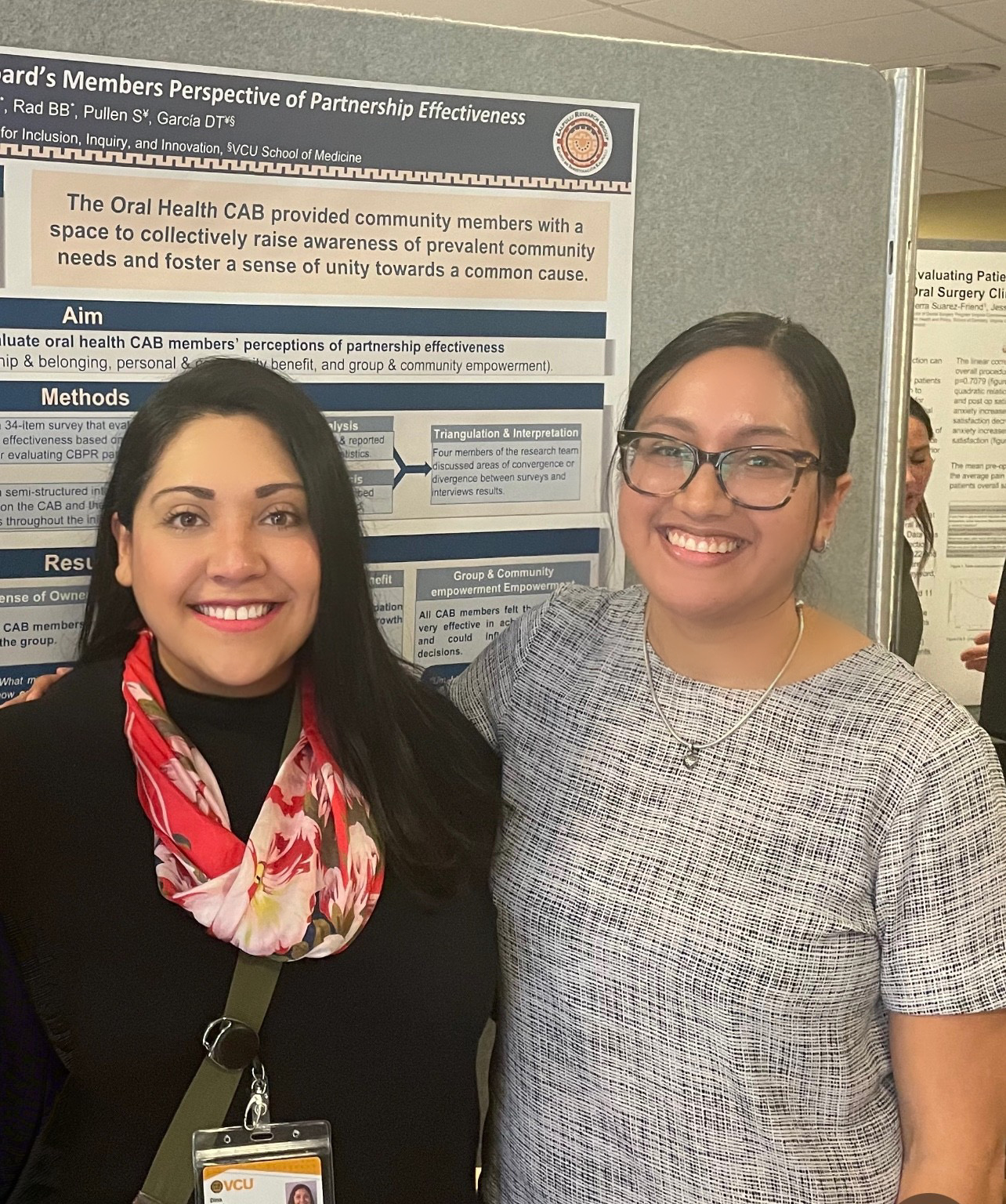
Dra. Dina García has many roles within the department, school, and university. She is a scientist, with a program of research focused on uncovering the underlying causes and mechanisms of oral health inequities. She is an activist, working in partnership with communities to make meaningful change. She is an educator, committed to equity-driven, student-centered pedagogy combining theoretical and experiential learning. She is a leader and innovator, serving as graduate program director for the department and co-developing VCU’s first Latinx/a/o student success course. Stretching over all of her achievements and contributions to public health and academia is García’s deep connection and dedication to mentorship. She has mentored over 50 students at VCU alone, and her thoughtful approach to uplifting and empowering her mentees allows them to grow and thrive both professionally and personally.
Mentoring with reciprocity and respect
One of the most important lessons I’ve learned from Dra. García is to honor myself. She reminds me to work hard and lead with passion, but also to recognize when it is time to rest and reset. She has taught me the importance of boundaries, of speaking up for myself, and of recognizing and respecting my own needs. That balance, between dedication to the work and care for oneself, is a lesson that has truly stayed with me.
-Jocelyn Espinoza
In the past two years, García has been honored twice for her dedication to mentorship: in 2025 she received the Outstanding Faculty Mentor Award from VCU Undergraduate Research and Creative Inquiry, and this year she received the VCU Graduate Faculty Mentoring Award for Early Career faculty. These awards reflect the visible quality and impact of her mentorship, but her dedication comes from a deeper drive. García views mentorship as a process of liberation and restoration, where scholars are allowed to flourish without the constraints or opposition they may face elsewhere in academia. She describes mentorship as a mutual relationship developed on a level playing field, with respect and reciprocity as the foundation.
This strong commitment to the individual is what underlies García’s success as a mentor, and what her mentees take away from their experiences. “She consistently modeled genuine respect for people’s lived experiences and emphasized the value of listening and learning from them,” says Nixon Araúz, Ph.D., M.A., a graduate of the Social and Behavioral Sciences doctoral program. “This lesson resonated deeply with me because it aligned with my own personal values and worldview. Through her mentorship, I strengthened my understanding that honoring people’s knowledge, experiences, and perspectives is essential for conducting ethical research, building meaningful partnerships, and advancing health equity. This principle continues to guide my work as a researcher and public health professional.”
Engaging trainees in research
One of the most important lessons she has taught me is the significance of truly focusing on and serving the community I am researching—and, in the future, the patients I will care for clinically. Her emphasis on meaningful engagement and ethical responsibility in research has deeply shaped my perspective, reinforcing my commitment to community-centered work both now and in my future medical career.
-Aashka Patel
As director of the Kalpulli Research Group, García trains students from VCU and beyond in community-grounded research activities. Trainees have included undergraduate, master’s, and doctoral students with a broad scope of interests from chemistry to exercise science. Aashka Patel, an undergraduate student majoring in biology, began working with García as part of the Kalpulli Research Group in the fall of 2024. Patel emphasizes the impact that García has had not only on her education, but her life: “Over time, our relationship has evolved beyond just professional mentorship. She has become a close personal mentor, supporting me in various aspects of my life, including interpersonal relationships, medical school, and my future aspirations.”
Jocelyn Espinoza is a recent graduate from the School of Public Health’s MPH program who began working with García as an undergraduate. “It was my very first research assistant position and truly my introduction to research overall,” Espinoza says of her time in the research group, “Years later, when I entered VCU’s MPH program, [García] was assigned as my mentor, which felt like a full circle moment.”
Having a supervisor and mentor who could share her personal experiences has made all the difference for Espinoza: “My dynamic with Dra. García is rooted in shared identity and values. As a Latina in higher education and public health, she represents a path that feels both inspiring and affirming for me. Her presence has been a blessing, offering guidance that speaks directly to our lived experiences and positioning in society. As a first‑generation student, having her mentorship has been invaluable.”
Another Kalpulli trainee, Mariah Cropp, joined García’s team as an undergraduate and will continue on to pursue her MPH with the School of Public Health starting this fall. “Dra. García has a unique ability to see potential in me that I often don’t recognize in myself, inspiring me to push beyond my limits,” says Cropp, “she encourages self-reflection, helping me set clear goals and guiding me through the process of achieving them.”
Refreshing the graduate program environment
Dra. García is entering her third year as graduate program director for the department of Social and Behavioral Sciences. In this time, her leadership has been transformational for the SBS program culture and curriculum. Importantly, she reimagined the admissions process to be intentionally holistic in nature and aligned with department values. Other standout efforts include the creation of the Cohort Success Program, where structured support is offered to first-year students during their transition into academia, and the Peer Mentorship Program, where doctoral students support one another throughout their time in the department.
The first group of peer mentors started their work last fall, and included Malik Phillips, M.P.H., Avijit Saha, M.Sc.I.H., Samuel Sijuade, M.P.H., and Afua Twumasi, M.P.H., M.B. Ch.B. “A peer mentorship program’s success depends on whether mentees feel that they can trust their peer mentors enough to be honest about their questions, uncertainties, challenges, and even areas where they may be struggling,” says Sijuade, “…the approach that Dr. García introduced made the peer mentors’ role and that of the peer mentee well-defined. These clearly defined expectations…make both the peer mentor and peer mentee feel safe around each other in the process of requesting and receiving needed guidance.”
Shaping independent researchers
Dra. García inspires me through her passion for research, her commitment to excellence, and her genuine interest in my growth, both professionally and personally. She encourages me to challenge myself, ask questions, and think critically about my work. Her mentorship is characterized by thoughtful feedback and an openness to new ideas, which motivates me to push the boundaries of my own potential. Knowing that I can always turn to her for guidance and that she believes in my abilities has been a constant source of motivation, and it drives me to give my best in everything I do.
-Laura Armijos, D.D.S.
As a mentor of both pre-and post-doctoral scholars, García helps her mentees shape their futures and meet their career goals. Nixon Araúz, Ph.D., M.A., a graduate of the Social and Behavioral Sciences doctoral program, was a mentee of García’s and still maintains their connection as a postdoctoral fellow in the School of Medicine. Araúz recalls that García set an example for how a mentor should lead a team, as he hopes to in the future. “I learned a tremendous amount from Dra. García about how to build and lead a successful research team,” he says, “she encouraged students in her team to think critically, ask thoughtful questions, and reflect on our experiences to maximize learning and professional growth.”
Laura Armijos, D.D.S, a fellow in the School of Dentistry, has worked with García since 2022. Armijos describes the evolution of their relationship from a focus on research fundamentals to a more nuanced form of mentorship: “As I grew more confident, our conversations expanded beyond the classroom, delving into academic research, professional guidance, and personal development. What started as a student-teacher relationship has transformed into a more collaborative one, where I feel comfortable seeking her advice on both academic and career matters.”
For more on García’s philosophy and experience mentoring scholars in public health, tune into her podcast with the VCU Graduate School! The episode is available here: https://gradpodvcu.substack.com/p/the-power-of-mentorship-in-conversation
Categories Faculty News