
Q&A with the Dean: Engineering Education in the Age of Physical AI
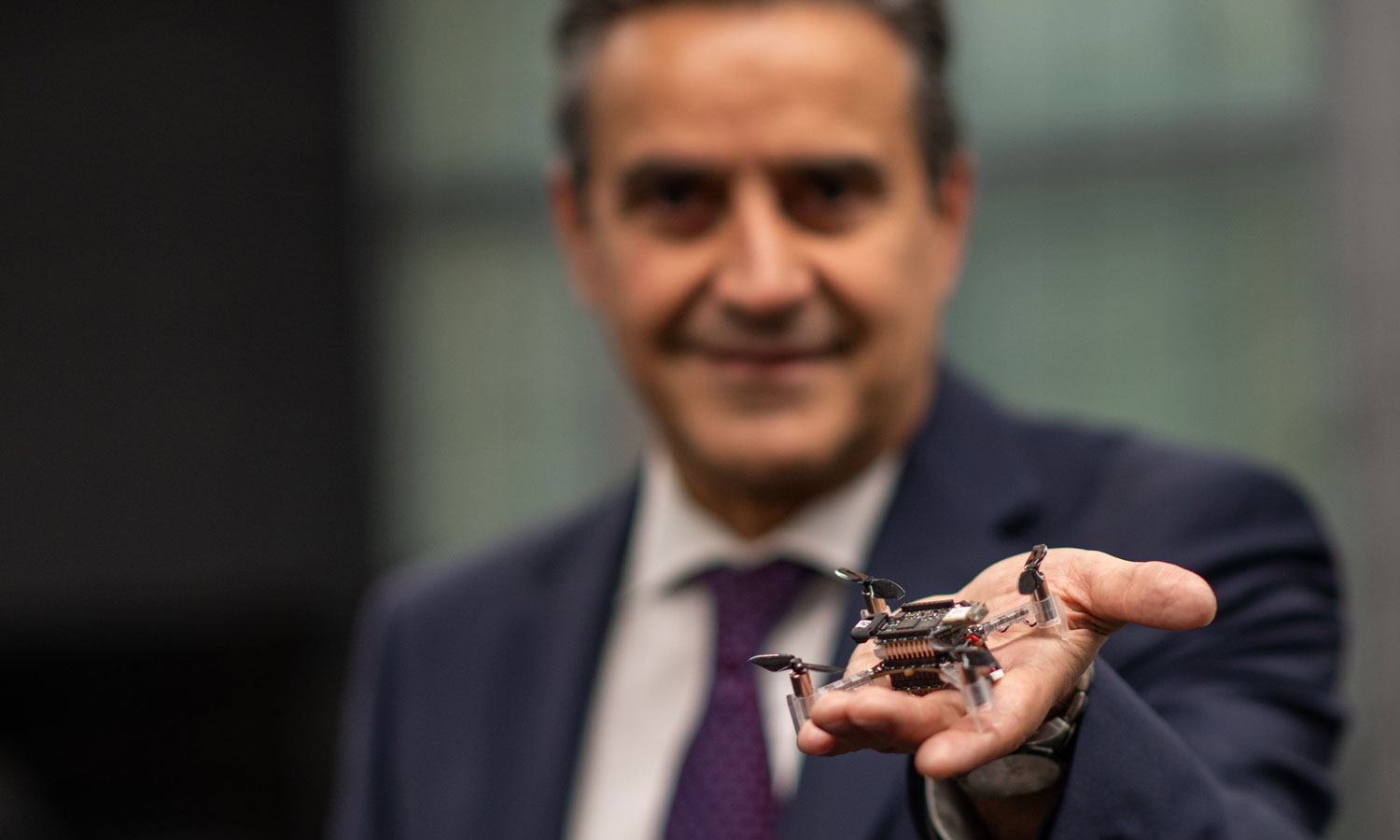
Modern engineering requires interdisciplinary expertise, and robotics is one of those important, shared disciplines. Learn more about VCU’s new Bachelor of Science in Robotics and Autonomous Systems (RAS) Engineering, a first-of-its-kind program in Virginia, in this interview with Azim Eskandarian, D.Sc., the Alice T. and William H. Goodwin Jr. Dean of the Virginia Commonwealth University (VCU) College of Engineering.
Eskandarian is an internationally renowned expert in intelligent vehicles, robotics and autonomous systems, a distinguished researcher and scholar, and a fellow of ASME (American Society of Mechanical Engineers), IEEE (Institute for Electrical and Electronics Engineers) and SAE International (previously Society of Automotive Engineers). He was inducted into the Virginia Academy of Science, Engineering, and Medicine (VASEM) this year. With the help of VCU faculty and staff, he has introduced several new, innovative programs at the university, expanded research and interdisciplinary collaborations, partnered with industry, and advanced student success.
Give us some background on the purpose of the engineering programs at VCU?
Let’s go back to why VCU started a new engineering school 30 years ago — what is now the College of Engineering.
The college began as a partnership between industry and the Commonwealth to build a new engineering school that could meet the tech talent needs of the state’s capital and nearby regions. Other schools in Virginia were outstanding, but none served this population directly. Proximity to industry and home matters, both to students and to the commercial and manufacturing companies that hire them. So the college gave central Virginia a new way to build engineering skills, while bringing in new ideas and avoiding duplication of what other schools already did well. The goal was always a highly competitive, innovative program the region actually needs, without repeating others.
Some engineering fundamentals are required in any program, even if they overlap with other schools. For example:
- Our Department of Mechanical and Nuclear Engineering offers a mechanical engineering degree, but every student must have some nuclear engineering knowledge because the local power industry needs it.
- Biomedical engineering has strong ties to VCU’s medical school, with joint research programs.
- Chemical engineering focuses heavily on pharmaceuticals, with a joint doctorate in pharmaceutical engineering with the School of Pharmacy that’s unmatched nationwide.
Historically, we’ve built programs with a niche specialty within traditional engineering fields, and our newer programs tend to maintain that same uniqueness.
What are robots and autonomous systems, and why did the college decide to create this new degree program?
Let’s start with a simple definition. A robot is any automatically operated machine that replaces human effort. An autonomous system is one that can perform complex tasks independently. Put those together, and you can see that while not every robot is autonomous, autonomous systems represent a form of robot with increasing levels of independence.
Historically, robots operated under detailed, pre-programmed instructions with no ability to adapt — think of the first-generation robots that took over repetitive tasks such as welding, painting, assembly and packaging in automotive manufacturing. These systems reduced costs and increased efficiency, but could not respond to changing conditions or perform beyond narrowly defined functions.
Advances in sensing, artificial intelligence, machine learning and computing in the late 20th and early 21st centuries enabled robots to operate with greater independence, adapt to changing environments and collaborate with humans. Milestones such as the Defense Advanced Research Projects Agency (DARPA) Grand Challenge accelerated research into self-driving vehicles and mobile robotics. Today, robotics and autonomous systems engineering integrates engineering, computing and data analytics to support applications across multiple sectors.
That’s the “what.” As for the “why now” — industry wants interdisciplinary engineering expertise, and robotics is one of the clearest examples of that need. Think about something as ordinary as a car engine — it only comes together because of mechanical, chemical, materials, electronics and computer engineering all working in concert. Or a smartphone, where hardware and software from a dozen different specialties have to function as one device. Robotics depends on that same kind of cross-disciplinary teamwork, arguably more than most fields — and it’s not just engineering disciplines either; today’s engineers also need real grounding in things like ethics, law and economics to do the job well. The field is growing exponentially. Industrial robots have long had a home in manufacturing, and autonomous drones in defense, but autonomous vehicles and humanoid and service robots are emerging fast — some still in development, some already here. Self-driving taxis like Waymo are already operating in cities like San Francisco.
The numbers back this up — according to research from MarketsandMarkets the worldwide market for advanced robotics and autonomous systems could grow past $10 trillion by 2035.1 Virginia already has a strong presence in unmanned systems — uncrewed aircraft and advanced air mobility — and as those applications grow, so does the demand for engineers who can build them.
In manufacturing, we’re heading toward what’s being called Industry 5.0, where humans and robots work side by side, with robots that have advanced sensing and AI control to operate safely around people. The push to bring manufacturing back to the U.S. only increases the need for engineers who can build those systems, and Virginia is already a growing hub for advanced manufacturing.
In healthcare, robotic systems are already used in neurosurgery, orthopedics, laparoscopy and vascular procedures, and researchers are working on miniature robots that could one day be implanted to heal injuries or fight disease. In rehabilitation, AI-powered smart prosthetics and exoskeletons are helping patients regain function — and Virginia is home to three nationally ranked medical schools, including VCU’s, which conducts advanced healthcare research.
I’ll also say this: Robotics and autonomous systems engineering is essentially the physical form of AI. There is significant emphasis and investment in AI globally right now, and the nations that lead in AI will succeed not only economically, but will have an unprecedented advantage and power over competitors. Robotics is where that intelligence meets the physical world.
All of that points to one conclusion: There’s a growing need for engineers with real expertise in advanced robotics. So we built a new project-based Bachelor of Science in Robotics and Autonomous Systems Engineering to meet it.
What will this program accomplish for students? What will they learn as they finish this degree?
Robotics and autonomous systems are reshaping industries at an unprecedented pace, and understanding them is becoming essential for students in almost any field — they’ll interact with or be impacted by this technology throughout their careers.
Our curriculum integrates across four areas: mechanical systems, electrical and electronic systems, and programming and computer science, plus biomedical engineering for domains like rehabilitation or surgical robotics. That comprehensive combination — all four areas in one degree — isn’t something a traditional single-discipline program can offer.
The goal is to prepare students to design, implement and test modern robotic and autonomous systems. They’ll build a foundation in electrical engineering, mechanical engineering, computer science, AI and biomedical engineering, where relevant, and learn to apply systems thinking to bring that knowledge together. They will also explore the ethical considerations around autonomy, preparing them to design and deploy these systems responsibly.
Graduates of this program will be prepared to design robotic systems, including humanoid and collaborative robots, prosthetic and assistive devices, and autonomous systems like self-driving vehicles, unmanned aerial platforms and autonomous spacecraft. They will be ready to join the robotics (or a related) industry directly or continue into graduate study. This expertise carries over into complex engineering systems more broadly, such as aerospace and systems engineering, which means strong employment prospects well beyond robotics.

You mentioned the program’s interdisciplinary and practical nature. Why do you emphasize a “project-based program?”
Going back to that definition — robots are meant to perform tasks more efficiently, precisely and reliably than we can by hand. Autonomous systems do that with minimal human intervention while still responding safely to their environment. This field is inherently practical, so it makes sense to go beyond theory and get students actually building machines.
Project-based learning is already part of every major engineering curriculum here at VCU— all of our students complete capstone design projects, and many also participate in faculty research labs and vertically integrated projects throughout their studies. In these courses, they work in teams to conceptualize, design, build, test and validate real engineering products defined by industry or our faculty. We would like to incorporate more project-based learning into our other courses over time.
Robotics and autonomous systems lend themselves especially well to this learning paradigm, so we designed the program such that the later courses — not the foundational prerequisites — are project-based. Students learn better this way, understand the systems more deeply, and are better prepared for real engineering jobs, which minimizes the on-the-job training that industry has been asking us to build into the curriculum.
Experiential learning has a real emphasis at VCU Engineering, and it’s part of why our placement rate runs 90% to 93%, on par with the best engineering schools in the country. Our graduates are in demand and earn above the national average. I expect robotics and autonomous systems engineering to be another success story in that tradition.
Which engineering department will be teaching this curriculum?
This program is truly interdisciplinary — it doesn’t belong to any single department. The State Council of Higher Education for Virginia approved it as a new degree program, the only one of its kind in the state.
Our faculty from four departments — Electrical and Computer Engineering, Mechanical and Nuclear Engineering, Computer Science, and Biomedical Engineering — will teach the robotics and autonomous systems courses and their prerequisites. Building this program took real time and effort from a dedicated group of faculty, and I’m grateful to every one of them — they are listed on our website. We have also hired several additional faculty recently, significantly expanding what we can offer
As the program grows and eventually offers master’s and doctoral degrees, we may create a dedicated department or administrative unit for it. But its transdisciplinary nature will stay intact — faculty from multiple departments will keep sharing the instructional and research responsibilities.
What resources or equipment do you have or need for this program? How are you getting them?
Without the right resources, we couldn’t offer this program. We’re fortunate to already have solid infrastructure and space within our current engineering buildings. We have acquired instructional tools for an introductory robotics course using articulated, desktop-programmable robots, and two more instructional labs — mobile robotics and drones, and robot programming — are under development with internal funding.
We already have labs that give students a running start. Our Autonomous Robots and Vehicle Lab houses an autonomous car, mobile robots, micro-drones, a humanoid robot and a driving simulator. Our rehabilitation robotics lab is expanding with new funding, and our Smart City lab gives students a testbed for real urban applications — along with mechatronics, automation, electromagnetics, neuro-engineering and manufacturing labs rounding out the picture. These established resources give undergraduates real research opportunities.
So we started from a solid foundation, added internal funding for new robotics lab courses and received state funding through Higher Education Equipment Trust Fund to build out our instructional labs. We’ve also secured sponsored research funds for new equipment that will be in place this academic year. In addition to our existing labs, we’re developing a new shared space for collaborative robotics research and education, featuring humanoid, quadruped, mobile and micro-drone robots.
This program is starting strong, with instructional and research capabilities that rival the best in the country.
What are the job and employment prospects for students in this field?
Our goal is always our students’ success in landing real, productive careers. Robotics and autonomous systems engineering is a field in demand now and for the foreseeable future, and the project-based nature of the curriculum prepares students well for it. They can also go on to graduate school here or elsewhere for more research-focused roles.
This field is growing rapidly, and I expect that to continue as AI expands and robotics grows alongside it — especially autonomous and service robots. I expect robotics and automation jobs to grow faster than many other engineering fields over the next five years . This is what people are calling an “automation gap” — a shortage of skilled workers who understand both the hardware and the complex software behind robots. Hiring managers are looking for robotics software engineers, perception engineers, automation data engineers — roles that don’t map cleanly onto traditional computer science, electrical and computer engineering, or mechanical engineering positions, and require exactly the skill set our students will have.
I’d also point to the International Federation of Robotics — they publish an annual list of top robotics trends, and 2026’s list backs this up: robots working more independently thanks to AI, more versatile robots as information technology and operational technology converge, humanoids proving out their reliability, safety and security becoming essential as robots work alongside people, and robots helping close labor gaps.2 All of it points to real growth and real opportunity for our graduates.
What else would you like to share about this program?
We’re excited about this program and its unique approach to a growing, in-demand field. We’re equally enthusiastic about expanding our expertise and labs through internal and external funding, while our faculty keep doing the research that shapes where robotics and autonomous systems go next. Students at every level benefit: Undergraduates can get into research labs, the program strengthens our vertically integrated projects and more students will have access to internships and co-ops as their skills develop.
It also connects us to something bigger at the university — AI is one of six focus areas in VCU’s Office of University Convergence Initiatives. Robotics, as a physical form of AI, creates an opportunity for non-engineering students to engage with the field. I expect it will expand our collaborations across the university. We already work across schools, but this opens up more interactions: social aspects of robotics with the School of Social Work, policy with the Wilder School of Government, rehabilitation robotics with Medicine, Public Health and Nursing, and creative work with our School of the Arts.
All in all, I see a very bright and successful future for this program and its graduates. I am proud that we’re building a new generation of successful alumni and fulfilling a real, timely industry need.
Categories General College