
Eleven new faculty join VCU College of Engineering for the 2026 fall semester
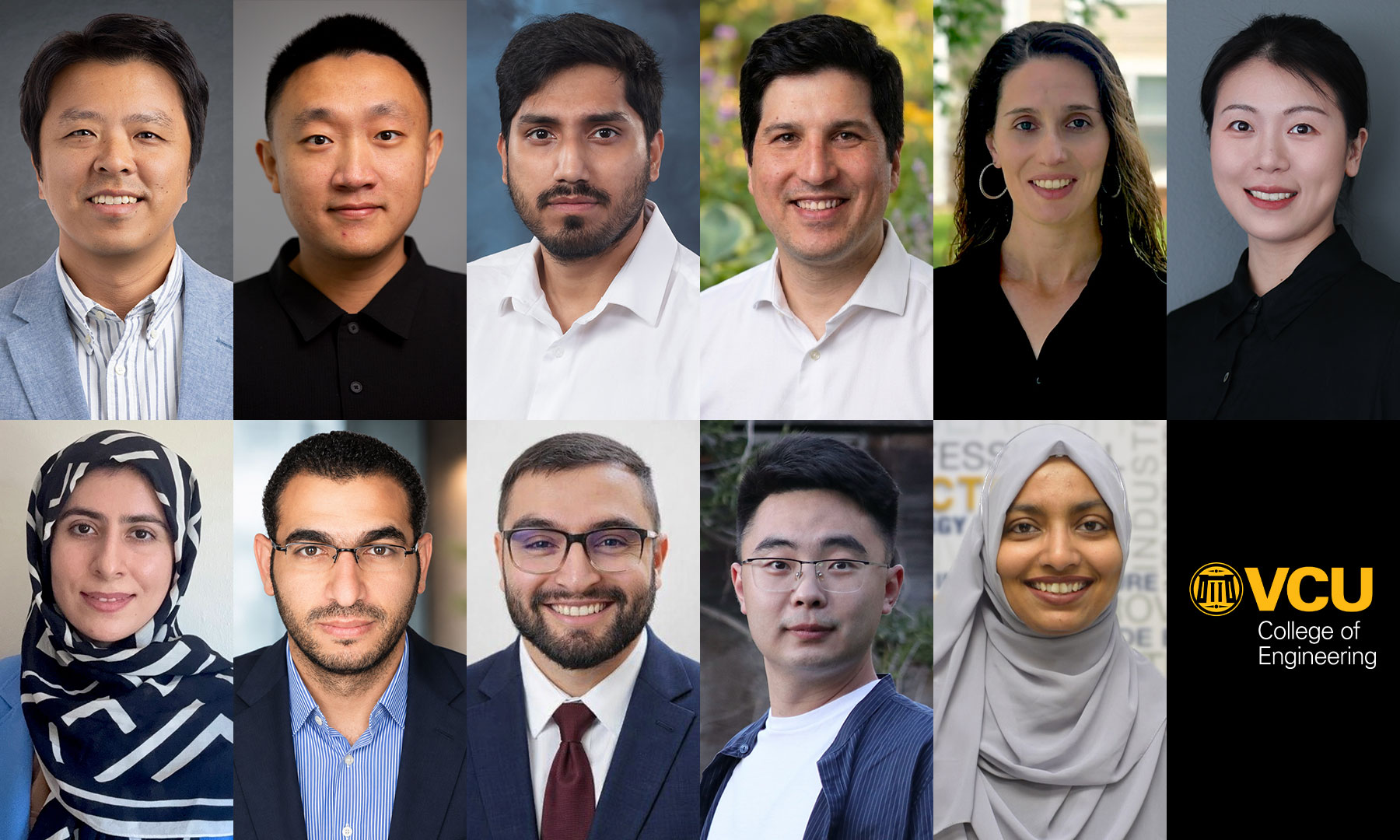
Top to bottom, left to right: Juhwan Lee, Ph.D., Zixuan “Steve” Feng, Ph.D., Syed Irfan Ali Meerza, Ph.D., Javier Tibau, Ph.D., Maryna Veksler, Ph.D., Xiwei Xuan, Ph.D., Zahra Marvi, Ph.D., Hossam Abdellatif, Ph.D., Gustavo Cardona, Ph.D., Ziquan Deng, Ph.D., and Ambreen Nisar, Ph.D.
With expertise ranging from artificial intelligence to automation to nuclear energy systems, ten new faculty members will start at the Virginia Commonwealth University (VCU) College of Engineering this fall. The individuals will support existing programs and lend their expertise to VCU Engineering’s new Bachelor of Science Robotics and Autonomous Systems Engineering, which also debuts this fall.
Congratulations to all our new faculty, and welcome to the VCU College of Engineering!
Department of Biomedical Engineering
Juhwan Lee, Ph.D.
Lee earned his Ph.D. from Dongguk University and joins VCU from Case Western Reserve University. Lee’s research focuses on developing AI methods for intravascular imaging, coronary computed tomography angiography, coronary artery calcium scoring and chest X-ray analysis to predict short- and long-term cardiovascular outcomes. As a translational scientist, Lee has more than a decade of experience conducting interdisciplinary research that helps cardiologists and radiologists make more informed treatment decisions. He has significant experience in medical image processing, machine/deep learning and their clinical applications. Lee currently serves as principal investigator on multiple NIH-funded projects, with a long-term goal of developing interpretable AI models that improve personalized cardiovascular care and patient outcomes.
Department of Computer Science
Zixuan “Steve” Feng, Ph.D.
Feng earned his Ph.D. in software engineering from Oregon State University. His research focuses on empirical software engineering, software quality, open-source ecosystems, developer productivity and collaboration, and the evolving role of AI in software development.
Syed Irfan Ali Meerza, Ph.D.
Meerza received his Ph.D. in computer engineering from the University of Tennessee, Knoxville. His research interests include trustworthy AI, generative AI security, multimodal learning and data privacy.
Javier Tibau, Ph.D.
Tibau received his Ph.D. from Virginia Tech. His work focuses on human-computer interaction and human-centered design, using qualitative methods and research-through-design to study interactive systems in the settings where people actually use them. Tibau has also contributed to the Association for Computing Machinery’s Special Interest Group on Computer Science Education, with publications highlighting instructional materials he helped design.
Maryna Veksler, Ph.D.
Joining us after completing her Ph.D. at Florida International University and a postdoctoral appointment at VCU, Veksler’s research focuses on trustworthy and secure AI, adversarial AI, cybersecurity, digital forensics, and autonomous systems, helping advance the security and reliability of AI in critical applications.
Xiwei Xuan, Ph.D.
Xuan joins VCU from the University of California, Davis, where she earned her Ph.D. in computer science. Her research spans artificial intelligence, computer vision, multimodal learning and reliable intelligent systems.
Department of Electrical and Computer Engineering
Zahra Marvi, Ph.D.
Marvi joins VCU from the University of Minnesota, where she was a postdoctoral associate in mechanical engineering. She received her Ph.D. in electrical engineering from Michigan State University. Marvi’s research includes development of safe and scalable control and learning frameworks, with applications in energy systems and robotics.
Department of Mechanical and Nuclear Engineering
Hossam Abdellatif, Ph.D.
Completing his postdoctoral research in nuclear engineering at Kansas State University, Abdellatif earned his Ph.D. in nuclear engineering from the University of Idaho. His research focuses on advanced nuclear energy systems, including molten salt reactors, small modular reactors and Generation-IV reactor concepts. Abdellatif’s expertise includes reactor thermal-hydraulics, nuclear safety analysis, multiphysics modeling and simulation of innovative nuclear fuel designs, and machine-learning applications for accident prediction.
Gustavo Cardona, Ph.D.
Cardona received his Ph.D. in mechanical engineering from Lehigh University. His dissertation developed formal methods for scalable, robust multi-robot planning using temporal logic and optimization under uncertainty. He joins VCU from the University of Delaware where he was a postdoctoral researcher working on human-humanoid interaction.
Ziquan Deng, Ph.D.
Deng earned his Ph.D. in mechanical and aerospace engineering from the University of California, Davis. His research focuses on explainable artificial intelligence, human–autonomy teaming and computer vision for safety-critical systems. With interdisciplinary research applications in robotics, deep-space exploration, manufacturing, neuroscience and healthcare, Deng develops AI frameworks that combine causal reasoning, human–AI collaboration and structure-aware modeling to enable trustworthy decision-making
Ambreen Nisar, Ph.D.
Nisar earned her Ph.D. in materials science and engineering from the Indian Institute of Technology. Her research focuses on additive manufacturing of advanced ceramics for extreme-environment applications in aerospace and nuclear systems. It integrates 3D printing of ceramics, spark plasma sintering, interfacial joining, and AI-enabled process optimization.
The VCU College of Engineering offers innovative undergraduate and graduate degree programs tailored to meet the demands of the rapidly evolving engineering field. As part of a premier research university, students are given the opportunity to perform real-world research in our state-of-the-art facilities as soon as they enroll. Browse videos and recent news to discover how the College of Engineering at Virginia Commonwealth University prepares the next generation of scientists and engineers for the challenges of the future.
Categories Computer Science, Electrical & Computer Engineering, Mechanical & Nuclear Engineering