
Helping every body stay in motion
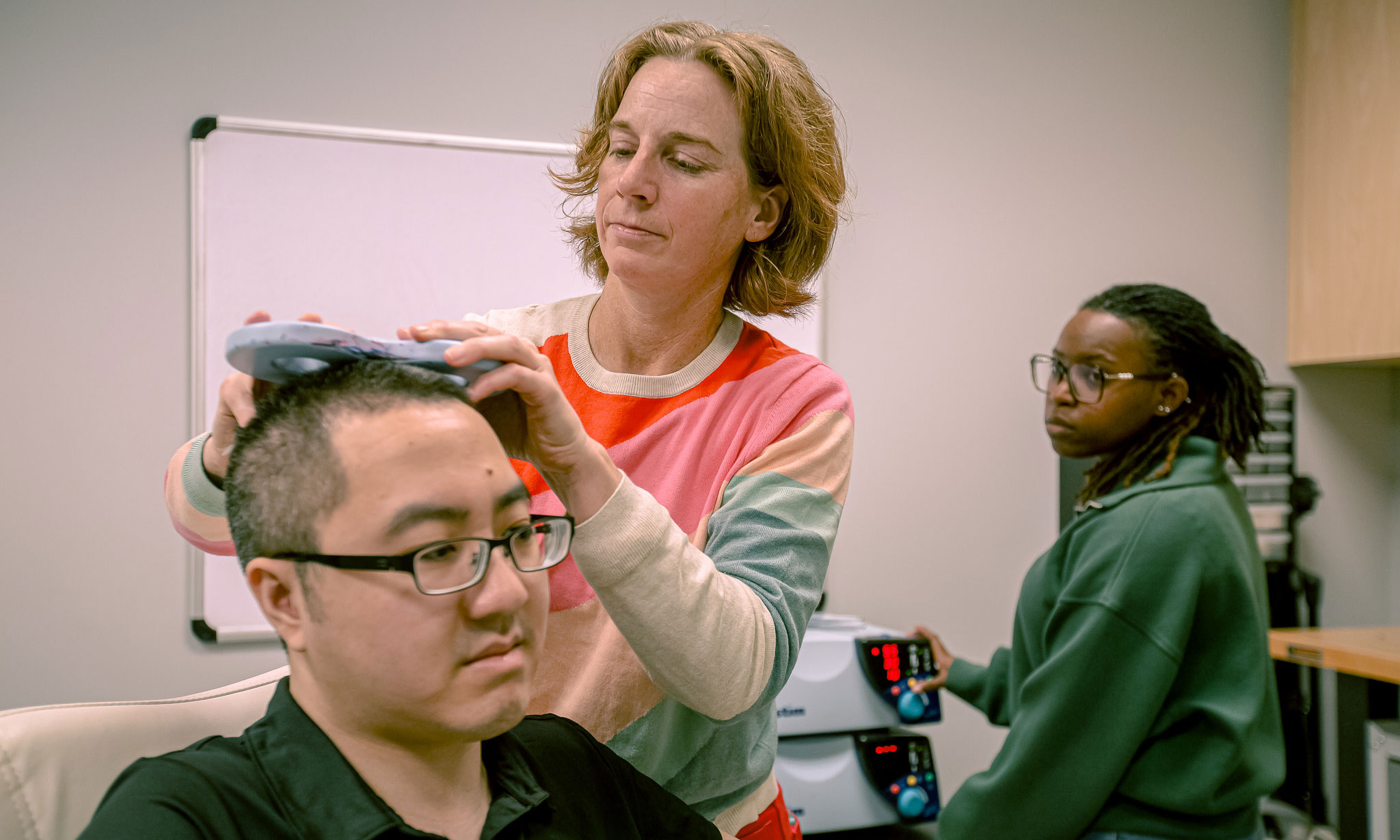
Associate Professor Carrie L. Peterson, Ph.D. is conducting two rehabilitation engineering research studies, both aimed at limiting physical pain and improving mobility across an entire life span.
Associate Professor Carrie L. Peterson, Ph.D. describes herself as a mover and a shaker—which could easily be interpreted both literally and figuratively.
In her capacity in the Department of Biomedical Engineering, Peterson researches the mechanics of human movement—specifically, rehabilitation engineering. By applying engineering principles to the recovery process, she helps individuals regain function after injury or neurological disorders. While her original interest in neuromuscular biomechanics was related to high-performance athletes, she emphasizes that the same tools are vital for anyone seeking to restore their mobility and independence.
“Generally, I am driven by the idea of helping everyday people,” says Peterson. “In fact, everything I do in my research is directly related to that goal.”
Outside of her work and research, Peterson is no stranger to movement; she stays active by competing in triathlons, playing volleyball, mountain biking and dancing.
“I’ve been very good at keeping active as a hobby,” Peterson says.
Right now, in her lab at VCU, Peterson is “always moving” between two extensive research projects, both of which apply rehabilitation engineering to help individuals of all walks of life.
Wheelchair Propulsion Dynamics
Peterson’s first research project is focused on shoulder pain experienced by individuals who utilize wheelchairs. The project is led by doctoral student Hanhsen Zhao.
To improve long-term quality of life, Peterson and her collaborators at the University of Wisconsin-Milwaukee and Northwestern University are studying wheelchair propulsion dynamics, looking for the ‘why’ behind the pain in order to identify actionable solutions for patients of all ages. Supported by a five-year NIH grant, the team hit a milestone in 2025: collecting data from 84 individuals with spinal cord injuries (SCI).
“Our role here at VCU is to estimate forces in the body during wheelchair propulsion,” explains Peterson. “The other sites do the data collection including motion capture, handrim kinetics, muscle electrical activity and ultrasound. We then implement these data in musculoskeletal models to estimate muscle and joint forces because those cannot be directly measured.”
The study is unique in its scope, as it examines three distinct groups:
- Children with SCI
- Adults who sustained their injury as children
- Adults who sustained their injury later in life
“This work is incremental,” describes Peterson. “We’ve collected all the data, but even once we have an understanding of the forces at play here, it still isn’t the full picture. Using the data to inform the next steps towards real solutions—that’s where we stand now.”
Transcranial Magnetic Stimulation
Beyond biomechanics, Peterson is exploring the frontier of neuroplasticity through Transcranial Magnetic Stimulation (TMS), an FDA-approved, non-invasive method to stimulate neurons in the brain. In a rehab setting, medical professionals can use TMS to target the motor cortex of the brain to increase or inhibit pathways to muscles.
The challenge? People respond quite differently to this method of therapy. That’s where Peterson’s work comes into play.
A doctoral student in Peterson’s lab, Mahdi Paslar, recruited 30 individuals for a recent study and measured their “recruitment curve,” or response to brain stimulation across different intensities. Mahdi also measured the functional connectivity and neuroanatomy of their brain via MRI, and resting state brain measurements via EEG.
“We now have a lot of data about people’s brains, and we’re currently trying to see if that’s enough to predict how any one person is going to respond to brain stimulation,” says Peterson.
To do so, Peterson is collaborating with Ravi Hadimani, Ph.D. and Jayasimha Atulasimha, Ph.D. in the Department of Mechanical & Nuclear Engineering at VCU to employ machine learning (ML). By training ML models on these complex datasets, they aim to accurately predict how an individual patient will respond to TMS before the first pulse is ever delivered. Eventually, ML can be used to indicate the correct dosing (i.e., stimulus intensity and frequency of TMS pulses) for an individual patient.
All testing for the 30 individuals were able to be completed in Peterson’s lab at VCU, with the exception of the MRI, which was conducted at the Collaborative Advanced Research Imaging center.
Inspiring the Next Generation
For Peterson and her colleagues, the work on wheelchair propulsion dynamics and TMS requires a blend of high-level strategy and real world logistics—both of which she enjoys sharing with her students.
“I’m so lucky because I get to teach classes that are directly related to my work,” says Peterson. “When you’re living in this world of cutting edge research, you get to share what you find with your students. It’s fun to blow their minds sometimes.”
Peterson also recognizes that beyond the cutting edge findings and life-altering impact these research projects yield, she wants to give her students insight into the logistics involved—something that isn’t always as glamorous.
“You can have a great idea, but you also need to ensure people support it and know how to effectively sell that vision,” says Peterson.
In the case of these two research projects, Peterson’s vision is the long-term, positive impact on quality of life.
“Even small advances build up as people across the nation contribute their individual pieces of the puzzle. It is clear how much medicine has progressed, and being part of those advances—and helping the next generation realize their potential—is truly inspirational.”
The Department of Biomedical Engineering provides undergraduate and graduate students with the opportunity to perform real-world research as soon as they enroll. From delving into the intricacies of cell migration in cancer research to exploring tissue engineering in menisci, tendons and ligaments, our students pursue a diverse range of cutting-edge research topics. Browse videos and recent news from the Department of Biomedical Engineering to discover how the College of Engineering at Virginia Commonwealth University prepares the next generation of scientists and engineers for the challenges of the future.
Categories Biomedical Engineering