
Boron nitride coating developed by VCU engineer seeks to protect Artemis missions from radiation in space
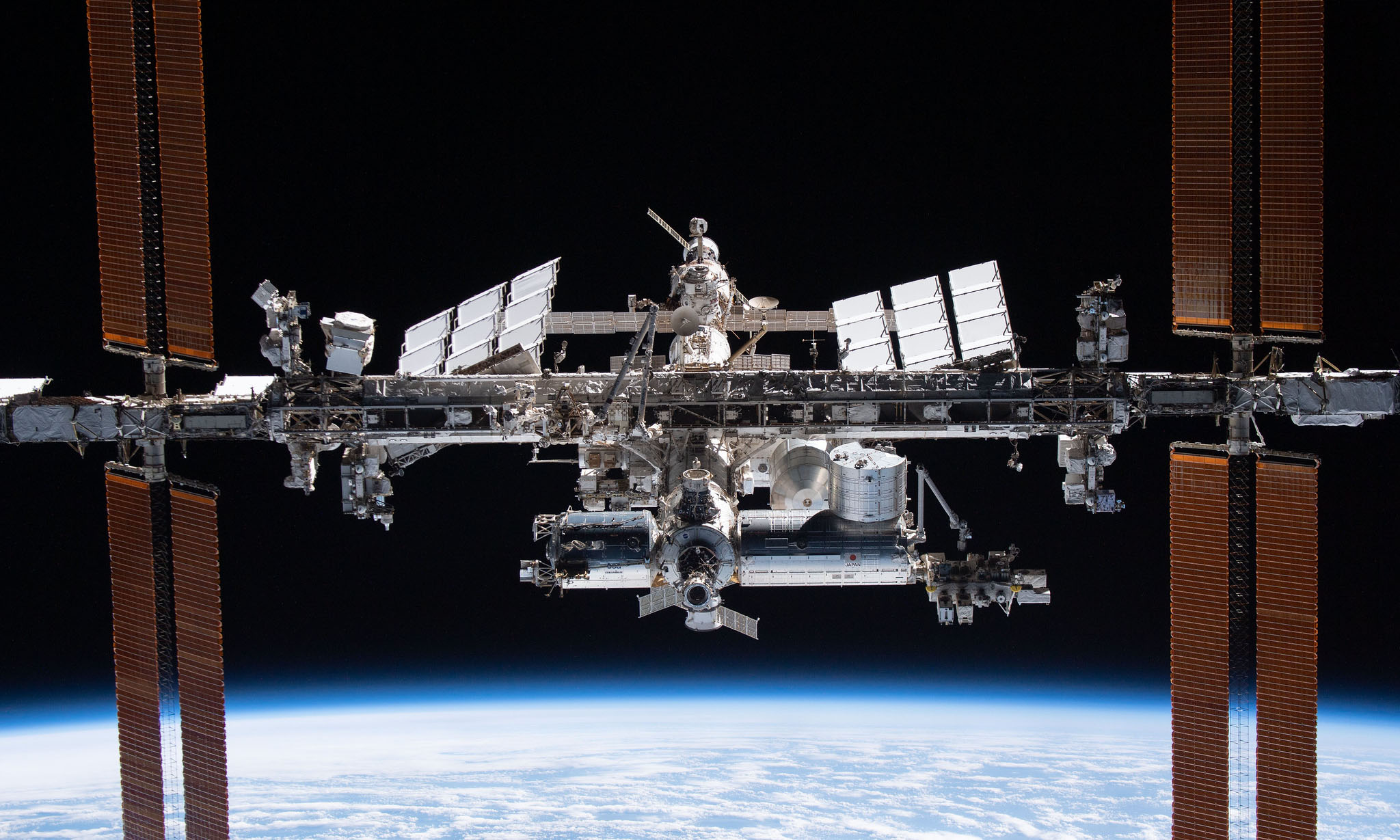
Photo of the International Space Station taken from the SpaceX Crew Dragon Endeavour 2021. (Credit: NASA)
Arvind Agarwal, Ph.D., works with NASA to create flexible spacesuit material that is radiation and abrasion resistant
Outside the protective field of Earth’s magnetosphere is an invisible cascade of danger. Ionizing radiation from both the remnants of distant supernovas and solar particles generated from our own sun can damage our cells, causing cancer and other harmful effects. Shielding astronauts from these and other sources of ionizing radiation is an important step for manned spaceflight to Mars and beyond. Arvind Agarwal, Ph.D., professor and chair of the Virginia Commonwealth University (VCU) Department of Mechanical & Nuclear Engineering, is using his expertise in plasma and cold sprayed coatings to develop multifunctional boron nitride composite coatings capable of protecting astronauts from radiation as well as the abrasion and erosion caused by regolith on the moon and Mars.
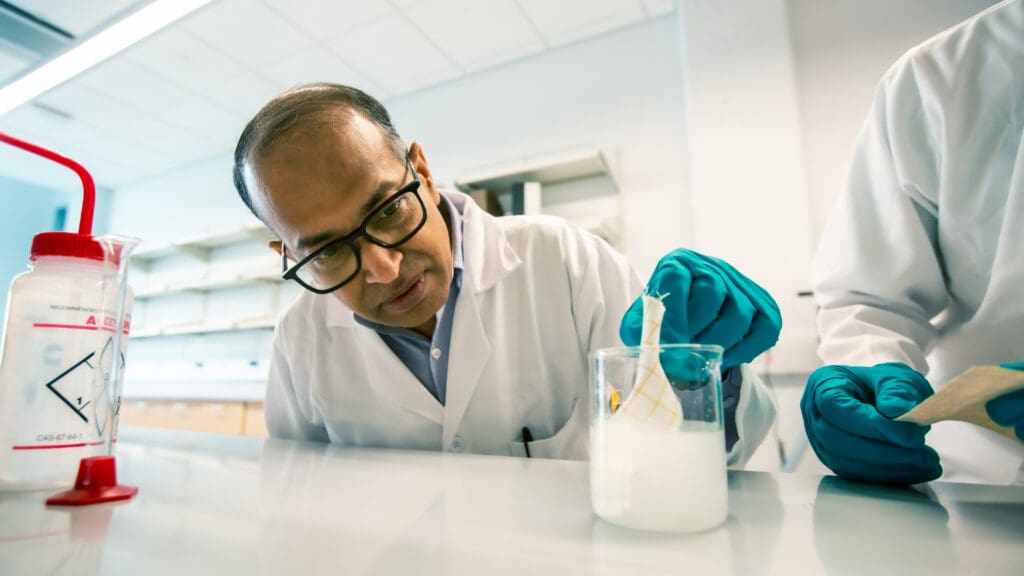
“Boron-nitride is a light material that absorbs the particles of neutron radiation capable of harming us,” said Agarwal. “Its low coefficient of friction also makes it an excellent solid lubricant, meaning anything impacting the material slides off easily. Because of this, boron-nitride based coatings can be extremely abrasion resistant and protect against impacts from small rocks and debris.”
Setting healthy boundaries
Neutron radiation is formed during nuclear fission or fusion when unbound neutrons are released from atomic nuclei. These particles interact with the hydrogen in our bodies to catastrophic effect because of their ability to break our DNA strands. Light elements, like boron, excel at creating a boundary against neutron radiation. Building nanotubes and nanosheets from these elements creates an effect similar to how a water filter removes large impurities and makes it safer to drink.
Agarwal’s coatings were developed in collaboration with former student Sara Rengifo, now at NASA’s Marshall Space Flight Center, who served as a primary investigator on NASA’s Metallic Environmental Resistant Coatings Rapid Innovation Initiative project while at Florida International University. He is continuing that work at VCU, with an experiment currently underway aboard the International Space Station (ISS).
“We started this work five years ago to develop shielding for future space missions, like Artemis, to protect spacecraft from radiation and physical impacts caused by lunar dust,” said Agarwal. “This focused on applying a coating to metals and hard surfaces with the idea to cover a ship or habitat. A second experiment involved using the same techniques on insulating polymer composite foam for inside the spacecraft or shelter. After these tests, our colleagues at NASA wanted to employ this technology on something flexible, like a spacesuit. Astronauts living on the moon and Mars will go outside their habitats often, and taking that same kind of protection with them wherever they are is essential to their safety.”
Boron nitride is commonly produced in flat layers. Stacking these layers one atop the other, like a Post-it note, makes the material more resilient against repeated physical impact. It can also be made as a nanotube, employing the geometry’s structural advantages to make it even more durable. Boron nitride nanotubes are cylinders inside cylinders inside cylinders that are unbelievably small at no more than 50 nanometers in diameter, roughly 100,000 times thinner than a human hair.
“While it’s an amazing material, boron nitride is soft. Even as a nanotube, repeated impacts will eventually cause it to lose its abrasion resistant properties,” said Agarwal. “But when you combine it with a metal matrix, like titanium for example, the resulting material is much stronger. Titanium reacts with nitrogen and boron, but just a little. You can control the reaction to get enough titanium nitride and titanium boride so that the material doesn’t peel off easily while still getting enough boron nitride from the combination that the abrasion resistant and radiation absorption properties remain. The key is getting the formulation right, and that’s what we’re experimenting with. Trying to find the right recipe, the right combination of these materials and the right manufacturing technique to make the most effective product for a spaceship or habitat.”
Boron to be Styled
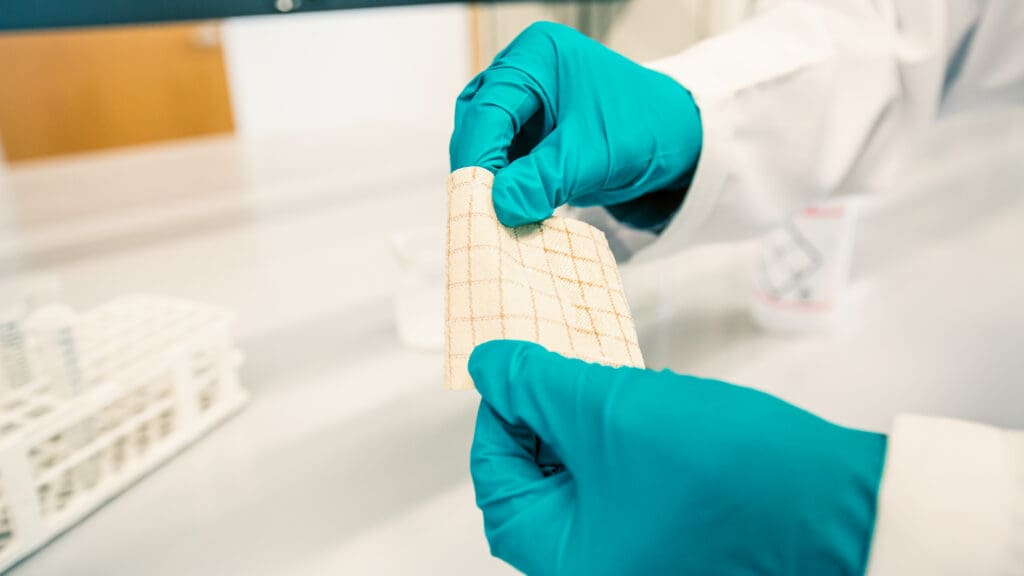
Agarwal’s continued research at VCU tests the application of boron nitride to polymer materials, like fabric. Instead of titanium, this formulation is made into a slurry by combining it with polydimethylsiloxane (PDMS), a silicon-based polymer. The viscous material is then applied to fabric in a very thin layer. Like with the titanium surface coating for ships and habitats, finding the right ratio of PDMS, boron and nitrogen is crucial to making a protective and durable material that remains flexible for polymer application.
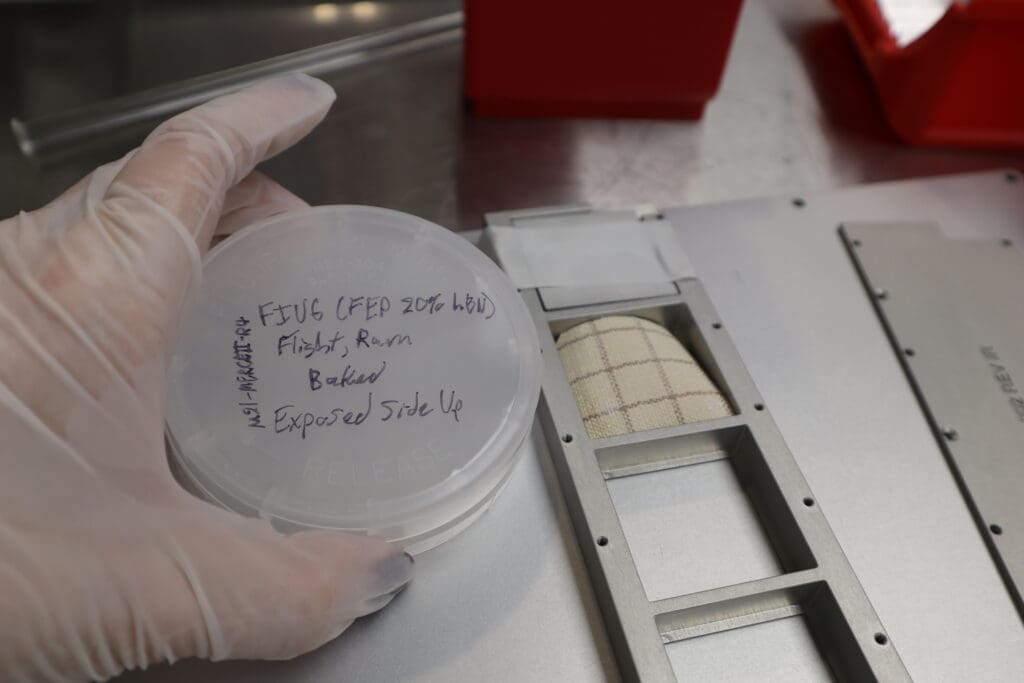
“The layer we’re testing is about 10 microns thick. It’s very, very thin. Think about dipping a white shirt into a colored dye, only the polymer slurry is more viscous than water,” said Agarwal. “We still want abrasion resistance, but for a spacesuit the important thing is radiation protection and for the material to be flexible.”
Before its rocket ride to the ISS, Agarwal conducted a lunar storm erosion test of the PDMS boron nitride material in a patented test rig in his lab. Coated fabric was exposed to high velocity impact to cause erosion with sharp lunar regolith particles. After surviving the erosion test, the PDMS-boron nitride-coated fabric moved to the second phase of experimentation to gauge its radiation absorption properties while exposed to the vacuum of space on a panel outside the ISS.
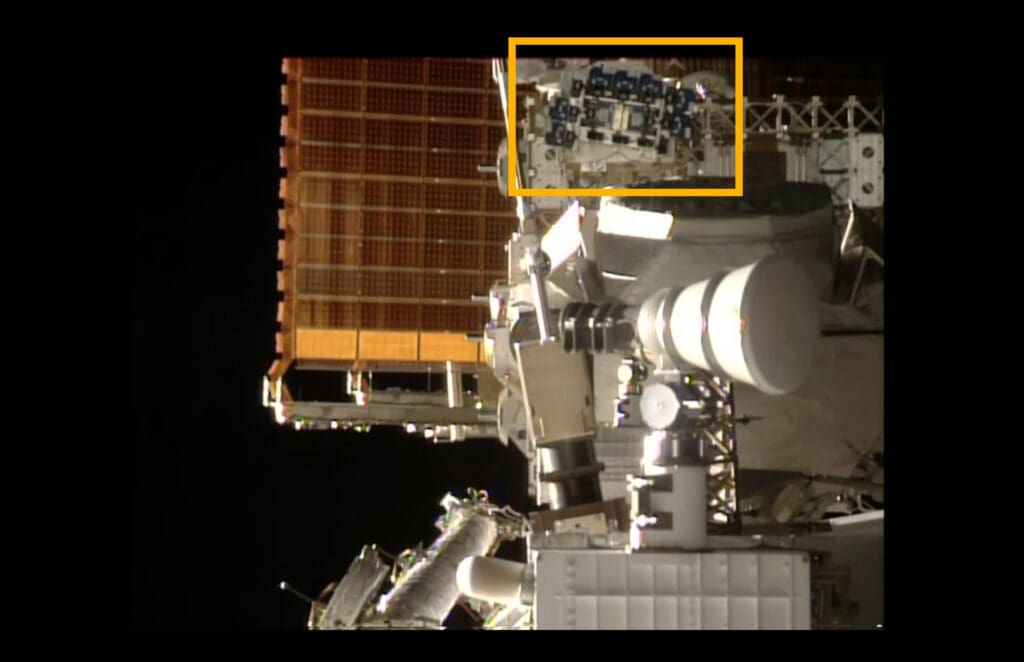
“ Radiation exposure makes polymer material hard and brittle, causing it to crack. The easiest way to detect this degradation is visually, so we have a camera on the ISS taking pictures of our samples outside of the space station at regular intervals. If they start to crack, we can see which piece it’s happening to and when,” said Agarwal. “They’re also weighing the samples at intervals to measure atomic oxygen. If enough oxygen has entered the sample that the weight has changed then that means the coating has degraded.”
In addition to ascertaining the material’s effectiveness, studying degradation over time helps researchers predict the coating’s lifetime. A fixed expiration date could signal when a spacesuit needs replacement or the coating reapplied.
Once the samples return to Earth, an in-depth analysis will provide more detailed information with electron microscopy and other high-end tools for materials and chemical analysis.
Applications on Earth and next steps
Boron nitride is a good thermal conductor and electric insulator. Researchers seek to apply it to electronic packaging. Think of your phone. Holding it up to your ear for a long conversation, it gets noticeably warmer. A boron nitride nanotube heat sink could channel heat away more effectively, making the device more comfortable for extended use.
“In its layered sheet form, boron nitride is a cheap and common solid lubricant. However, its nanotube form is significantly more expensive at around $1,600 a gram,” said Agarwal. “The work we’re doing on the ISS could eventually lead to several new applications of boron nitride nanotubes, resulting in nanotubes being cheaper.”
The data Agarwal and his collaborators receive from this experiment will dictate its next steps. With a measure of effectiveness and lifespan, space agencies can potentially begin implementing the technology in suits for practical testing to find a balance between material flexibility and how much protection the suit will provide over time.
The Department of Mechanical and Nuclear Engineering provides undergraduate and graduate students with the opportunity to perform real-world research as soon as they enroll. From applying material science to additive manufacturing techniques to optimizing coolant systems for nuclear reactors and more, students gain understanding of many important engineering topics. Browse videos and recent news from the Department of Mechanical and Nuclear Engineering to discover how the College of Engineering at Virginia Commonwealth University prepares the next generation of scientists and engineers for the challenges of the future.
Categories Mechanical & Nuclear Engineering