
Turning frontline frustration into functional devices
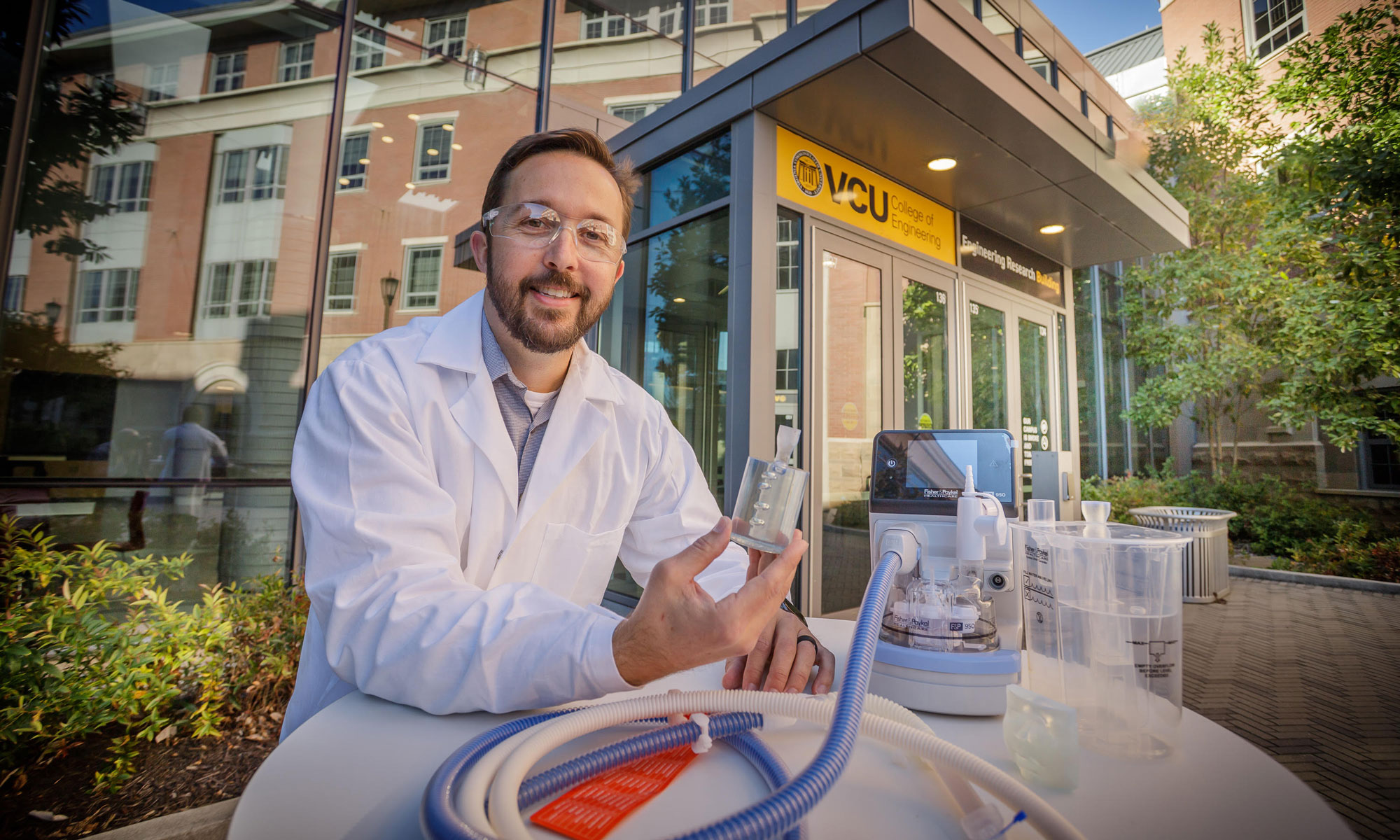
Casey Grey, Ph.D., is something of an engineering Swiss Army knife. A postdoctoral researcher in the College of Engineering’s Aerosols in Medicine Lab, Grey moves between disciplines — neuroscience, respiratory medicine, critical care, pharmacology — to make products that can ultimately help patients young and old.
He gets called into clinics, listens, identifies what the provider can’t explain, and builds something to fix the problem.
“You have an idea and you don’t know where to go with it?” he said. “That’s me.”
He’s got his own project, funded in 2025 by the VCU TechTransfer and Ventures Commercialization Fund: a modified “bubble CPAP” designed to improve respiratory support for premature infants.
Grey reimagined the decades-old technology by engineering a system that stabilizes pressure delivery and creates a high-frequency oscillation — specifically at 40Hz, which reflects the number of pressure wave oscillations per second (a typical bubble CPAP pulses at 5Hz). Clinical studies show 40Hz frequencies can stimulate the brain’s glymphatic system, which uses cerebrospinal fluid to clear waste and toxins from the brain and support neurological development. “By superimposing a 40Hz signal onto the existing 5Hz bubble CPAP, we believe we can support brain development in preterm infants,” he said.
For Grey, who earned his doctorate at VCU in 2014, the pursuit of a better bubbler is both personal and professional. Though always interested in neuroscience, surviving a concussion years ago motivated him to leave his corporate career and return to academia to tackle the significant gaps in neurological care, especially related to concussion and traumatic brain injury.
Today, he is an adjunct professor researching under P. Worth Longest, Ph.D., the Alice T. and William H. Goodwin Jr. Endowed Chair in the Department of Mechanical and Nuclear Engineering (and one of VCU’s 2025 Innovators of the Year).
Grey is also collaborating with VCU Health ICU nurse Emma Shawcross and is co-inventor of the Flow Positioning Wedge, a fecal-management device that helps position the critically ill patients to improve dignity, comfort and safety. Additionally, he leads a team in VCU’s Acute Medical Care and Systems Strengthening (ACCESS) Vertically Integrated Project (VIP) focusing on preventing pressure injuries and major complications for patients on ventilators. He mentors engineering senior design teams and holds six full patents with seven more pending.
“My goal is simple: keep asking questions and keep helping people,” Grey said. “There are so many opportunities to collaborate between VCU Engineering and VCU Health, and I intend to explore as many of them as I can to help our patients.”
The Department of Mechanical and Nuclear Engineering provides undergraduate and graduate students with the opportunity to perform real-world research as soon as they enroll. From applying material science to additive manufacturing techniques to optimizing coolant systems for nuclear reactors and more, students gain understanding of many important engineering topics. Browse videos and recent news from the Department of Mechanical and Nuclear Engineering to discover how the College of Engineering at Virginia Commonwealth University prepares the next generation of scientists and engineers for the challenges of the future.
Categories Mechanical & Nuclear Engineering