
Probing for success: How College of Engineering students collaborate with industry to build a Capstone Design Expo project with real-world impact
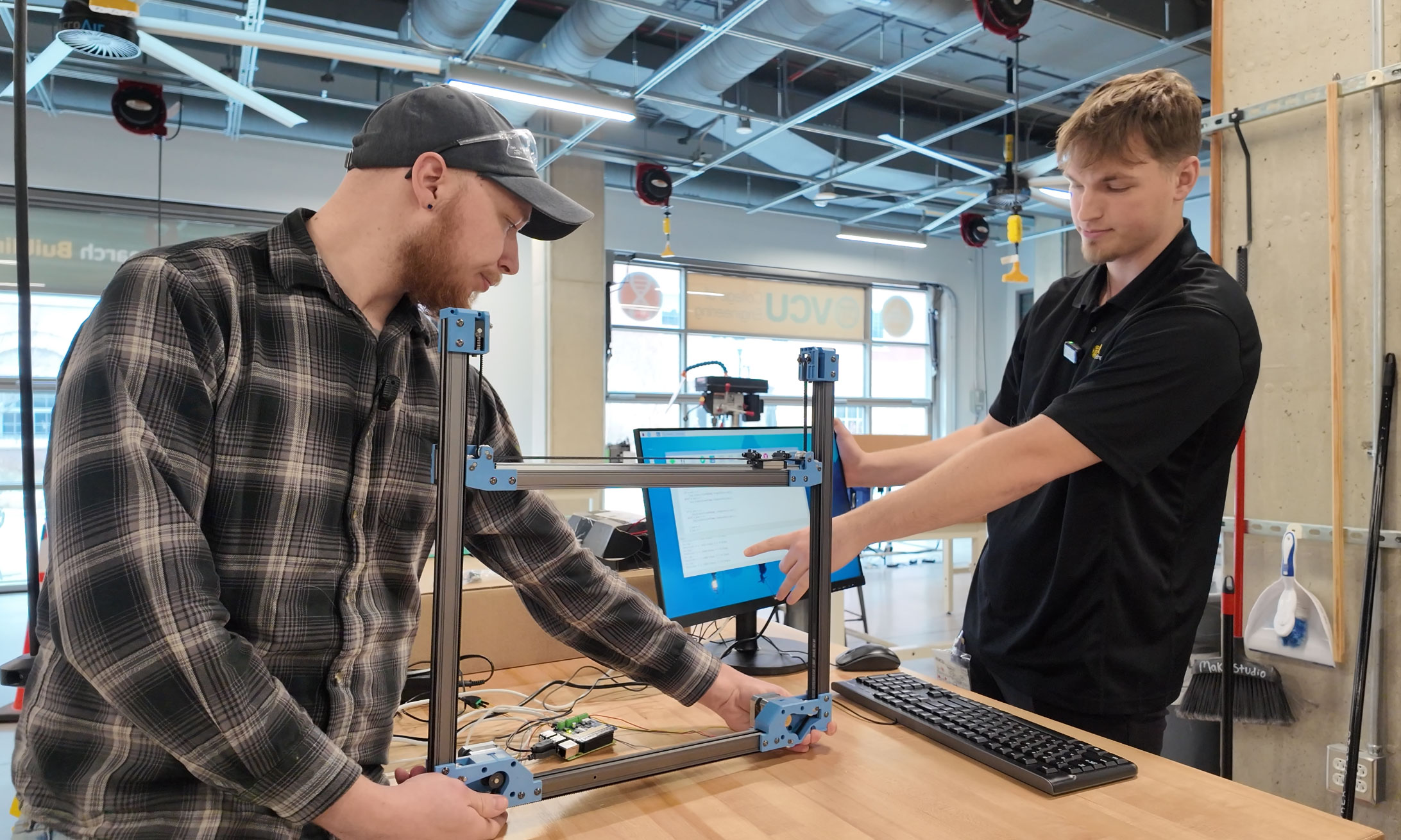
United States Naval Surface Warfare Center Dahlgren Division challenges students to improve data collection from weapon tests
Undergraduates at the Virginia Commonwealth University (VCU) College of Engineering are making a real-world impact on the design of high-powered microwave (HPM) weapons. Landen Sabolski, Graham Boone, Tasmaiy Patel and Mohammed Ahmad are collaborating with the United States Naval Surface Warfare Center Dahlgren Division (NSWCDD) to implement a more efficient method to collect data from HPM weapon tests.
The student team is designing and building a translation gimbal system for the probe NSWCDD uses to measure the intensity of electromagnetic radiation at various points within an HPM beam. It is one of many projects currently under development by students for the annual Capstone Design Expo, a showcase of the technical, management and communication skills students develop during their undergraduate experience.
The Journey Begins
Before the start of the fall semester in their final academic year, students bid on Capstone projects matching their interests. Once faculty advisors confirm team assignments, students meet to define project goals and determine how those objectives will be achieved..
“I have had internships working in aerospace and defense, so when I saw this project on the bid list, it drew my immediate attention. There were a few other projects that seemed interesting but this project was my number one choice. I feel lucky to be a part of this team,” Sabolski said.
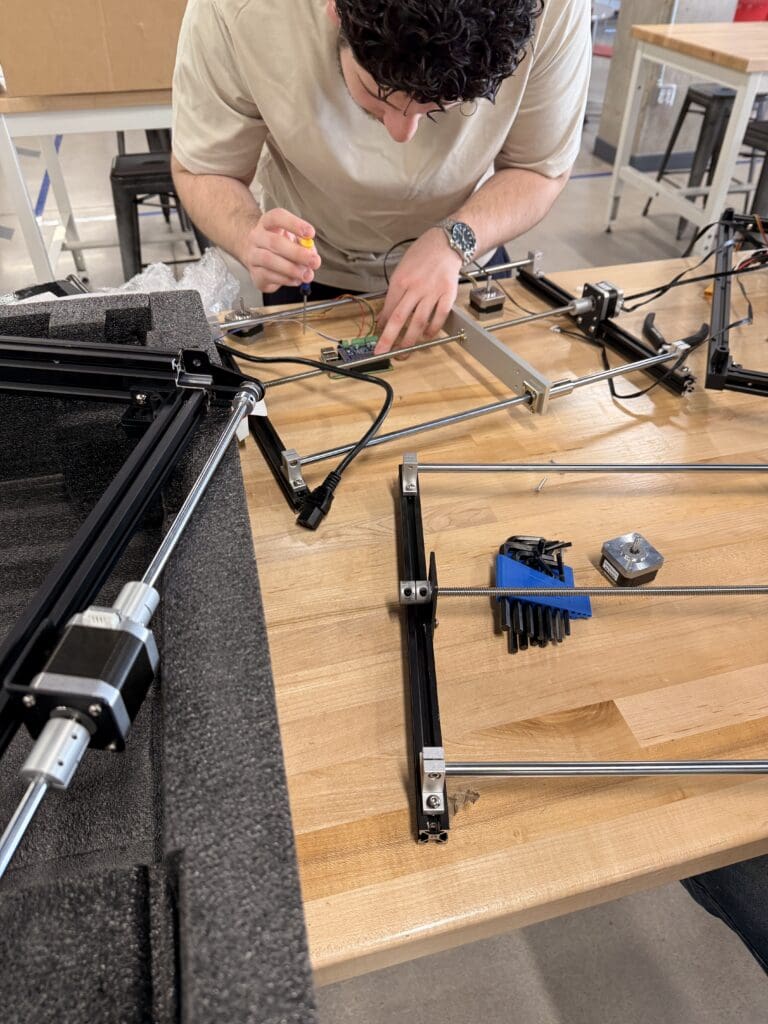
Sabolski, Boone, Patel and Ahmad, became Team Translation Gimbal for NSWCDD and quickly organized into a functional group. Discipline and time management skills are as important as technical engineering knowledge in order to stay on track, so after forming an initial plan, Team Translation Gimbal divided into two groups. A mechanical engineering subteam, comprised of Sabolski and Boone, designs and builds the physical prototype while an electrical engineering subteam, comprised of Patel and Ahmad, develop a robust controls system. This enables them to make steady progress on technical problem solving while moderating the pace of development, in case a subteam falls behind, and continues to leveraging strengths from each student’s specific engineering discipline.
“This project takes mechanical engineering and bridges it with electrical and computer engineering. I wanted an opportunity to collaborate with students outside my department, and this seemed a great way to combine two different disciplines, ” Ahmad said.
Team Translation Gimbal is aided by faculty advisors Bradley Nichols, Ph.D., associate professor in the Department of Mechanical & Nuclear Engineering and director of Capstone Design, and Supriyo Bandyopadhyay, Ph.D., Commonwealth Professor in the Department of Electrical & Computer Engineering. Two graduate students, Grey English (B.S. ‘20) and Joseph Lee (B.S. ‘25), serve as mentors to Sabolski, Boone, Patel and Ahmad. English, an employee of NSWCDD, is also Team Translation Gimbal’s business sponsor and primary contact.
“The support our two mentors from the Engineering Management master’s program provide is invaluable. Grey and Joseph have been a great help with operations tasks, like our overall project timeline and upcoming deadlines. We communicate daily within our team and present to our sponsors and advisors every Thursday to share updates on our progress,” Sabolski said.
The Problem
High powered microwave weapons emit a directional beam of radio frequencies (RF) to interfere with electronics. Unlike conventional weapons, HPM systems offer a less lethal way of disabling cars, boats, drones and other targets with sensitive electronics. The beam does not travel in a perfect line, instead covering a small, controlled area. During testing, NSWCDD measures beam characteristics by firing at stationary probes. To collect data from different locations within the beam, the probe must be repositioned by hand, requiring testing to pause. Team Translation Gimbal is using their engineering skills to design a device capable of moving NSWCDD’s probe along a vertical x-y plane, allowing continuous data collection without manual repositioning. This approach will improve efficiency and provide researchers with a more detailed understanding of beam behavior.
“I have a great understanding of electromagnetic field calculations and learning to collect and understand wave characteristics through my experience with a VCU Engineering biomagnetics lab. I also have lots of theory knowledge in creating circuits and programming that will help with the project,” said Patel.
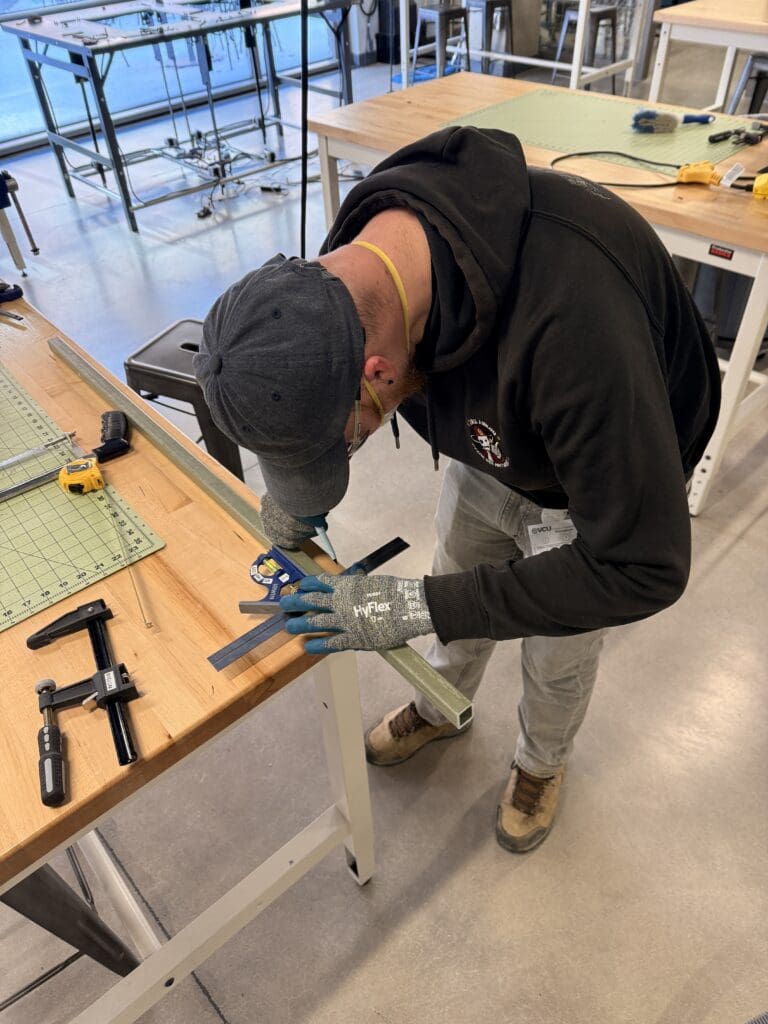
Each student contributes specialized skills: Patel’s experience helps inform Sabolski’s design, who is most proficient in CAD modeling. Boone’s automotive expertise gives him a unique perspective on how things fit together, providing insight into part design and manufacturing for ease of maintenance. Ahmad’s background in controls engineering and electric components help bring it all together with programming to give the final product the desired functionality.
“We got ahead of ourselves in the beginning. Building a full, 10×10 foot prototype was our first goal, but we needed to dial back our ambition to a 1×1 foot model in order to fit our Capstone budget and be realistic with time constraints while working on other classes and jobs during the semester, ” said Boone.
Industry Collaboration
Experts from NSWCDD, including sponsor representatives Grey English, Chris Reichart and Alan Overby, are vital resources for students during the lead up to the Capstone Design Expo. Industry-sponsored groups account for approximately 40 percent of Capstone projects. Students working with industry partners are held to professional engineering standards, resulting in more detailed and robust final projects.
Multidisciplinary groups like Team Translation Gimbal also build strong products because of the collaboration between fields. Students get different perspectives on their project through the variety of coursework and expertise each team member possesses that is different from the knowledge of fellow teammates.
The NSWCDD is very hands-on. English and Overby make themselves available for weekly progress meetings with Team Translation Gimble and their faculty advisors.
“At Dahlgren, we have many experts in very specific, niche fields students don’t normally encounter, so it gives the Capstone team an opportunity to gain perspective on topics and ideas they wouldn’t think of,” English said. “This translation gimbal project is niche as well…Here we have a project with so much information that students need to have a close relationship with the Naval Surface Warfare Center at Dahlgren in order to succeed. That kind of collaboration is an excellent learning experience because it mimics the real-world scenarios students will enter after graduation.”
Practice Makes Perfect
To prepare students for the Capstone Design Expo, all student teams participate in a midpoint presentation. The fall poster session in the atrium of the Engineering Research Building at the College of Engineering lets students practice their presentation skills and receive feedback as they continue working on their projects.
“A week before the fall midpoint presentation, I see students walking around with their posters and proud of the work they’ve done.,” Bradley Nichols, Ph.D., said, Capstone director and one of Team Translation Gimbal’s faculty advisors. “It’s great to see that kind of engagement from students while also getting the critical practice needed for the Capstone Design Expo in the spring.”
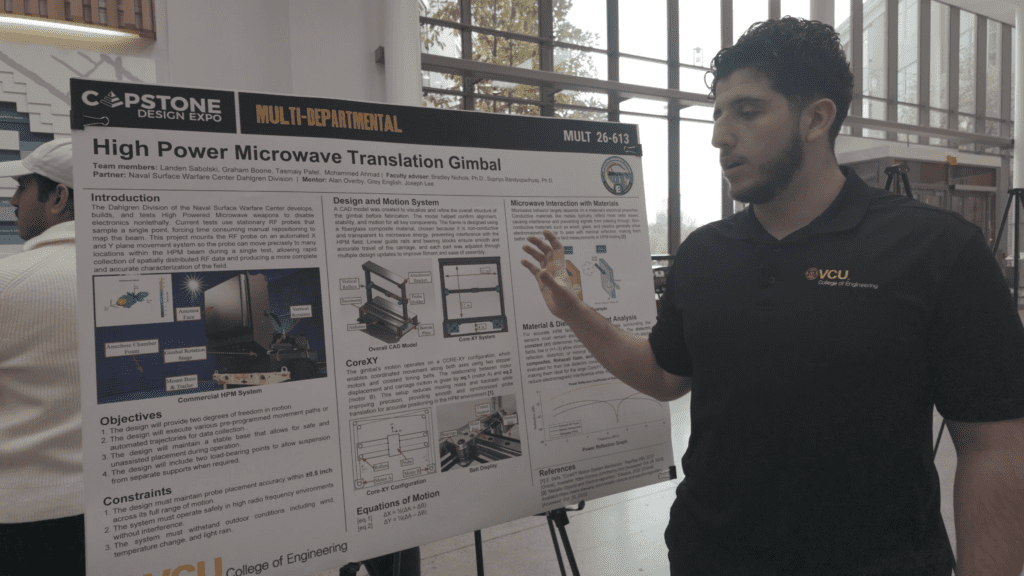
The Capstone midpoint presentation started three years ago and is now mandatory for all student teams.
”Multidiscplinary projects like the one Team Translation Gimbal is undertaking are more akin to what you’ll see in real-life industry,” Nichols said. “At a company, you’re not just going to be working in your field. You’ll be collaborating with professionals from many different backgrounds. When industry partners choose to support the College of Engineering, they get a pipeline to our students. Take the Naval Surface Warfare Center at Dahlgren for example, not only have they supported Capstone projects across a number of years, they’re hiring our students. Those former students come back as alumni to mentor and stay involved with the Capstone program. Team Translation Gimbal has three generations of Capstone students involved with the project, our current students, Joseph Lee and Grey English.”
Moving past the initial hurdles of determining the project’s scope and establishing realistic goals, Sabolski, Boone, Patel and Ahmad have done the important work of developing a project plan that will lead them to success. With the guidance of advisors Nichols and Bandyopadhyay, mentor Lee, sponsor Overby, and English serving the dual role of mentor and sponsor, Team Translation Gimbal is on track to deliver a working prototype for NSWCDD at the Capstone Design Expo, Friday, April 24 at VCU’s Stuart C. Siegel Center. The event is open to the public, with more than 100 senior design projects on display from 9 a.m. to 1 p.m.
The VCU College of Engineering offers innovative undergraduate and graduate degree programs tailored to meet the demands of the rapidly evolving engineering field. As part of a premier research university, students are given the opportunity to perform real-world research in our state-of-the-art facilities as soon as they enroll. Browse videos and recent news to discover how the College of Engineering at Virginia Commonwealth University prepares the next generation of scientists and engineers for the challenges of the future.
Categories Mechanical & Nuclear Engineering, Student Stories, Undergraduate Student Stories