‘Faculty that looked like me’: Meet the 2024-25 social work Ph.D. cohort
The VCU School of Social Work’s Ph.D. Program welcomed five new students in this academic year’s cohort. They are:
Why did you choose to pursue a Ph.D. and why was the VCU School of Social Work your choice?

Lisa Borntrager
I want the skills to be able to conduct my own research toward suicide prevention and policy work. I chose VCU because of the focus on issues of social justice and Richmond being a beautiful city.
Aya Caballero
I chose to pursue a Ph.D. because I am passionate about research and the opportunity to contribute to knowledge in my field. I wanted to deepen my understanding of the issues surrounding race, identity and belonging, particularly among mixed-race youth, and explore how these factors impact their self-efficacy and well-being.
I chose the VCU School of Social Work specifically because of its strong emphasis on social justice and community-engaged research. VCU’s program aligns with my commitment to addressing issues of racial and social equity and provides a supportive environment to explore my research interests.

Zoljargalan Gantumur
Before joining the VCU School of Social Work, I worked as a lecturer at the Mongolian National University of Medical Sciences between 2015 and 2024. My primary responsibility was teaching macro social work courses to undergraduate health social work students. My experience at the university not only strengthened my interest in research, but also highlighted the significance and joy of research and teaching.
My decision to apply to the VCU School of Social Work was driven by my aspiration to enhance my research and teaching skills and knowledge, thus enabling me to further my career in higher education. VCU stood out as my top choice due to its diverse community-engaged research projects and the global reach of the School of Social Work, including projects in Mongolia.
Liliana Morales
I decided to pursue a Ph.D. because my life experiences fueled my desire to create meaningful change that addresses the systemic challenges faced by underserved populations. My previous mentor, Dr. Lisa Cox (of Stockton University), and her guidance during my master’s program, particularly in research and international social work, inspired me to continue my academic journey. Dr. Cox’s deep connection to VCU (two-time graduate and former faculty member) and her praise for the program’s focus on social justice and research made it the perfect fit for me.
Rayelle Ross
I chose to pursue a doctorate after working in an underserved elementary school and witnessing the impacts of trauma on Black youths’ ability to be successful in school. I chose VCU, as they are one of the top 50 public research universities and among the top producers of research. More importantly, their commitment to acknowledging the structures of oppression and anti-Black racism is why I chose VCU.
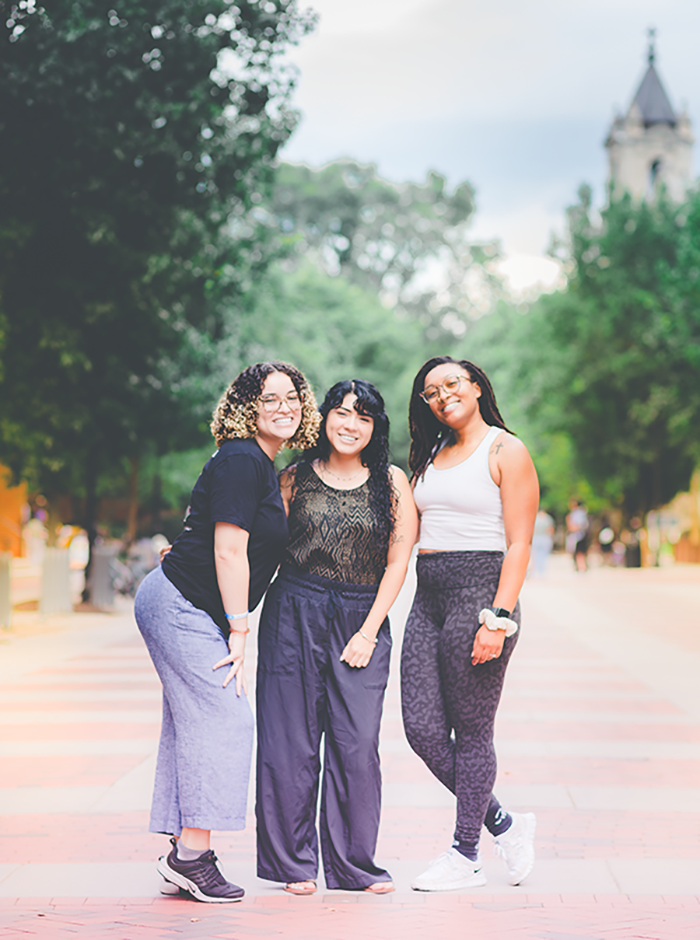
Are there any faculty or research-specific connections that drew you to the program?
Caballero
Dr. McKenzie Green’s research focus on race, identity and social justice aligns closely with my own interests, especially regarding mixed-race youth and the concept of belonging. I am excited about the potential to collaborate with her, as her work deeply resonates with my goal of exploring how racial identity and social dynamics impact self-efficacy and well-being. Moreover, Dr. Green was the first faculty member I encountered who looked like me, which had a profound impact on my decision to choose VCU.
Gantumur
I had the opportunity to collaborate with Dr. Denise Burnette during her visit to our university in Mongolia as a Fulbright Specialist in 2023. During her visit, I had a chance to discuss my research interest in the health and well-being of Mongolian older adults. Professor Burnette’s expertise in gerontology and Mongolian social work greatly influenced my decision to pursue a Ph.D. at VCU.
Morales
I was drawn to VCU because of faculty like Dr. Christina Huerta and Dr. Maurice Gattis. Their work on Hispanic youth mental health and international social work directly aligns with my research interests and goals of addressing systemic issues affecting low-income and immigrant communities.
Ross
Dr. Alex Wagaman, Dr. Nicole Corley, and seeing other faculty that looked like me, a Black woman. Representation matters.
What social problem are you trying to solve and/or what population will you focus on?
Borntrager
I want to concentrate on exploring precursors to suicidal ideation and how specific policies can be developed to prevent the immense suffering associated with suicidal thoughts.
Caballero
I am focused on the racial and identity-based challenges faced by mixed-race youth, particularly those who identify as Multiracial-Black. My research aims to explore how these individuals navigate their unique racial identities and how experiences of racial stress, discrimination, and exclusion impact their mental health and overall well-being.
By focusing on this population, I hope to contribute to a more nuanced understanding of their experiences and to develop strategies that support their mental health and identity development.
Gantumur
My research interest is around the health and well-being of older adults. Common issues faced by older adults globally include functional decline due to multiple chronic diseases, loneliness, ageism, and a lack of age-friendly neighborhood, person-centered health and social care. Social work can significantly contribute to solving these challenges because it empowers individuals and families, supports community ties, and connects multidisciplinary initiatives.
Morales
I want to focus on research involving Hispanic youth and education, as well as mental health within immigrant populations, particularly Hispanic communities. I hope to eventually identify effective interventions and explore how systemic and social barriers impact youth development and student success in low-income immigrant communities.
Ross
The population I will focus on are Black youth and families as the social work system historically has been rooted in racism. I plan on solving these deeply rooted issues by contributing more culturally informed interventions and practices that are used in Black communities.
Any fun facts about yourself?
Caballero
A fun fact about me is that I have a diverse background, being both Syrian and Jamaican. This multicultural heritage has shaped my worldview and fueled my interest in international research and understanding different cultural perspectives. I’ve had the opportunity to study abroad in Ghana, which was an incredible experience that deepened my appreciation for global social issues and the importance of culturally relevant research.
Additionally, I am actively involved in supporting a school in Jamaica, which aligns with my passion for educational equity and community engagement. This work allows me to connect with my Jamaican roots while contributing to meaningful initiatives that promote social change.
Morales
A fun fact is that my desire to do research on Hispanic youth in education and interventions for youth education in South Africa was inspired by my own experiences growing up in a minority community, which motivated me to further explore issues within the Hispanic community as well as global social issues.
Ross
My grandfather was born in 1899, and my father was born December 1950. This meant my grandfather was 56 years old and my father was about 4 years old at the time of Emmet Tills lynching. My father is also the youngest of 16 children, and I am the youngest grandchild, being born in ’96. Most of my cousins are at least 30 years older than me. Though I’m considered the baby of my family, I have an old soul. I am my ancestors’ wildest dreams.