
Trauma Informed Care and Healing Centered Engagement
In this episode we are joined by Gerontologist, Dr. Gigi Amateau who serves as Assistant Professor for the Virginia Commonwealth University Department of Gerontology. Dr. Amateau focuses on developing trauma-informed approaches in nursing homes, evaluating a statewide training initiative for the direct care workforce, and teaching in the graduate program. In our third episode on an important discussion topic, Dr. Amateau introduces us to the concept of Healing Centered Engagement. Make sure you also check out our discussions on trauma informed approaches with Morgan Alexander and Paige Hector for more.
Meet our Special Guest!
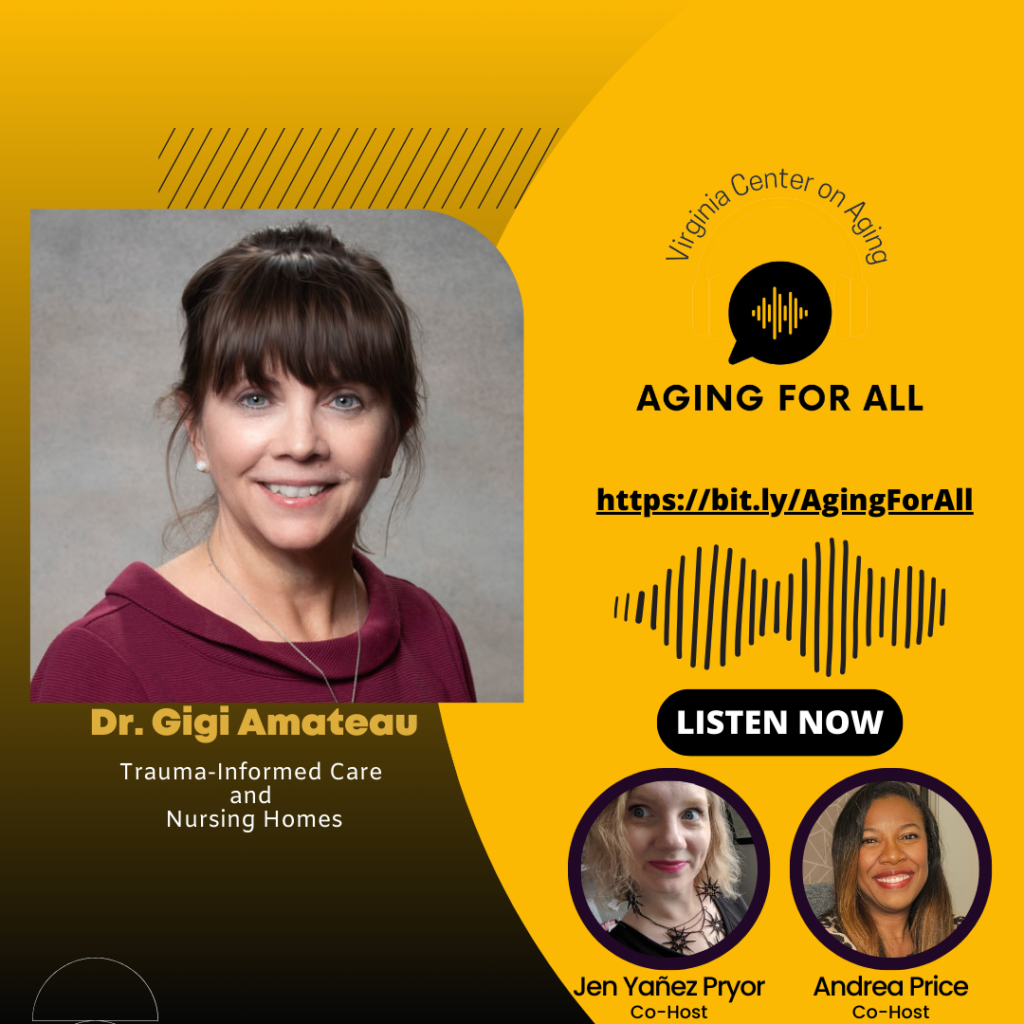
Dr. Gigi Amateau holds a Master of Science in Gerontology and a Ph.D. in Health Science. She is also a certified personal care aide in the Commonwealth of Virginia and is certified by Yoga Alliance as an RYT-200 Yoga Instructor. Gigi speaks and trains at the national, state, and local levels on topics related to social connection, person-centered practices for direct care providers, and trauma-informed care for agencies serving elders. She serves on Virginia’s No Wrong Door Resource Advisory Council.
Gigi’s professional goal is to foster respect, appreciation, and fair compensation and treatment for direct care providers working in all settings. She is also a children’s book author interested in how diverse stories in children’s literature can promote appreciation and celebration of elderhood and intergenerational friendships. Gigi was awarded the Best Data Insight Award by Homeward for early identification of an increase in older adults experiencing homelessness in the Richmond region in 2019. In 2017, she was awarded the Pat Asch Social Justice Fellowship by YWCA Richmond.
Listen to the Episode
Additional Resources
Healing-Centered Engagement
Healing-Centered Engagement is a framework developed by Dr. Shawn Ginwright out of his work with youth of color. As you explore these resources, which are youth-oriented, ask how these ideas might translate to older adults and the direct care workforce. Consider the intersectional identities of elders. Think, too, about how we, in aging services and gerontology, might incorporate these concepts.
The Future of Healing: Shifting from Trauma-Informed Care to Healing-Centered Engagement
Flourish Agenda’s CARMA Chronicles Podcast