
Class of ’17 resplendent in new white coats
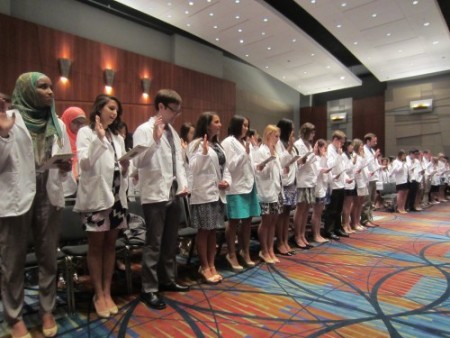
Nearly 800 students, family members, friends and faculty converged on the Greater Richmond Convention Center Aug. 24 for the VCU School of Pharmacy’s annual White Coat Ceremony.
School of Pharmacy Dean Victor Yanchick delivered remarks to the Class of 2017. “Since I am retiring and this is my last White Coat Ceremony,” he said, laughing, “I thought I’d hog it to myself!”
The white coat is a symbol of professionalism and serves as a reminder of future pharmacists’ covenant with the patients they will serve. (To read Yanchick’s address to the class, see below.)
Tom Reinders, associate dean for admissions and student services, read the names of 137 students who were about to become official student pharmacists.
As the last student moved offstage, Yanchick said, “I know your families feel so proud. As the Class of 2017 makes its journey toward professional practice, you’re going to see a tremendous transformation in these young men and women over the next four years.”
Student body president Erich Brechtelsbauer administered the Oath of a Student Pharmacist to the class.
This year, alumni and friends of the school donated more than $8,500 to purchase coats for the class of 2017.
The ceremony was sponsored by Farm Fresh Pharmacies/Shoppers Pharmacies-SUPERVALU. Farm Fresh/Shoppers representative and SOP alumna Ashley Savage (Pharm.D. ’12) was unable to attend the ceremony but sent best wishes and a message of encouragement to the class.
A pre-ceremony open house at the school’s R. Blackwell Smith Jr. Building attracted more than 300 first-year students, family members and friends.
***************************
Here is Dean Victor Yanchick’s White Coat Ceremony address, in its entirety, to the VCU School of Pharmacy class of 2017:
White coat’s symbolic role
The ceremonial presentation of the white coat is based on the practice established by Dr. Arnold Gold at Columbia University to express the important symbolic role the white coat plays in the relationship between the patient and the health practitioner. It signifies the professional responsibilities that you will be assuming, not only as student pharmacists, but also as practitioners after you graduate.
But before we begin the ceremony itself, I would like to provide a little insight about what I see ahead of you and what your future practice environment may involve.
You are entering a profession that is undergoing a major transformation in the health care environment. What I see for you in your long-range future is anyone’s guess, but I do know for sure that you, the class of 2017, will be right in the thick of it, and it will be you who will be responsible for continuing to reshape pharmacy’s destiny.
So what you must do right now is begin to plan for where you want to be in pharmacy’s future. I call it advanced planning, and to best illustrate this concept I have a story that I would like to relate to you that clearly represents advanced planning.
The story is about a husband and wife named Harry and Louise. Harry and Louise were sitting at the breakfast table one morning when Harry looked up from his newspaper and asked Louise what she would do if he died first. “Would you remarry?” he asked.
Louise thought for a moment and responded, “Well, Harry, we had a good life together, we’ve shared good times and bad times; I would be very lonely without a mate. Sure, I would remarry.”
Then Harry asked, “Would you ask him to live in this house”? And Louise countered, “Well, this is my dream house, newly decorated and landscaped. The pool and yard are in perfect shape. I can’t imagine living anywhere else. You bet I would.”
Undaunted, Harry went on: “Do you think you would let him wear my clothes?” To which Louise replied, “Harry, you have beautiful clothes – dozens of tailored suits and sports jackets, the best custom-made shirts and ties from Italy. And half of everything is brand new. Yes, he would be welcome to wear your clothes.”
“Would you let him drive my new Ferrari?” Harry queried. “You know how much I love this car.”
“Why, Harry, I could not just let it sit in the garage – and besides, I can’t drive a car with stick shift – so why not?” answered Louise.
Becoming very discouraged, Harry finally asked, “Now, Louise, you certainly would not give him my brand new custom- made set of TaylorMade golf clubs, would you?”
To which Louise immediately replied without missing a step, “Of course not, Harry – he’s left-handed!!!”
You see, Louise already had in place a plan for her future. And I guess that’s what I am suggesting that you begin to think about right now.
Begin to plan for your future. We are now seeing what I believe is the beginning of a revolution in health care. Lines of authority and scopes of practice are becoming blurred, and pharmacists are moving rapidly to being recognized as primary health care providers with the authority and responsibility for the outcomes of medication use as well as for the delivery of primary health care.
Unbelievable advances
Advances in the diagnosis and treatment of disease are moving with lightning speed through unbelievable developments in technology. We are entering the realm of biogenetically and biochemically unique drugs – drugs that are based upon our own personal unique needs and genotypical characteristics.
Phenomenal advances are being made scientifically that will totally redefine how pharmacy will be practiced. Futurists tell us there will be organ banks where we will have the opportunity to have our own replacement organs cloned. The population shift will be skewed dramatically to the elderly, with over 35 percent of the population in the U.S. being over the age of 65 by the year 2025. Today there are approximately 85,000 people over the age of 100. In 30 years, it is estimated that there will be over 325,000. The average life expectancy will continue to increase to well over 85 years. It is predicted that a baby born this year in the United States will have better than a 50-50 chance of seeing the 22nd century.
What factors will influence this remarkable shift in longevity? One factor may be application of pharmacogenomics or personalized medicine where the drugs that will be used to treat and even prevent disease will be selected based on the patient’s DNA. Another factor may be the use of “nanotechnology.” Nanotechnology is a growing science of what I can best describe as the use of micro-molecular machines and whose prospects seem like science fiction. The scientists who are working in this area predict that these molecular machines will be able to roam the blood stream seeking and destroying unfriendly microbes and cancer cells, detecting and stopping disease processes and even preventing others from occurring.
Consider the fascinating prospects of this technology as it is applied to human medicine. Newborns will be immunized with nanomedicine vaccines that will not only protect them from such communicable diseases as measles, smallpox, mumps and polio but will also have the potential to “immunize” them from certain debilitating diseases such as cancer, heart disease or Alzheimer’s Disease. These agents will be unique to each individual. They will not totally supplant all of the treatment modalities that we rely upon today, but they will no longer seem like science fiction. These drugs will NOT be mass produced for use by all patients with a given set of symptoms and clinical characteristics. They will be single person, or “designer” drugs, that will be able to provide cures or prevent disease rather than simply treat the symptoms of disease like the drugs we currently have in our pharmacies today.
How does one make such a drug? How does one study such a drug to understand its safety and efficacy? What are the professional and ethical issues that must be considered? Clearly, the concepts of mass production and clinical trials to demonstrate safety and efficacy in a population whose n is “1” are outside our current paradigm. The notion of a factory producing drugs for a single individual suggests to me that the factory will be small and will need to be close to the patient. I suggest most of these “factories” will be located in the pharmacies of the future and that the compounder of these products will be the pharmacist.
Will all of these new concepts be commonplace within the next 10 to 20 years? Probably not. But will they likely occur within your professional lifetime? Absolutely!! I firmly believe that you will experience these remarkable advances first- hand within your professional lifetime. You must be prepared scientifically as well as professionally and ethically to make your contribution to the profession. These new approaches to preventing and treating diseases cause us to continually re-examine what our professional and ethical responsibilities should be.
The next four years
Your faculty will be working with you over the next four years to begin to think about your future, to develop your talents and to become leaders of innovation and responsible citizens of the world.
Your responsibility from this moment on is to accept the challenge to embrace and follow a sound set of professional and ethical principles. These high ideals are necessary to ensure that quality of care is extended to the patients that you will serve. I do not believe this responsibility begins after you graduate. Rather, it begins right now – today – and it must be continually reexamined, nurtured and respected.
You must consider yourselves as student pharmacists and not pharmacy students. You can never, ever forget that from now on you will be looked upon by your university and the community at large as student pharmacists, whether you are in the classroom, in a practice setting, on the street or in a bar in downtown Richmond. Regardless of where you are or what you are doing, you represent this School of Pharmacy as well as the profession of pharmacy. If you get into trouble and make the front page of the Richmond newspaper, you will not be described as John or Mary Jones, but as John or Mary Jones, pharmacy student at VCU School of Pharmacy. Always remember that.
So in order for you to begin your professional journey to become a pharmacist, we have established this White Coat Ceremony so that you will begin to think and act from this day forward as health care professionals.
The white coat that you will receive is a symbolic, nonverbal communication used to express and reaffirm a fundamental belief in a system that society respects. It is a guide to the patient and the health care professional on how to behave. It must convey to even the most anxious a sense of seriousness and purpose that helps provide reassurance and confidence that his or her needs will be dealt with competently, compassionately and seriously.
As you receive your white coat today, you will begin to grow and mature in your chosen profession of pharmacy with great ambitions and dreams of success and professional advancement, as well as wishes for a career that meets your personal criteria for happiness and for serving others.
But wishing will not make it come true. Please understand that there is no magic that comes with the white coat. The white coat is only a trapping.
Nor is the white coat of a pharmacist a bulletproof vest. This coat will not protect all from the temptations of abusing the power that comes with being a professional. It cannot protect those who choose to use their position to become self-centered and arrogant. It cannot subdue greed in some or the temptation to abuse the substances that you are entrusted with.
The white coat is a cloak of compassion and trust and a mantle of your chosen profession. Always remember that each and every fiber of your white coat is woven with integrity and character.
Embrace the profession
So as the white coat lands on your shoulders today, see yourself in proper context. See the threshold you are now crossing. Embrace the profession of pharmacy, its traditions and its responsibilities with an expanding mind. Continue to reflect on the professional maturation process you will be experiencing and know that you are going to grow into that coat along with those that came before you. Realize that you must continue to re-examine your commitment to the service of mankind to accept these responsibilities.
The future of this profession – as in all health professions — lies in change. You are the ones who can and will form the future of pharmacy. To envision the future – to anticipate what lies ahead – to adapt new technologies to old systems – to replace old systems with new technologies. To take the pulse of an everchanging patient population and plan for its needs. To meet the challenge of change is to choose to advance the profession of pharmacy, which is the most exciting part of what lies ahead for you and your colleagues.
Today’s ceremony reminds us of the importance of this quality as you begin your journey toward becoming pharmacists. You will be administered the student pharmacist’s oath after you have received your white coat. Please listen carefully to the words you will be saying, and always adhere to this code both personally and professionally.
Right now your task is to wear your white coat with pride while preparing for your undiscovered future. You will be challenged every day here at the university and eventually in your individual practices, whether it will be in community pharmacy practice, health systems practice, research, academia or management. My wish is that all of you will welcome change and the professional challenges that lie ahead. Those of you who meet your challenges head on will succeed and advance the profession. Those who simply wish for the easiest answer will have a lot of difficulty. Always remember you are being prepared for a CAREER in pharmacy, not a JOB in pharmacy!!
As a pharmacist, you will be challenged to maintain the trust and confidence from the patients who seek out your services. But trust cannot be attained without honor and integrity.
What I can caution you against is being naïve enough to think that you will be spared from these difficult challenges after you graduate. Your professionalism will be challenged continually in your career. So start now to think like a pharmacist. Developing these habits now will make the transition from student pharmacist to pharmacy practitioner much easier. Just remember that your white coat can’t protect you, but your training, education, and your personal moral values and the integrity that your parents instilled in you can.
Now, as we continue on with this ceremony, I want to leave you with three simple questions that I want you to contemplate every time you put on your white coat:
Can I live up to the promise and the hope that this garment symbolizes to my patients?
Can I provide comfort, caring, empathy and compassion to those in need?
Can I provide meaning and substance to this symbol?
If the answer is yes to these questions, then you can wear it with pride and with the assurance that you will make a difference. So now we ask you to come onstage to begin your journey into the noble profession of pharmacy.
Again – congratulations to each of you, and we welcome you to your exciting journey into the profession of pharmacy.
Categories Alumni news, Faculty news, Student news