Ready to launch: College of Engineering’s student rocketry team prepares for 2026 Intercollegiate Rocket Engineering Competition
By Jena Salem
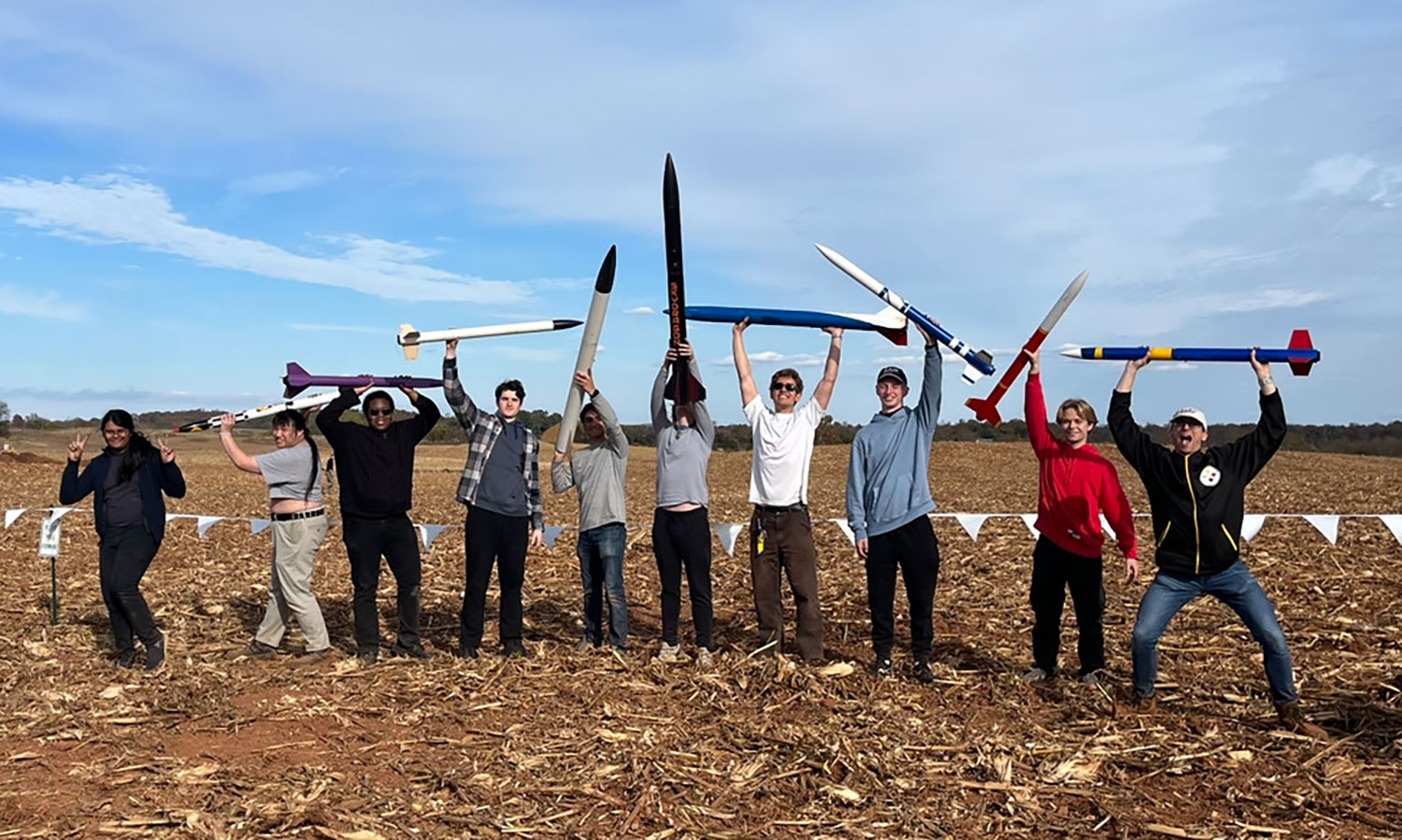
With the Experimental Sounding Rocket Association’s (ESRA) 2026 Intercollegiate Rocket Engineering Competition (IREC) on the horizon, the College of Engineering’s student-led organization Ram Rocketry is gearing up to take home the gold.
The event is taking place this summer in Spaceport Midland, Texas and will begin June 15th and last through June 20th. Mechanical engineering undergraduate Christopher Kato, Ram Rocketry’s current student president, is leading the team. He has been proactive in creating their latest project and refining the rocket’s design so it adheres to IREC’s guidelines.
“We have completely revamped our design and lowered the total size and weight significantly,” said Kato. “Customizing the fabrication of many components is also something we’re working on, which represents a leap forward in our in-house abilities. We are aiming for our first top ten finish, which would be an amazing result for a team of our caliber.”
Known as the largest intercollegiate rocket engineering competition at the college and university level, IREC’s core objective is to encourage students to pursue STEM-based career paths. Participants learn how to work as a team, problem-solving under pressure with the same risk factors they will encounter in their respective fields.
Each team’s aircraft must perform a flight test before the competition to ensure the rocket and its components perform correctly. Written technical reports detailing project concepts, requirements, design implementation and testing, as well as appendices on safety analysis, are also submitted for consideration. Technical poster and podium sessions are held before a panel of judges during a conference day.
Robert Klenke, Ph.D., associate professor and chair of the Department of Electrical & Computer Engineering, is Ram Rocketry’s faculty advisor and has an integral role in preparing the group for what is to come.
“About four years ago, I was asked to be the faculty advisor. I’m also what the competition calls the ‘flyer of record,’ meaning I’m the one with the certification that allows them to launch,” said Klenke. “Before I decided to do it, I needed to figure out how this high-powered rocketry stuff works. To better understand what to expect from the competition, I got my L1, L2 and L3 certifications with a large rocket that I built. I used that knowledge to help oversee the first set of students. I look over the design of their rocket, the recovery system and make suggestions to help with certain aspects they may not be familiar with, like the wiring.”
Ram Rocketry sees entering IREC as an opportunity to demonstrate their skillsets as engineering students in a rigorous environment.
“Ram Rocketry is a very active group that focuses on high-powered rocketry, which means their engines are designated above a certain level of thrust,” said Klenke. “Students are familiar with smaller model rockets that can fall anywhere between 5-7 pounds to several hundred pounds of thrust. They can reach altitudes of 10,000 to 45,000 feet, sometimes even higher. It’s all determined by the national organization and government organizations like the Federal Aviation Administration. To buy the motors needed for flying these rockets, you have to have the proper certifications either done through a Tripoli Rocketry Association or the National Association of Rocketry. Ram Rocketry is a club where students can navigate the certification process.”
The group competes under the Commercial Off-the-Shelf (COTS) motor 10k class, where the goal is for the rocket to reach an apogee of 10,000 feet, or as close as possible to it. The COTS rocket motor is built by Aerotech, a company that specializes in fabrication of rocket motors for commercial and consumer use. Once Ram Rocketry members receive the correct parts, the team works together on the rocket’s design and recovery systems. The maximum number of points is awarded to the team that carries their payload up to the 10,000 foot altitude goal. The rocket must also pass a safety inspection in order to qualify for the competition flight. All student submissions and the result of the competition flight are graded, adding up to a final point value that determines the winner of the competition.
Though Ram Rocketry does receive funding from the College of Engineering, students also earned money for their project independently by working through the Engineering Foundation. In addition, the group has a fundraising page on the foundation’s website where they can collect smaller donations.
“We have worked to raise money from companies that club members have interned at, as well as other local businesses, rocketry-related organizations and the College of Engineering departments,” said Kato. “The funds were used for bodytubes and other materials, electronics, rocket motors and competition registration fees, as well as travel expenses such as plane tickets, car rentals, gas and hotel rooms for the week that we will be in Midland, Texas.”
This year, Ram Rocketry aims to increase the aircraft’s altitude by pairing the same type of motor with a smaller, lighter model.
“Most of the adjustments have to do with the construction of the rocket,” said Klenke. “It should be able to withstand 15-30 Gs of acceleration, so that is where my input is needed. I also give input on the electronic systems.”
With a strong camaraderie formed during their time together, Ram Rocketry’s members are ready for any challenge IREC 2026 will bring.
The VCU College of Engineering offers innovative undergraduate and graduate degree programs tailored to meet the demands of the rapidly evolving engineering field. As part of a premier research university, students are given the opportunity to perform real-world research in our state-of-the-art facilities as soon as they enroll. Browse videos and recent news to discover how the College of Engineering at Virginia Commonwealth University prepares the next generation of scientists and engineers for the challenges of the future.
Categories Electrical & Computer Engineering, Student Stories