What a three-minute film can teach an M.B.A.
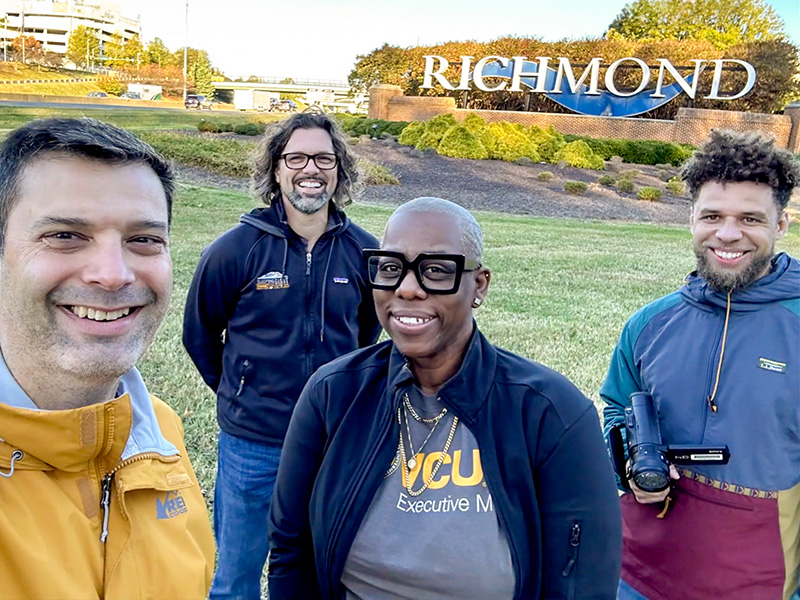
In a team building and leadership course, crews fan out across Richmond to turn a simulated brief into a finished film.
By Megan Nash
At the beginning of the Executive M.B.A. program, students at the VCU School of Business are presented with a unique question: What happens when project management and team building play out behind a camera?
It may sound like a content-creator boot camp, but in truth, it’s a study in leadership under pressure. Over several weeks, students pitch, budget and deliver a finished video about Richmond for a simulated client—learning to navigate deadlines, personalities and the creative chaos that comes with both.
“It’s not really about making a video,” said Vince Foley (M.B.A. ’04), who teaches the course alongside Brent Reese (M.B.A. ’18). “It’s about how you work with a team, manage a client’s expectations and deliver something under real pressure. The film just makes all of that visible.”
Foley is an adjunct professor and region director for North America at GE Vernova. Reese, also an adjunct, is a senior content producer at Capital One. Both are alumni of the School of Business’s Executive M.B.A. program they now teach—and both have reimagined the course to reflect how real client work unfolds.
The first-semester project begins with a challenge straight out of a client brief. Foley plays the buyer, issuing a formal request for proposal, followed by a mock contract tilted in his favor. Students, already divided into small production teams, have a week to study the fine print of the contract, price their services and push back on terms before signing.
“It’s designed to feel real,” Foley said. “Every group has to think like a business—where to draw the line, what to negotiate and what they’re willing to own once they sign.”
The negotiation is staged at speed. “I simulate that I’m in Richmond Airport,” Foley said. “I’ve got an hour to go; I’ve got a flight. If we can make an agreement in the next hour, we’re good to go.” Foley plays a middleman brokering on behalf of Richmond Tourism; the students act as Virginia-based vendors.
Once the contracts are signed, and unlike real life, every team is awarded the project, the assignment shifts to Reese, who picks up where Foley leaves off. If Foley’s portion teaches the discipline of business, Reese’s teaches the art of storytelling.
“I go through the creative process with them—from brief to script to storyboard to schedule—so they can see how an agency really works,” said Reese. “It helps students understand how to take a beat before they go into the actual production piece.”
Before anyone can overthink “video,” Reese takes the mystery out of it. “On the first day, I tell them, ‘Take out your phones, flip it to selfie mode, and tell me in 30 seconds why you’re here.’ And then I say, ‘You just made a video,” said Reese. Making a good one will take more time and care, but the fear is gone.
From there, students brainstorm concepts, assign roles and scout locations. “Every single storyboard I get from students looks radically different,” said Reese.
Some teams focus on local business; others highlight Richmond’s culture or energy. The goal is the same: to deliver a cohesive story, on time and within budget. Along the way, they manage their client, creative conflicts and technical mishaps—all the messiness that comes with real collaboration. “Production equals pivot,” said Reese. “That’s just how it goes.”
On screening day, videos are presented like a small festival. Teams share their films, then walk the room through their choices and what they learned. Students described the project as a defining early milestone in the program.
“It taught me early on that relationship-building is the foundation of success in the E.M.B.A. program,” said Erin White (M.B.A. ’26). “It pushed me to bond quickly with my team and gave me invaluable negotiation and communication skills that I still rely on today.”
William Reichert (M.B.A. ’26) added that the assignment “felt like more than just an assignment; it was a shared journey,” saying, “We navigated uncertainty, balanced ideas and leaned on each other’s strengths, which reminded me why teamwork matters so much.”
For Foley and Reese, the screenings are less about production quality and more about watching students connect the dots between teamwork, creativity and leadership.
“Creativity can be brought into every aspect of what you’re doing,” said Reese. “That’s what I want students to see—that the creative process isn’t just for artists or agencies. It’s rewarding to teach something that had such an impact on me.”
And for Foley, “Every year, one or more students come to me and say, ‘I used some of what you taught us at work.’ That’s what it’s all about.”
Categories EMBA-news, News