Moving Forward Together: Women’s History Month 2025 – Dr. Vanessa Sheppard
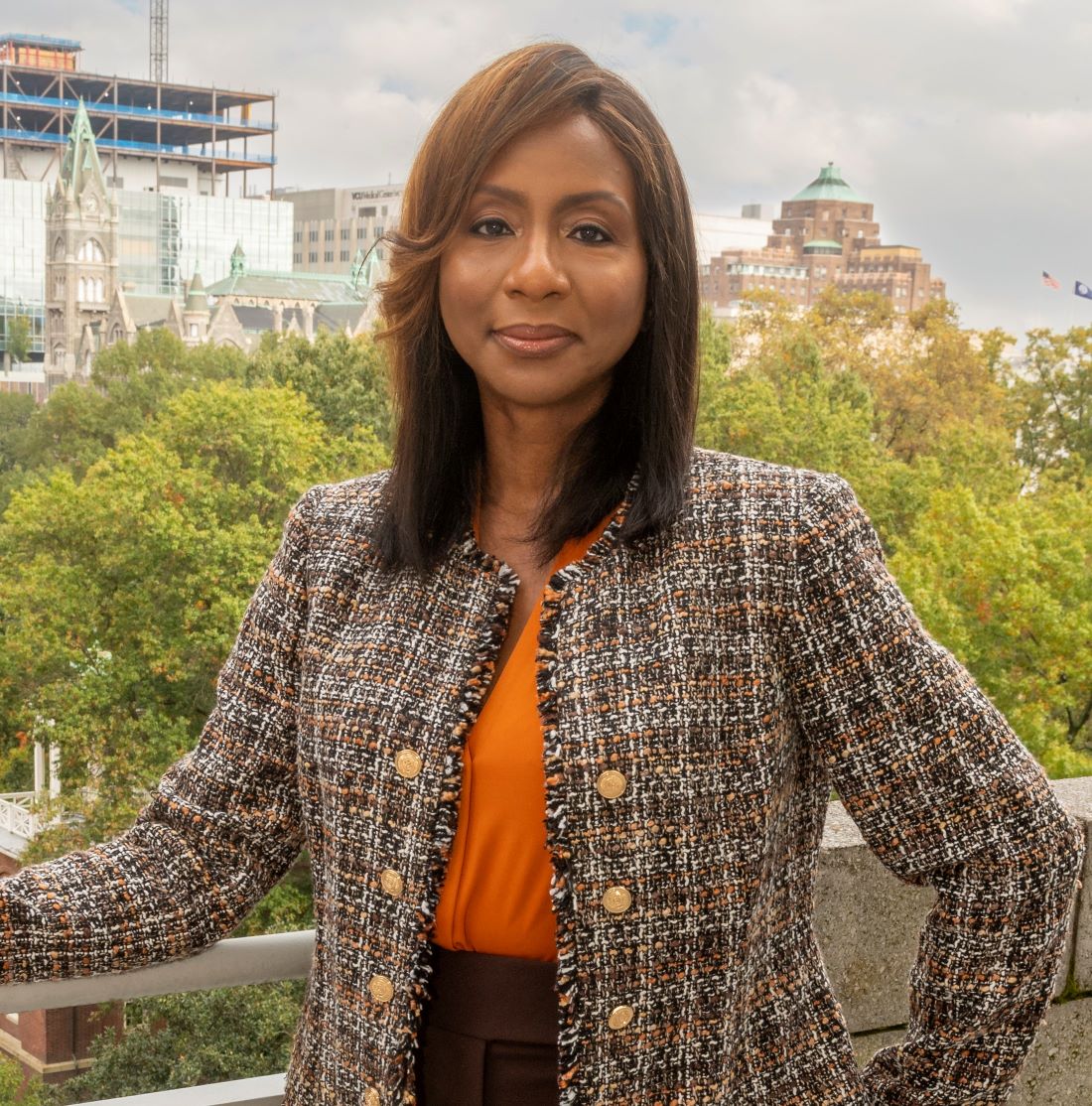
In keeping with the theme of this year’s Women’s History Month, this series highlights the importance and impact of mentoring partnerships between department faculty and their mentees.
Vanessa B. Sheppard, Ph.D. is a population scientist whose research focuses on reducing cancer disparities. She has prioritized work among racial/ethnic minorities in order to identify factors that impact disparities. She was recently funded by the American Cancer Society to test her “Sisters Informing Sisters” intervention, which seeks to improve communication between Black breast cancer patients and their healthcare providers. The goal of the project is to increase understanding and commitment to treatment regimens among this patient population, ultimately helping to reduce Black women’s breast cancer death rates. Additionally, Sheppard has served in multiple leadership roles during her time at VCU, including Associate Director for Community Outreach and Education and Health Disparities Research at Massey Comprehensive Cancer Center. She currently serves as the Founding Interim Dean for the School of Public Health.
The first time I met Dr. Sheppard, she told me, “There are people who are born as leaders, and I see that in you.” That moment has stayed with me, as it was the first time a mentor recognized and vocalized my leadership potential. She didn’t just see me as a trainee—she saw me as someone capable of making a real impact.
-Asmaa Namoos, M.D., M.P.H., Ph.D.
Sheppard also stands out as a mentor to the next generation of women scientists. Her former mentees have gone on to hold postdoctoral research positions as well as tenure-track faculty positions. Asmaa Namoos completed her Ph.D. in Social and Behavioral Sciences in 2023, and is now a postdoctoral fellow in VCU’s Injury and Violence Prevention Program in the School of Medicine, where her work focuses on fall-related injuries among older adults and cancer survivors. She describes Sheppard’s strength as a role model, saying “she inspired me not just through her words but through her actions, demonstrating how to be a mentor, a leader, and an advocate for others.”
Namoos details two sides of Sheppard’s mentorship approach – the practical and the personal. She gives her mentees the tools they will need to succeed in their career goals, as well as the individual support they need in their lives. “She provided extensive training in grant writing, networking, and professional development,” says Namoos, “ensuring that I was ready to apply for every possible funding opportunity.” Simultaneously, Sheppard was encouraging and supportive when Namoos needed it. “When I developed a disability following brain surgery, I was overwhelmed and uncertain about what this meant for my health and career,” recalls Namoos. “She reminded me of my resilience, my achievements, and my ability to overcome obstacles.”
Dr. Sheppard taught me the importance of community engaged research, particularly in the context of breast cancer. I can read all the publications and books, go to all the conferences, but I will never really understand the journey of survivorship if I do not talk to and engage the women who live it.
-Arnethea Sutton, Ph.D., M.S.
Arnethea Sutton worked with Sheppard as a postdoctoral fellow after earning her Ph.D. in Health Related Sciences from VCU in 2017. She is currently assistant professor in the Department of Kinesiology and Health Sciences. From the very first day, recalls Sutton, Sheppard challenged her to go above and beyond in her work, recruiting her to assist with a pending grant application. “Dr. Sheppard is a ‘trial by fire’ type of mentor,” says Sutton. “She gives you a challenge and all the resources to succeed and she lets you go!”
Sutton also explains her appreciation for Sheppard’s honest feedback in the lab. “If my work was not good, she would tell me that! Conversely, if my work was good, she would shower me with praise! She did not sugarcoat anything,” recalls Sutton. Much like Namoos, Sutton also experienced Sheppard’s talent at personal connection. “I could always talk to Dr. Sheppard about anything, and I appreciate that,” she says. “She inspired me to do my best work by being real with [me] and offering constructive criticism.”
Dr. Sheppard creates a welcoming environment where it’s okay to ask questions and seek clarification. This approach has helped me feel comfortable sharing my thoughts and asking for guidance. She encourages me to believe in myself and step out of my comfort zone. Her resilience and strength is a constant source of inspiration, and I am so grateful to have her as a mentor and role model.
-Fariha Tariq, M.B.B.S., M.P.H.
Fariha Tariq is a student in the Department of Social and Behavioral Sciences Ph.D. program, and a current mentee of Sheppard’s. Her work with Sheppard has helped her advance toward developing her own research goals, and she recently received a predoctoral research award for her ongoing dissertation study on breast cancer outcomes. “Working with her has been an incredibly rewarding experience,” says Tariq of Sheppard. “Over time, our relationship has grown even stronger as I’ve gained more confidence and knowledge under her mentorship.” One of the most important lessons Tariq has learned from her mentor is how to navigate challenges. “What matters most is staying focused and continuing to work toward your goals,” she says.
Categories Faculty News, Student News