
Summer research gives students valuable hands-on experience through REU sites at the VCU College of Engineering
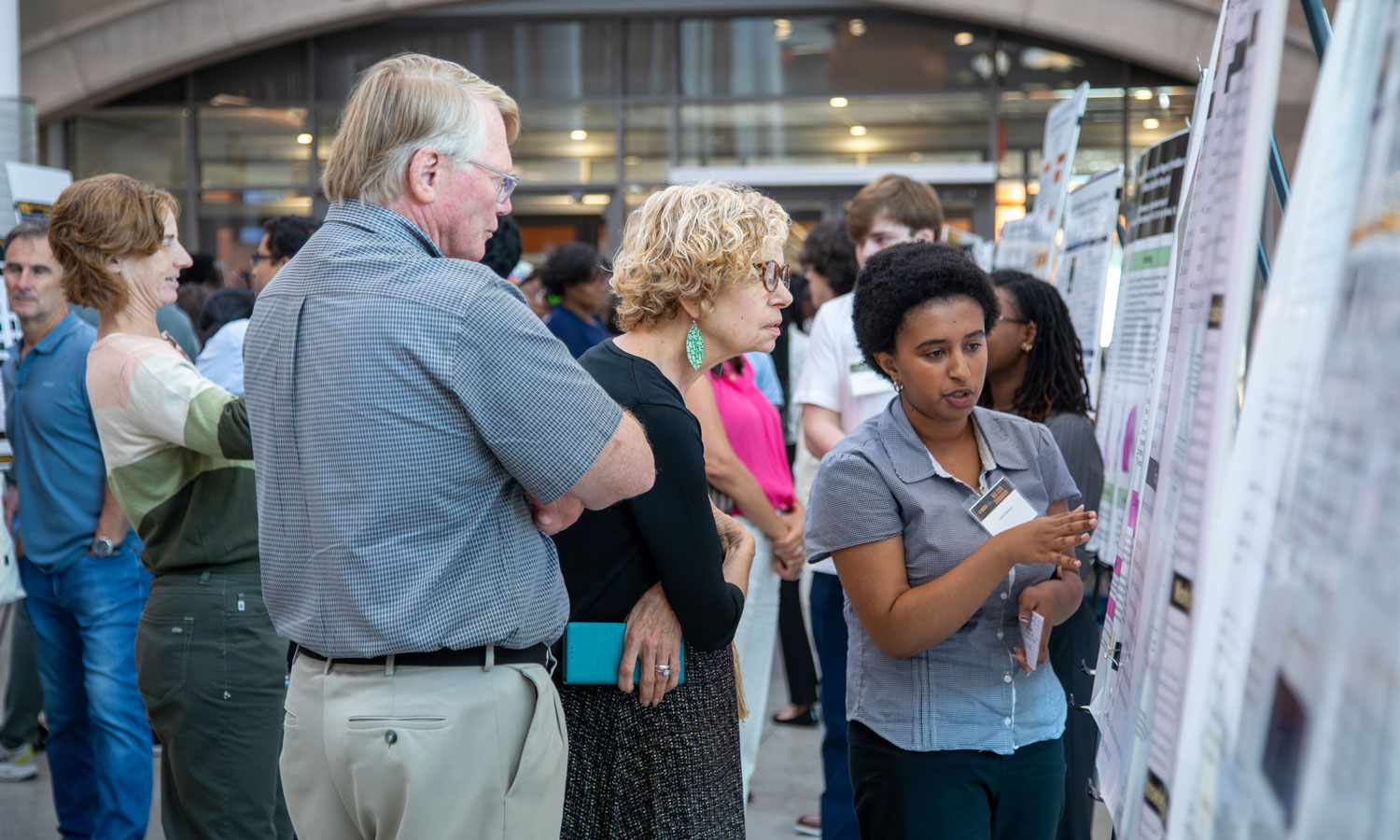
Research Experiences for Undergraduates (REU) provide opportunity for inquisitive minds looking to build an early foundation of technical experience and applied knowledge. Students who participate engage in hands-on lab work accompanied by classroom education, seminars and workshops that cover technical and soft skills. Research paper writing, research ethics and effective presentation techniques are some topics meant to develop undergraduates professionally and personally. This experiential learning is directed by the Virginia Commonwealth University (VCU) College of Engineering’s experienced faculty and industry professionals. They also give undergraduates who are undecided about their educational path a first look at a career in research.
View photos from the end-of-summer poster session on the VCU College of Engineering Flickr.
Build Back Better Summer REU
Funded by the Department of Commerce Build Back Better Regional Challenge award, the collaborative VSU-VCU Pharmaceutical Engineering Pathways Project REU program serves as a pathway towards the nation’s only pharmaceutical engineering Ph.D. program, offered by VCU, and related graduate programs in chemical and biomolecular engineering. Participants in this fourth cohort gained experience in experimental and computational research, product innovation, poster development, technical writing and teamwork. In addition to mentorship from faculty and doctoral students, REU students participated in co-curricular activities including seminars, luncheons, How-To workshops and social activities. Their experience culminated in a joint REU Symposium that featured research from both VCU and VSU while fostering exchange between students and faculty from both universities.
Program Coordinators
Nastassja A. Lewinski, Ph.D.
Associate Professor,
Department of Chemical and Biomolecular Engineering
Kathy Goodson, Ph.D.
Associate Professor, Applied Engineering Technology, Virginia State University
Student Projects
- Jayla Agarrat, Computational Exploration of IKKβ as a Covalent Therapeutic Target in Cancer
- Mikayla Bradley and Jaylen Raspberry, Evaluating the Effects of Transition Metal Doping on Quantification of Small Pharmaceutical Compounds by UiO-67-BPY
- Taylor Clements, Opportunity Scout Corps: Improving Student Access at VSU
- Isaiah Cuttino, Separation and Partitioning Power of the Zaiput Flow Separator
- Madison A. Davis, Analysis of Wrist Joint Loads and Muscle Forces During Manual Wheelchair Propulsion
- Christian Ellis, Efficacy of Curcumin-Loaded UiO-66-NH2 Decorated with Folate for Cancer Treatment
- Brianna P. Johnson and Robert M. Wilson, Fluorescence-Based Detection of PFOS Using Rhodamine B-Loaded Metal-Organic Frameworks
- Jalen Lowery, Loading Capacity Investigation & Comparison of Amine-Functionalized Curcumin Doped Metal-Organic Frameworks
- Zion Nelson, Engineering Defects in 2D MOF Interfaces via Modular Synthesis for Real-Time Molecular Detection
- Zhenya Rance, Mapping Cannabis Use Motives: Identifying Primary and Secondary Themes Related to Sleep
- Dominique Rhoden, Benchmarking Gaussian Process Regression Against Mean-Variance Estimation Models for Predictive Uncertainty
- Hadeyjha D. Taylor, Investigating Silver Nanoparticle Loading Capacity and Its Impact on the Antibacterial Properties of UiO-66-NH2
- Katherine Williams, Preliminary Assessment of a Custom Cell Signaling Well Culture Plate Using SIM-A9 Microglia Cells
- Robert M. Wilson and Brianna P. Johnson, Fluorescent Detection of PFOS Using Rh-B Soaked, Fluorinated UiO-66 MOFs
Digital Forensics REU Site
Conducted in collaboration with the Virginia State Police (VSP) High Tech Crimes Division, the Digital Forensics REU site allows students to engage in cutting-edge research and real-world digital forensic applications. Students work closely with faculty, postdoctoral researchers, Ph.D. student mentors, and digital forensic professionals to conduct original research addressing emerging cybersecurity and digital forensics challenges.
Professional, experiential and cohort-building events are part of the summer activities. Students visited the VSP High Tech Crimes Division, presenting their research projects to digital forensic investigators and receiving feedback from practitioners. They also toured the division’s forensic laboratories and investigative facilities.
At the 2026 Annual Digital Forensics Research Conference, students presented their research while participating in technical sessions and the conference banquet. Arya Kunisetty received Third Prize for his poster: Forensic Attribution of Human and Autonomous Control in Unmanned Aerial Systems.
In addition to professional events, students also participated in social activities at Topgolf and Kings Dominion to strengthen collaboration and build a supportive cohort community.
Program Coordinator
Irfan Ahmed, Ph.D.
Engineering Foundation Professor,
Department of Computer Science
Student Projects
- Logan Altomonte, Automation of Authentication Vulnerability Discovery on PLC’s
- Aleksandar Sasha Babic, Network-Layer Forensic Readiness of a Point-of-Care Ultrasound Platform A State-Driven DICOM Capture Study of the GE Venue R2
- Cosme Boisset, Beyond Volatile Memory: Non-Volatile Forensic Reconstruction of Authentication and PHI Exposure on a Point-of-Care Ultrasound Device
- Sansrkiti Gyawali, Quantum-Ready Image Segmentation for Image Forgery Localization
- Emirhan Kir, Communication-Aware Passive WiFi Sensing Under Dynamic Traffic and Environmental Conditions
- Arya Kunisetty, Forensic Attribution of Human and Autonomous Control in Unmanned Aerial Systems
- Vaishnavi Sharma, Explainable LLM-assisted Authorship Similarity Analysis for Digital Forensics
- Zoe McIvor, SPICE: A Messenger-Based Research Platform for Understanding Cybercrime Against Older Adults
- Sebastian Alcibar, Reverse Engineering Starlink LEO Network Behavior for User Terminal Environment Inference
Magnetics REU Site
This unique program is the only magnetics REU in the United States. Students learn the application of magnetics principles in a variety of practical and cutting-edge research scenarios. From employing voltage control of skyrmions that can be used to build synapses for neural networks to development of transcranial magnetic stimulation coils for brain therapy, a variety of detailed topics are presented for participants to examine.
Program Coordinator
- Ravi Hadimani, Ph.D.
Professor and Director of Robotics Program,
Department of Mechanical and Nuclear Engineering
Student Projects
- Autumn Campbell, Rotator Cuff Muscle Forces and Acromioclavicular Intersegmental Forces in Children and Adults with Paraplegia
- Ockidde Harris II, Magnetic Actuated Soft Robots
- Cael Johnson, An Analog AC Voltage Amplifier Based on a Single Straintronic Magnetic Tunnel Junction
- Aidan Kelley, Multifunctional Magnetic Phase Change Composites for Thermal Management Technologies
- Henry Dangerfield Lemasters, Modeling the Effect of Transcranial Magnetic Stimulation on Deep Brain Stimulation Using Ansys
- Luz Lomas, Bulk and Nanoparticle Characterization of Magnetic Material
- Sabeya Neeha, Development of an Anatomic and Acoustically Accurate Head Phantom for Transcranial Ultrasound Imaging
- Jordan Simmons, Investigation of the Relationship between Magnetic Dust Properties of Dust Samples in Richmond City and High Asthma Rates
- Jenny Wang, Simulations of TMS-Induced Electrical Fields Using ANSYS Maxwell
- Norah Farley, Voltage control of skyrmions and strain-mediated control of magnetism for energy-efficient non-volatile memory
Mechanobiology at VCU
Funded by the National Science Foundation, undergraduates in the Mechanobiology at VCU REU work at the intersection of engineering and life science. They are provided with opportunities to enhance scientific literacy and communication, preparing them for graduate study or careers in research.
Projects teach research skills in the areas of microfluidics, mechanotransduction pathway analysis, functional tissue engineering, cell-material interactions and cancer cell biophysics. Students also learn the basic scientific method, statistics skills, research ethics and the workings of collaborative biomedical research laboratories.
Throughout the summer, students participated in professional development activities, including academic and industry panels to broaden their network. Jason Gleghorn, Ph.D., a leader in the field of mechanobiology from the University of Delaware, spoke to students about his work to make microfluidic models accessible for all, and how he develops collaborations with researchers all over the world, at a seminar hosted by the REU program. An engineering educational outreach activity also had students developing a mechanobiology-focused lesson plan to teach engineering with a colorful approach while providing support for different learning styles as part of Engineering Practices in Color, a VCU biomedical engineering outreach program.
Students presented their research findings at the end of the summer and are submitting their work to professional conferences, like the Biomedical Engineering Society, to expand the impact of their findings.
Program Coordinators
- Rebecca Heise, PhD
Professor and Chair,
Department of Biomedical Engineering - Priscilla Hwang, Ph.D.
Associate Professor,
Department of Biomedical Engineering
Student Projects
- Olamide Afolayan: Evaluating whether cyclic loading upregulates estrogen receptors in human MSCs, possibly contributing to female athlete sensitivity to estradiol
- Erin Coates, Investigating Traction Forces in Ovarian Cancer Cells
- Danielle Martinez: The effects of substrate stiffness, fibronectin coating, and lipopolysaccharide stimulation on macrophages and mesenchymal stem cells
- Anthony Mugavero, Delivery of miRNA Using a Hydrogel-LNP System for Bone Regeneration Applications
- Juliana Norman: Evaluating whether cyclic loading upregulates estrogen receptors in human MSCs, possibly contributing to female athlete sensitivity to estradiol
- Ighelose Ohonsi, The Therapeutic Effects of Decellularized Cell Extracellular Matrix and Surfactant on Lipopolysaccharide-induced Lung Injury
- Martina Ribera, Effects of Cell Seeding Density on Myotube Formation in Decellularized Skeletal Muscle Scaffolds
- Hazel Sterling, Vinculin Knockout in MDCK Cells Decreases Invasive Migration Phenotype
- Manvee Vuppala, Effect of Mechanical Strain and Respiration Rate on Myofibroblast Differentiation in Human Lung Fibroblasts
- Rachel Watkins, Correlation of Bladder vs. Brain Hemodynamics using Near Infrared Spectroscopy in Individuals With and Without Overactive Bladder
Virginia Microelectronics Consortium (VMEC) Summer Scholars
Supporting sophomores, juniors and seniors attending a university in Virginia, the VMEC Summer Scholar Program provides an opportunity for hands-on research and development in microelectronics.
Program Coordinator
- Vitaliy Avrutin, Ph.D.
Associate Professor,
Department of Electrical and Computer Engineering
Student Projects
- Richie de Luna, Infra-red optical absorption in polar and nonpolar ZnO/BeMgZnO multiple quantum wells with intersubband optical transitions
- Maxi Wilkinson, Optimization of design of microelectromechanical system (MEMS) devices for memory applications
The VCU College of Engineering offers innovative undergraduate and graduate degree programs tailored to meet the demands of the rapidly evolving engineering field. As part of a premier research university, students are given the opportunity to perform real-world research in our state-of-the-art facilities as soon as they enroll. Browse videos and recent news to discover how the College of Engineering at Virginia Commonwealth University prepares the next generation of scientists and engineers for the challenges of the future.
Categories Biomedical Engineering, Chemical & Biomolecular Engineering, Computer Science, Electrical & Computer Engineering, Mechanical & Nuclear Engineering, Student Stories, Undergraduate Student Stories